For the following questions answer them individually
Let $$\alpha, \beta; \alpha > \beta$$, be the roots of the equation $$x^2 - \sqrt{2}x - \sqrt{3} = 0$$. Let $$P_n = \alpha^n - \beta^n, n \in \mathbb{N}$$. Then $$(11\sqrt{3} - 10\sqrt{2})P_{10} + (11\sqrt{2} + 10)P_{11} - 11P_{12}$$ is equal to
Let $$z$$ be a complex number such that the real part of $$\frac{z-2i}{z+2i}$$ is zero. Then, the maximum value of $$|z - (6 + 8i)|$$ is equal to
Let $$a, ar, ar^2, \ldots$$ be an infinite G.P. If $$\sum_{n=0}^{\infty} ar^n = 57$$ and $$\sum_{n=0}^{\infty} a^3 r^{3n} = 9747$$, then $$a + 18r$$ is equal to
The sum of the coefficient of $$x^{2/3}$$ and $$x^{-2/5}$$ in the binomial expansion of $$\left(x^{2/3} + \frac{1}{2}x^{-2/5}\right)^9$$ is
Two vertices of a triangle $$ABC$$ are $$A(3, -1)$$ and $$B(-2, 3)$$, and its orthocentre is $$P(1, 1)$$. If the coordinates of the point $$C$$ are $$(\alpha, \beta)$$ and the centre of the circle circumscribing the triangle $$PAB$$ is $$(h, k)$$, then the value of $$(\alpha + \beta) + 2(h + k)$$ equals
Let the foci of a hyperbola $$H$$ coincide with the foci of the ellipse $$E : \frac{(x-1)^2}{100} + \frac{(y-1)^2}{75} = 1$$ and the eccentricity of the hyperbola $$H$$ be the reciprocal of the eccentricity of the ellipse $$E$$. If the length of the transverse axis of $$H$$ is $$\alpha$$ and the length of its conjugate axis is $$\beta$$, then $$3\alpha^2 + 2\beta^2$$ is equal to
$$\lim_{x \to \frac{\pi}{2}} \left(\frac{\int_{x^3}^{(\pi/2)^3} \left(\sin(2t^{1/3}) + \cos(t^{1/3})\right) dt}{\left(x - \frac{\pi}{2}\right)^2}\right)$$ is equal to
$$\lim_{x \to 0} \frac{e - (1+2x)^{\frac{1}{2x}}}{x}$$ is equal to
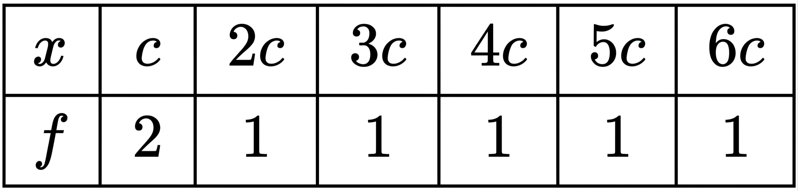
If the variance of the frequency distribution
is 160, then the value of $$c \in \mathbb{N}$$ is
Let $$B = \begin{bmatrix} 1 & 3 \\ 1 & 5 \end{bmatrix}$$ and $$A$$ be a $$2 \times 2$$ matrix such that $$AB^{-1} = A^{-1}$$. If $$BCB^{-1} = A$$ and $$C^4 + \alpha C^2 + \beta I = O$$, then $$2\beta - \alpha$$ is equal to
The integral $$\int_{1/4}^{3/4} \cos\left(2\cot^{-1}\sqrt{\frac{1-x}{1+x}}\right) dx$$ is equal to
Let the range of the function $$f(x) = \frac{1}{2 + \sin 3x + \cos 3x}, x \in \mathbb{R}$$ be $$[a, b]$$. If $$\alpha$$ and $$\beta$$ are respectively the A.M. and the G.M. of $$a$$ and $$b$$, then $$\frac{\alpha}{\beta}$$ is equal to
If $$\log_e y = 3\sin^{-1} x$$, then $$(1 - x^2)y'' - xy'$$ at $$x = \frac{1}{2}$$ is equal to
Let $$\int_0^x \sqrt{1 - (y'(t))^2} \, dt = \int_0^x y(t) \, dt, \, 0 \le x \le 3, \, y \ge 0, \, y(0) = 0$$. Then at $$x = 2$$, $$y'' + y + 1$$ is equal to
The value of the integral $$\int_{-1}^{2} \log_e\left(x + \sqrt{x^2 + 1}\right) dx$$ is
The area (in square units) of the region enclosed by the ellipse $$x^2 + 3y^2 = 18$$ in the first quadrant below the line $$y = x$$ is
Between the following two statements: Statement I : Let $$\vec{a} = \hat{i} + 2\hat{j} - 3\hat{k}$$ and $$\vec{b} = 2\hat{i} + \hat{j} - \hat{k}$$. Then the vector $$\vec{r}$$ satisfying $$\vec{a} \times \vec{r} = \vec{a} \times \vec{b}$$ and $$\vec{a} \cdot \vec{r} = 0$$ is of magnitude $$\sqrt{10}$$. Statement II : In a triangle $$ABC$$, $$\cos 2A + \cos 2B + \cos 2C \ge -\frac{3}{2}$$.
Let $$\vec{a} = 2\hat{i} + \alpha\hat{j} + \hat{k}, \vec{b} = -\hat{i} + \hat{k}, \vec{c} = \beta\hat{j} - \hat{k}$$, where $$\alpha$$ and $$\beta$$ are integers and $$\alpha\beta = -6$$. Let the values of the ordered pair $$(\alpha, \beta)$$, for which the area of the parallelogram of diagonals $$\vec{a} + \vec{b}$$ and $$\vec{b} + \vec{c}$$ is $$\frac{\sqrt{21}}{2}$$, be $$(\alpha_1, \beta_1)$$ and $$(\alpha_2, \beta_2)$$. Then $$\alpha_1^2 + \beta_1^2 - \alpha_2\beta_2$$ is equal to
Consider the line $$L$$ passing through the points $$(1, 2, 3)$$ and $$(2, 3, 5)$$. The distance of the point $$\left(\frac{11}{3}, \frac{11}{3}, \frac{19}{3}\right)$$ from the line $$L$$ along the line $$\frac{3x-11}{2} = \frac{3y-11}{1} = \frac{3z-19}{2}$$ is equal to
If an unbiased dice is rolled thrice, then the probability of getting a greater number in the $$i^{th}$$ roll than the number obtained in the $$(i-1)^{th}$$ roll, $$i = 2, 3$$, is equal to
The number of integers, between 100 and 1000 having the sum of their digits equals to 14, is ________
If $$\left(\frac{1}{\alpha+1} + \frac{1}{\alpha+2} + \ldots + \frac{1}{\alpha+1012}\right) - \left(\frac{1}{2 \cdot 1} + \frac{1}{4 \cdot 3} + \frac{1}{6 \cdot 5} + \ldots + \frac{1}{2024 \cdot 2023}\right) = \frac{1}{2024}$$, then $$\alpha$$ is equal to ________
Let $$A, B$$ and $$C$$ be three points on the parabola $$y^2 = 6x$$ and let the line segment $$AB$$ meet the line $$L$$ through $$C$$ parallel to the $$x$$-axis at the point $$D$$. Let $$M$$ and $$N$$ respectively be the feet of the perpendiculars from $$A$$ and $$B$$ on $$L$$. Then $$\left(\frac{AM \cdot BN}{CD}\right)^2$$ is equal to ________
Consider the circle $$C : x^2 + y^2 = 4$$ and the parabola $$P : y^2 = 8x$$. If the set of all values of $$\alpha$$, for which three chords of the circle $$C$$ on three distinct lines passing through the point $$(\alpha, 0)$$ are bisected by the parabola $$P$$ is the interval $$(p, q)$$, then $$(2q - p)^2$$ is equal to ________
Consider the matrices : $$A = \begin{bmatrix} 2 & -5 \\ 3 & m \end{bmatrix}, B = \begin{bmatrix} 20 \\ m \end{bmatrix}$$ and $$X = \begin{bmatrix} x \\ y \end{bmatrix}$$. Let the set of all $$m$$, for which the system of equations $$AX = B$$ has a negative solution (i.e., $$x < 0$$ and $$y < 0$$), be the interval $$(a, b)$$. Then $$8\int_a^b |A| \, dm$$ is equal to ________
Let the inverse trigonometric functions take principal values. The number of real solutions of the equation $$2\sin^{-1} x + 3\cos^{-1} x = \frac{2\pi}{5}$$, is ________
Let $$A = \{(x, y) : 2x + 3y = 23, x, y \in \mathbb{N}\}$$ and $$B = \{x : (x, y) \in A\}$$. Then the number of one-one functions from $$A$$ to $$B$$ is equal to ________
For a differentiable function $$f : \mathbb{R} \to \mathbb{R}$$, suppose $$f'(x) = 3f(x) + \alpha$$, where $$\alpha \in \mathbb{R}$$, $$f(0) = 1$$ and $$\lim_{x \to -\infty} f(x) = 7$$. Then $$9f(-\log_e 3)$$ is equal to ________
Let the set of all values of $$p$$, for which $$f(x) = (p^2 - 6p + 8)(\sin^2 2x - \cos^2 2x) + 2(2 - p)x + 7$$ does not have any critical point, be the interval $$(a, b)$$. Then $$16ab$$ is equal to ________
The square of the distance of the image of the point $$(6, 1, 5)$$ in the line $$\frac{x-1}{3} = \frac{y}{2} = \frac{z-2}{4}$$, from the origin is ________