For the following questions answer them individually
Compare the energies of following sets of quantum numbers for multielectron system. (A) $$n = 4, l = 1$$ (B) $$n = 4, l = 2$$ (C) $$n = 3, l = 1$$ (D) $$n = 3, l = 2$$ (E) $$n = 4, l = 0$$. Choose the correct answer from the options given below :
Given below are two statements : Statement (I) : The oxidation state of an element in a particular compound is the charge acquired by its atom on the basis of electron gain enthalpy consideration from other atoms in the molecule. Statement (II) : $$p\pi - p\pi$$ bond formation is more prevalent in second period elements over other periods. In the light of the above statements, choose the most appropriate answer from the options given below :
In which one of the following pairs the central atoms exhibit $$sp^2$$ hybridization ?
Identify the incorrect statements regarding primary standard of titrimetric analysis. (A) It should be purely available in dry form. (B) It should not undergo chemical change in air. (C) It should be hygroscopic and should react with another chemical instantaneously and stoichiometrically. (D) It should be readily soluble in water. (E) $$KMnO_4$$ & $$NaOH$$ can be used as primary standard. Choose the correct answer from the options given below :
Methods used for purification of organic compounds are based on :
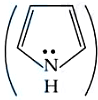
Correct order of basic strength of Pyrrole,
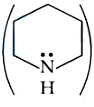
Pyridine,
and Piperidine
is:
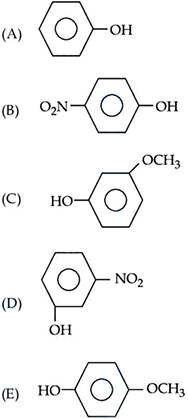
For the given compounds, the correct order of increasing $$pK_a$$ value :
Choose the correct answer from the options given below :
Relative stability of the contributing structures isÂ
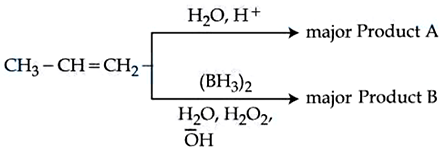
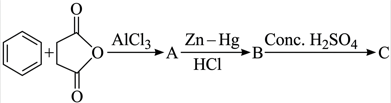
Identify the product A and product B in the following set of reactions.
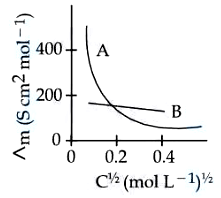
The molar conductivity for electrolytes A and B are plotted against $$C^{1/2}$$ as shown below. Electrolytes A and B respectively areÂ
Given below are two statements : one is labelled as Assertion (A) and the other is labelled as Reason (R). Assertion (A) : Both rhombic and monoclinic sulphur exist as $$S_8$$ while oxygen exists as $$O_2$$. Reason (R) : Oxygen forms $$p\pi - p\pi$$ multiple bonds with itself and other elements having small size and high electronegativity like C, N, which is not possible for sulphur. In the light of the above statements, choose the most appropriate answer from the options given below :
On reaction of Lead Sulphide with dilute nitric acid which of the following is not formed?
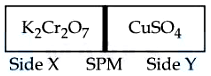
$$0.05$$ M $$CuSO_4$$ when treated with $$0.01$$ M $$K_2Cr_2O_7$$ gives green colour solution of $$Cu_2Cr_2O_7$$.Â
The two solutions are separated as shown below : [SPM : Semi Permeable Membrane]. Due to osmosis :
Electronic configuration of Cu(II) is $$3d^9$$ whereas that of Cu(I) is $$3d^{10}$$. Which of the following is correct?
The $$F^-$$ ions make the enamel on teeth much harder by converting hydroxyapatite (the enamel on the surface of teeth) into much harder fluoroapatite having the formula.
Given below are two statements : one is labelled as Assertion (A) and the other is labelled as Reason (R). Assertion (A) : The total number of geometrical isomers shown by $$[Co(en)_2Cl_2]^+$$ complex ion is three. Reason (R) : $$[Co(en)_2Cl_2]^+$$ complex ion has an octahedral geometry. In the light of the above statements, choose the most appropriate answer from the options given below :
Given below are two statements : one is labelled as Assertion (A) and the other is labelled as Reason (R). Assertion (A) : $$S_N2$$ reaction of $$C_6H_5CH_2Br$$ occurs more readily than the $$S_N2$$ reaction of $$CH_3CH_2Br$$. Reason (R) : The partially bonded unhybridized p-orbital that develops in the trigonal bipyramidal transition state is stabilized by conjugation with the phenyl ring. In the light of the above statements, choose the most appropriate answer from the options given below :
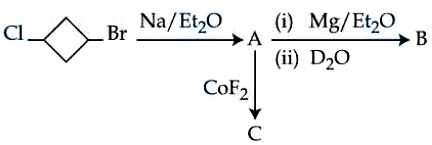
In the following sequence of reaction, the major products B and C respectively are :
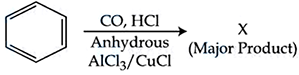
Identify major product "X" formed in the following reaction :
What is the structure of CÂ
Molarity (M) of an aqueous solution containing $$x$$ g of anhyd. $$CuSO_4$$ in $$500$$ mL solution at $$32°C$$ is $$2 \times 10^{-1}$$ M. Its molality will be ______ $$\times 10^{-3}$$ m. (nearest integer). [Given density of the solution $$= 1.25$$ g/mL]
The total number of species from the following in which one unpaired electron is present, is _______
$$N_2, O_2, C_2^-, O_2^-, O_2^{2-}, H_2^+, CN^-, He_2^+$$
When equal volume of $$1$$ M HCl and $$1$$ M $$H_2SO_4$$ are separately neutralised by excess volume of $$1$$ M NaOH solution. $$x$$ and $$y$$ kJ of heat is liberated respectively. The value of $$y/x$$ is _______
The heat of solution of anhydrous $$CuSO_4$$ and $$CuSO_4 \cdot 5H_2O$$ are $$-70$$ kJ mol$$^{-1}$$ and $$+12$$ kJ mol$$^{-1}$$ respectively. The heat of hydration of $$CuSO_4$$ to $$CuSO_4 \cdot 5H_2O$$ is $$-x$$ kJ. The value of $$x$$ is ______ (nearest integer).
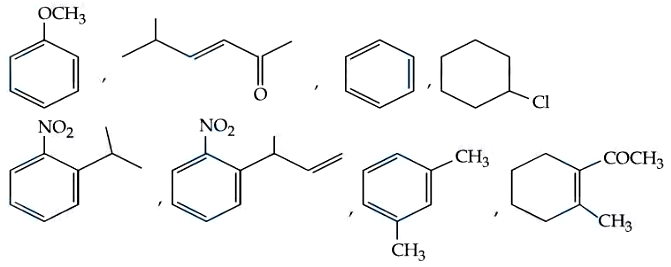
How many compounds among the following compounds show inductive, mesomeric as well as hyperconjugation effects?
The standard reduction potentials at $$298$$ K for the following half cells are given below :
$$Cr_2O_7^{2-} + 14H^+ + 6e^- \rightarrow 2Cr^{3+} + 7H_2O$$, $$E° = 1.33$$ V
$$Fe^{3+}(aq) + 3e^- \rightarrow Fe$$, $$E° = -0.04$$ V
$$Ni^{2+}(aq) + 2e^- \rightarrow Ni$$, $$E° = -0.25$$ V
$$Ag^+(aq) + e^- \rightarrow Ag$$, $$E° = 0.80$$ V
$$Au^{3+}(aq) + 3e^- \rightarrow Au$$, $$E° = 1.40$$ V
Consider the given electrochemical reactions, The number of metal(s) which will be oxidized by $$Cr_2O_7^{2-}$$, in aqueous solution is ______
Given below are two statements : Statement I: The rate law for the reaction $$A + B \rightarrow C$$ is rate $$(r) = k[A]^2[B]$$. When the concentration of both A and B is doubled, the reaction rate is increased "$$x$$" times. Statement II :Â
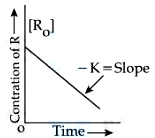
The figure is showing "the variation in concentration against time plot" for a "$$y$$" order reaction. The Value of $$x + y$$ is ______
Number of colourless lanthanoid ions among the following is ________
$$Eu^{3+}, Lu^{3+}, Nd^{3+}, La^{3+}, Sm^{3+}$$
Number of ambidentate ligands among the following is ______
$$NO_2^-, SCN^-, C_2O_4^{2-}, NH_3, CN^-, SO_4^{2-}, H_2O$$
Total number of essential amino acid among the given list of amino acids is _______ Arginine, Phenylalanine, Aspartic acid, Cysteine, Histidine, Valine, Proline