NTA JEE Mains 8th April 2024 Shift 1
For the following questions answer them individually
NTA JEE Mains 8th April 2024 Shift 1 - Question 81
The number of 3-digit numbers, formed using the digits 2, 3, 4, 5 and 7, when the repetition of digits is not allowed, and which are not divisible by 3, is equal to ________
789
456
123
0.-
Clear All
NTA JEE Mains 8th April 2024 Shift 1 - Question 82
Let the positive integers be written in the form:
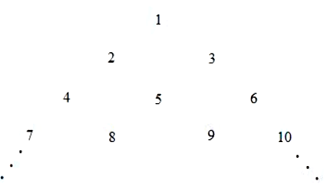
If the $$k^{th}$$ row contains exactly $$k$$ numbers for every natural number $$k$$, then the row in which the number 5310 will be, is ________
789
456
123
0.-
Clear All
NTA JEE Mains 8th April 2024 Shift 1 - Question 83
Let $$\alpha = \sum_{r=0}^{n}(4r^2 + 2r + 1)^nC_r$$ and $$\beta = \left(\sum_{r=0}^{n}\frac{^nC_r}{r+1}\right) + \frac{1}{n+1}$$. If $$140 < \frac{2\alpha}{\beta} < 281$$, then the value of $$n$$ is ________
789
456
123
0.-
Clear All

NTA JEE Mains 8th April 2024 Shift 1 - Question 84
If the orthocentre of the triangle formed by the lines $$2x + 3y - 1 = 0$$, $$x + 2y - 1 = 0$$ and $$ax + by - 1 = 0$$, is the centroid of another triangle, whose circumcentre and orthocentre respectively are $$(3, 4)$$ and $$(-6, -8)$$, then the value of $$|a - b|$$ is ________
789
456
123
0.-
Clear All
NTA JEE Mains 8th April 2024 Shift 1 - Question 85
The value of $$\lim_{x \to 0} 2\left(\frac{1 - \cos x\sqrt{\cos 2x}\sqrt[3]{\cos 3x} \cdots \sqrt[10]{\cos 10x}}{x^2}\right)$$ is
789
456
123
0.-
Clear All
NTA JEE Mains 8th April 2024 Shift 1 - Question 86
Let $$A = \begin{bmatrix} 2 & -1 \\ 1 & 1 \end{bmatrix}$$. If the sum of the diagonal elements of $$A^{13}$$ is $$3^n$$, then $$n$$ is equal to ________
789
456
123
0.-
Clear All
NTA JEE Mains 8th April 2024 Shift 1 - Question 87
If the range of $$f(\theta) = \frac{\sin^4\theta + 3\cos^2\theta}{\sin^4\theta + \cos^2\theta}, \theta \in \mathbb{R}$$ is $$[\alpha, \beta]$$, then the sum of the infinite G.P., whose first term is 64 and the common ratio is $$\frac{\alpha}{\beta}$$, is equal to ________
789
456
123
0.-
Clear All
NTA JEE Mains 8th April 2024 Shift 1 - Question 88
Let the area of the region enclosed by the curve $$y = \min\{\sin x, \cos x\}$$ and the $$x$$ axis between $$x = -\pi$$ to $$x = \pi$$ be $$A$$. Then $$A^2$$ is equal to ________
789
456
123
0.-
Clear All
NTA JEE Mains 8th April 2024 Shift 1 - Question 89
Let $$\vec{a} = 9\hat{i} - 13\hat{j} + 25\hat{k}$$, $$\vec{b} = 3\hat{i} + 7\hat{j} - 13\hat{k}$$ and $$\vec{c} = 17\hat{i} - 2\hat{j} + \hat{k}$$ be three given vectors. If $$\vec{r}$$ is a vector such that $$\vec{r} \times \vec{a} = (\vec{b} + \vec{c}) \times \vec{a}$$ and $$\vec{r} \cdot (\vec{b} - \vec{c}) = 0$$, then $$\frac{|593\vec{r} + 67\vec{a}|^2}{(593)^2}$$ is equal to ________
789
456
123
0.-
Clear All
NTA JEE Mains 8th April 2024 Shift 1 - Question 90
Three balls are drawn at random from a bag containing 5 blue and 4 yellow balls. Let the random variables $$X$$ and $$Y$$ respectively denote the number of blue and yellow balls. If $$\bar{X}$$ and $$\bar{Y}$$ are the means of $$X$$ and $$Y$$ respectively, then $$7\bar{X} + 4\bar{Y}$$ is equal to ________
789
456
123
0.-
Clear All