NTA JEE Mains 6th April 2024 Shift 1
For the following questions answer them individually
NTA JEE Mains 6th April 2024 Shift 1 - Question 1
To find the spring constant $$(k)$$ of a spring experimentally, a student commits 2% positive error in the measurement of time and 1% negative error in measurement of mass. The percentage error in determining value of $$k$$ is :
NTA JEE Mains 6th April 2024 Shift 1 - Question 2
Match List I with List II
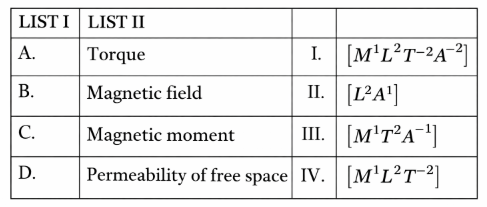
Choose the correct answer from the options given below:
NTA JEE Mains 6th April 2024 Shift 1 - Question 3
A train starting from rest first accelerates uniformly up to a speed of $$80 \text{ km/h}$$ for time $$t$$, then it moves with a constant speed for time $$3t$$. The average speed of the train for this duration of journey will be (in km/h) :

NTA JEE Mains 6th April 2024 Shift 1 - Question 4
A light string passing over a smooth light pulley connects two blocks of masses $$m_1$$ and $$m_2$$ (where $$m_2>m_1$$). If the acceleration of the system is $$\frac{g}{\sqrt{2}}$$, then the ratio of the masses $$\frac{m_1}{m_2}$$ is:
NTA JEE Mains 6th April 2024 Shift 1 - Question 5
A bullet of mass $$50 \text{ g}$$ is fired with a speed $$100 \text{ m/s}$$ on a plywood and emerges with $$40 \text{ m/s}$$. The percentage loss of kinetic energy is :
NTA JEE Mains 6th April 2024 Shift 1 - Question 6
Four particles $$A, B, C, D$$ of mass $$\frac{m}{2}, m, 2m, 4m$$, have same momentum, respectively. The particle with maximum kinetic energy is :
NTA JEE Mains 6th April 2024 Shift 1 - Question 7
To project a body of mass $$m$$ from earths surface to infinity, the required kinetic energy is (assume, the radius of earth is $$R_E$$, $$g =$$ acceleration due to gravity on the surface of earth):
NTA JEE Mains 6th April 2024 Shift 1 - Question 8
A small ball of mass $$m$$ and density $$\rho$$ is dropped in a viscous liquid of density $$\rho_0$$. After sometime, the ball falls with constant velocity. The viscous force on the ball is :
NTA JEE Mains 6th April 2024 Shift 1 - Question 9
A sample contains mixture of helium and oxygen gas. The ratio of root mean square speed of helium and oxygen in the sample, is:
NTA JEE Mains 6th April 2024 Shift 1 - Question 10
The specific heat at constant pressure of a real gas obeying $$PV^2 = RT$$ equation is: