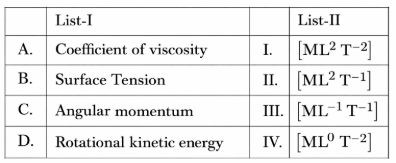
Match List-I with List-II.
Sign in
Please select an account to continue using cracku.in
↓ →

Join Our JEE Preparation Group
Prep with like-minded aspirants; Get access to free daily tests and study material.
Match List-I with List-II.
Login to view the detailed solution.
A particle of mass $$m$$ projected with a velocity $$u$$ making an angle of $$30°$$ with the horizontal. The magnitude of angular momentum of the projectile about the point of projection when the particle is at its maximum height $$h$$ is :
Login to view the detailed solution.
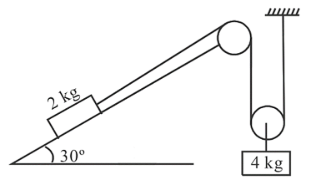
All surfaces shown in figure are assumed to be frictionless and the pulleys and the string are light. The acceleration of the block of mass $$2 \text{ kg}$$ is
Login to view the detailed solution.
.webp)
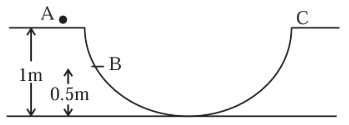
A particle is placed at the point $$A$$ of a frictionless track $$ABC$$ as shown in figure. It is gently pushed towards right. The speed of the particle when it reaches the point $$B$$ is: (Take $$g = 10 \text{ m s}^{-2}$$).
Login to view the detailed solution.
A spherical body of mass $$100 \text{ g}$$ is dropped from a height of $$10 \text{ m}$$ from the ground. After hitting the ground, the body rebounds to a height of $$5 \text{ m}$$. The impulse of force imparted by the ground to the body is given by: (given $$g = 9.8 \text{ m s}^{-2}$$)
Login to view the detailed solution.
The gravitational potential at a point above the surface of earth is $$-5.12 \times 10^7 \text{ J kg}^{-1}$$ and the acceleration due to gravity at that point is $$6.4 \text{ m s}^{-2}$$. Assume that the mean radius of earth to be $$6400 \text{ km}$$. The height of this point above the earth's surface is:
Login to view the detailed solution.
.webp)
Young's modulus of material of a wire of length $$L$$ and cross-sectional area $$A$$ is $$Y$$. If the length of the wire is doubled and cross-sectional area is halved then Young's modulus will be:
Login to view the detailed solution.
At which temperature the r.m.s. velocity of a hydrogen molecule equal to that of an oxygen molecule at $$47°C$$?
Login to view the detailed solution.
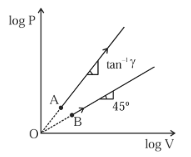
Two thermodynamical processes are shown in the figure. The molar heat capacity for process $$A$$ and $$B$$ are $$C_A$$ and $$C_B$$. The molar heat capacity at constant pressure and constant volume are represented by $$C_P$$ and $$C_V$$, respectively. Choose the correct statement.
Login to view the detailed solution.
.webp)
The electrostatic potential due to an electric dipole at a distance $$r$$ varies as :
Login to view the detailed solution.
A potential divider circuit is shown in the figure below. The output voltage $$V_0$$ is
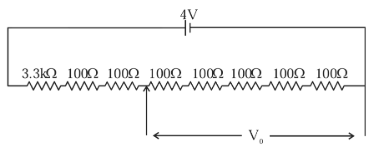
Login to view the detailed solution.
An electric toaster has resistance of $$60 \text{ } \Omega$$ at room temperature $$(27°C)$$. The toaster is connected to a $$220 \text{ V}$$ supply. If the current flowing through it reaches $$2.75 \text{ A}$$, the temperature attained by toaster is around: (if $$\alpha = 2 \times 10^{-4} \text{ °C}^{-1}$$)
Login to view the detailed solution.
.webp)
Two insulated circular loop $$A$$ and $$B$$ radius $$a$$ carrying a current of $$I$$ in the anti clockwise direction as shown in figure. The magnitude of the magnetic induction at the centre will be:
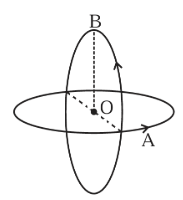
Login to view the detailed solution.
A series $$LR$$ circuit connected with an ac source $$E = (25 \sin 1000t) \text{ V}$$ has a power factor of $$\frac{1}{\sqrt{2}}$$. If the source of emf is changed to $$E = (20 \sin 2000t) \text{ V}$$, the new power factor of the circuit will be :
Login to view the detailed solution.
Primary coil of a transformer is connected to $$200 \text{ V AC}$$. Primary and secondary turns of the transforms are $$100$$ and $$10$$ respectively. Secondary coil of transformer is connected to two series resistances as shown in figure. The output voltage $$(V_0)$$ is :
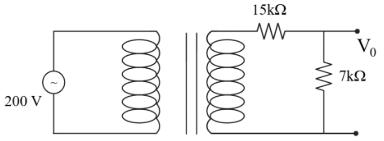
Login to view the detailed solution.

The electric field of an electromagnetic wave in free space is represented as $$\vec{E} = E_0 \cos(\omega t - kz)\hat{i}$$. The corresponding magnetic induction vector will be :
Login to view the detailed solution.
The diffraction pattern of a light of wavelength $$400 \text{ nm}$$ diffracting from a slit of width $$0.2 \text{ mm}$$ is focused on the focal plane of a convex lens of focal length $$100 \text{ cm}$$. The width of the $$1^{st}$$ secondary maxima will be :
Login to view the detailed solution.
The work function of a substance is $$3.0 \text{ eV}$$. The longest wavelength of light that can cause the emission of photoelectrons from this substance is approximately:
Login to view the detailed solution.
_1.webp)
The ratio of the magnitude of the kinetic energy to the potential energy of an electron in the $$5^{th}$$ excited state of a hydrogen atom is :
Login to view the detailed solution.
A Zener diode of breakdown voltage $$10 \text{ V}$$ is used as a voltage regulator as shown in the figure. The current through the Zener diode is
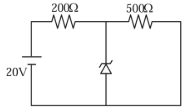
Login to view the detailed solution.
The displacement and the increase in the velocity of a moving particle in the time interval of $$t$$ to $$(t + 1)$$ s are $$125 \text{ m}$$ and $$50 \text{ m s}^{-1}$$, respectively. The distance travelled by the particle in $$(t + 2)^{th}$$ s is __________ m.
Login to view the detailed solution.
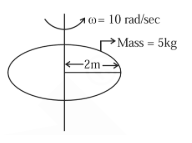
Consider a disc of mass $$5 \text{ kg}$$, radius $$2 \text{ m}$$, rotating with angular velocity of $$10 \text{ rad s}^{-1}$$ about an axis perpendicular to the plane of rotation. An identical disc is kept gently over the rotating disc along the same axis. The energy dissipated so that both the discs continue to rotate together without slipping is _________ J.
Login to view the detailed solution.
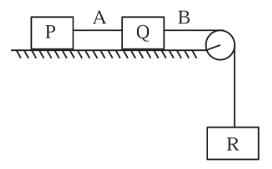
Each of the three blocks $$P$$, $$Q$$ and $$R$$ shown in the figure has a mass of $$3 \text{ kg}$$. Each of the wire $$A$$ and $$B$$ has a cross-sectional area $$0.005 \text{ cm}^2$$ and a Young's modulus $$2 \times 10^{11} \text{ N m}^{-2}$$. Neglecting friction, the longitudinal strain on wire $$B$$ is $$\_\_\_\_ \times 10^{-4}$$. (Take $$g = 10 \text{ m s}^{-2}$$)
Login to view the detailed solution.
In a closed organ pipe, the frequency of fundamental note is $$30 \text{ Hz}$$. A certain amount of water is now poured in the organ pipe so that the fundamental frequency is increased to $$110 \text{ Hz}$$. If the organ pipe has a cross-sectional area of $$2 \text{ cm}^2$$, the amount of water poured in the organ tube is ________ g. (Take speed of sound in air is $$330 \text{ m s}^{-1}$$)
Login to view the detailed solution.
A capacitor of capacitance $$C$$ and potential $$V$$ has energy $$E$$. It is connected to another capacitor of capacitance $$2C$$ and potential $$2V$$. Then the loss of energy is $$\frac{x}{3}E$$, where $$x$$ is ______.
Login to view the detailed solution.
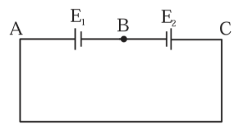
Two cells are connected in opposition as shown. Cell $$E_1$$ is of $$8 \text{ V}$$ emf and $$2 \text{ } \Omega$$ internal resistance; the cell $$E_2$$ is of $$2 \text{ V}$$ emf and $$4 \text{ } \Omega$$ internal resistance. The terminal potential difference of cell $$E_2$$ is ______ V.
Login to view the detailed solution.
A ceiling fan having $$3$$ blades of length $$80 \text{ cm}$$ each is rotating with an angular velocity of $$1200 \text{ rpm}$$. The magnetic field of earth in that region is $$0.5 \text{ G}$$ and angle of dip is $$30°$$. The emf induced across the blades is $$N\pi \times 10^{-5} \text{ V}$$. The value of $$N$$ is ______.
Login to view the detailed solution.
The horizontal component of earth's magnetic field at a place is $$3.5 \times 10^{-5} \text{ T}$$. A very long straight conductor carrying current of $$\sqrt{2} \text{ A}$$ in the direction from South east to North West is placed. The force per unit length experienced by the conductor is ________ $$\times 10^{-6} \text{ N m}^{-1}$$.
Login to view the detailed solution.
The distance between object and its two times magnified real image as produced by a convex lens is $$45 \text{ cm}$$. The focal length of the lens used is ________ cm.
Login to view the detailed solution.
An electron of hydrogen atom on an excited state is having energy $$E_n = -0.85 \text{ eV}$$. The maximum number of allowed transitions to lower energy level is _______.
Login to view the detailed solution.
Educational materials for JEE preparation
 Share
Share