NTA JEE Mains 29th Jan 2024 Shift 2
For the following questions answer them individually
NTA JEE Mains 29th Jan 2024 Shift 2 - Question 1
A physical quantity $$Q$$ is found to depend on quantities $$a, b, c$$ by the relation $$Q = \frac{a^4 b^3}{c^2}$$. The percentage error in $$a, b$$ and $$c$$ are $$3\%, 4\%$$ and $$5\%$$ respectively. Then, the percentage error in $$Q$$ is:
NTA JEE Mains 29th Jan 2024 Shift 2 - Question 2
A particle is moving in a straight line. The variation of position $$x$$ as a function of time $$t$$ is given as $$x = (t^3 - 6t^2 + 20t + 15)$$ m. The velocity of the body when its acceleration becomes zero is:
NTA JEE Mains 29th Jan 2024 Shift 2 - Question 3
A stone of mass $$900$$ g is tied to a string and moved in a vertical circle of radius $$1$$ m making $$10$$ rpm. The tension in the string, when the stone is at the lowest point is (if $$\pi^2 = 9.8$$ and $$g = 9.8 \text{ m s}^{-2}$$)

NTA JEE Mains 29th Jan 2024 Shift 2 - Question 4
The bob of a pendulum was released from a horizontal position. The length of the pendulum is $$10$$ m. If it dissipates $$10\%$$ of its initial energy against air resistance, the speed with which the bob arrives at the lowest point is: [Use, $$g = 10 \text{ m s}^{-2}$$]
NTA JEE Mains 29th Jan 2024 Shift 2 - Question 5
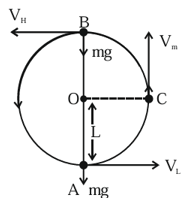
A bob of mass $$m$$ is suspended by a light string of length $$L$$. It is imparted a minimum horizontal velocity at the lowest point $$A$$ such that it just completes half circle reaching the top most position $$B$$. The ratio of kinetic energies $$\frac{(K.E.)_A}{(K.E.)_B}$$ is:
NTA JEE Mains 29th Jan 2024 Shift 2 - Question 6
A planet takes $$200$$ days to complete one revolution around the Sun. If the distance of the planet from Sun is reduced to one fourth of the original distance, how many days will it take to complete one revolution?
NTA JEE Mains 29th Jan 2024 Shift 2 - Question 7
A wire of length $$L$$ and radius $$r$$ is clamped at one end. If its other end is pulled by a force $$F$$, its length increases by $$l$$. If the radius of the wire and the applied force both are reduced to half of their original values keeping original length constant, the increase in length will become:
NTA JEE Mains 29th Jan 2024 Shift 2 - Question 8
A small liquid drop of radius $$R$$ is divided into $$27$$ identical liquid drops. If the surface tension is $$T$$, then the work done in the process will be:
NTA JEE Mains 29th Jan 2024 Shift 2 - Question 9
The temperature of a gas having $$2.0 \times 10^{25}$$ molecules per cubic meter at $$1.38$$ atm (Given, $$k = 1.38 \times 10^{-23} \text{ J K}^{-1}$$) is:
NTA JEE Mains 29th Jan 2024 Shift 2 - Question 10
$$N$$ moles of a polyatomic gas $$(f = 6)$$ must be mixed with two moles of a monoatomic gas so that the mixture behaves as a diatomic gas. The value of $$N$$ is: