NTA JEE Mains 29th Jan 2024 Shift 1
For the following questions answer them individually
NTA JEE Mains 29th Jan 2024 Shift 1 - Question 1
The resistance $$R = \frac{V}{I}$$, where $$V = (200 \pm 5)$$ V and $$I = (20 \pm 0.2)$$ A, the percentage error in the measurement of $$R$$ is :
NTA JEE Mains 29th Jan 2024 Shift 1 - Question 2
A body starts moving from rest with constant acceleration covers displacement $$S_1$$ in first $$(p - 1)$$ seconds and $$S_2$$ in first $$p$$ seconds. The displacement $$S_1 + S_2$$ will be made in time :
NTA JEE Mains 29th Jan 2024 Shift 1 - Question 3
If the radius of curvature of the path of two particles of same mass are in the ratio $$3 : 4$$, then in order to have constant centripetal force, their velocities will be in the ratio of:

NTA JEE Mains 29th Jan 2024 Shift 1 - Question 4
A block of mass $$100$$ kg slides over a distance of $$10$$ m on a horizontal surface. If the co-efficient of friction between the surfaces is $$0.4$$, then the work done against friction (in J) is:
NTA JEE Mains 29th Jan 2024 Shift 1 - Question 5
The potential energy function (in J) of a particle in a region of space is given as $$U = (2x^2 + 3y^3 + 2z)$$. Here $$x, y$$ and $$z$$ are in meter. The magnitude of $$x$$-component of force (in N) acting on the particle at point $$P(1, 2, 3)$$ m is:
NTA JEE Mains 29th Jan 2024 Shift 1 - Question 6
At what distance above and below the surface of the earth a body will have same weight? (Take radius of earth as $$R$$)
NTA JEE Mains 29th Jan 2024 Shift 1 - Question 7
Given below are two statements:
Statement I : If a capillary tube is immersed first in cold water and then in hot water, the height of capillary rise will be smaller in hot water.
Statement II : If a capillary tube is immersed first in cold water and then in hot water, the height of capillary rise will be smaller in cold water.
In the light of the above statements, choose the most appropriate from the options given below
NTA JEE Mains 29th Jan 2024 Shift 1 - Question 8
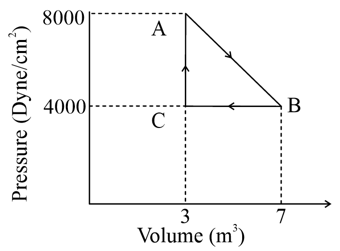
A thermodynamic system is taken from an original state $$A$$ to an intermediate state $$B$$ by a linear process as shown in the figure. Its volume is then reduced to the original value from $$B$$ to $$C$$ by an isobaric process. The total work done by the gas from $$A$$ to $$B$$ and $$B$$ to $$C$$ would be :
NTA JEE Mains 29th Jan 2024 Shift 1 - Question 9
Two vessels $$A$$ and $$B$$ are of the same size and are at same temperature. $$A$$ contains $$1$$ g of hydrogen and $$B$$ contains $$1$$ g of oxygen. $$P_A$$ and $$P_B$$ are the pressures of the gases in $$A$$ and $$B$$ respectively, then $$\frac{P_A}{P_B}$$ is :
NTA JEE Mains 29th Jan 2024 Shift 1 - Question 10
Two charges of $$5Q$$ and $$-2Q$$ are situated at the points $$(3a, 0)$$ and $$(-5a, 0)$$ respectively. The electric flux through a sphere of radius $$4a$$ having centre at origin is: