NTA JEE Mains 24th Jan 2025 Shift 2
For the following questions answer them individually
NTA JEE Mains 24th Jan 2025 Shift 2 - Question 51
For hydrogen atom, the orbital/s with lowest energy is/are:$$\text{ (A) } 4s \text{ (B) } 3p_x \text{ (C) } 3d_{x^2-y^2} \text{ (D) } 3d_{z^2} \text{ (E) } 4p_z$$ Choose the correct answer from the options given below:
NTA JEE Mains 24th Jan 2025 Shift 2 - Question 52
Match List - I with List - II.
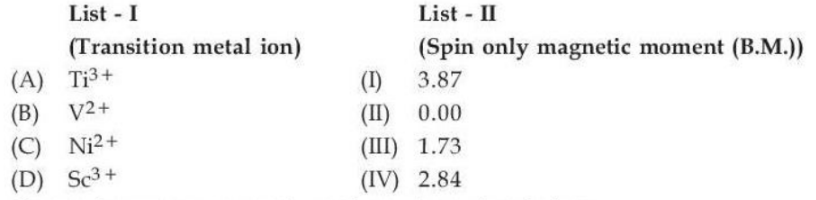
Choose the correct answer from the options given below :
NTA JEE Mains 24th Jan 2025 Shift 2 - Question 53
Given below are two statements : Statement (I): Experimentally determined oxygen-oxygen bond lengths in the $$ O_3 $$ are found to be same and the bond length is greater than that of a $$O = O$$ (double bond) but less than that of a single $$(O - O)$$ bond. Statement (II) : The strong lone pair-lone pair repulsion between oxygen atoms is solely responsible for the fact that the bond length in ozone is smaller than that of a double bond $$(O = O)$$ but more than that of a single bond $$(O - O)$$. In the light of the above statements, choose the correct answer from the options given below :

NTA JEE Mains 24th Jan 2025 Shift 2 - Question 54
When Ethane-1,2-diamine is added progressively to an aqueous solution of Nickel (II) chloride, the sequence of colour change observed will be :
NTA JEE Mains 24th Jan 2025 Shift 2 - Question 55
Given below are two statements :
Statement (I) : The first ionization energy of Pb is greater than that of Sn .
Statement (II) : The first ionization energy of Ge is greater than that of Si .
In the light of the above statements, choose the correct answer from the options given below :
NTA JEE Mains 24th Jan 2025 Shift 2 - Question 56
$$\text{Identify correct statement/s : }(A) -OCH_3 \text{ and } -NHCOCH_3 \text{ are activating groups. } (B)-CN \text{ and } -OH \text{ are meta directing groups. } (C) -CN \text{ and } -SO_3H$$ are meta directing groups. $$(D)$$ Activating groups act as ortho- and para-directing groups. $$(E)$$ Halides are activating groups. Choose the correct answer from the options given below:
NTA JEE Mains 24th Jan 2025 Shift 2 - Question 57
Based on the data given below: $$\begin{aligned}E^\circ_{\text{Cr}_2\text{O}_7^{2-}/\text{Cr}^{3+}} &= 1.33 \text{V} &E^\circ_{\text{Cl}_2/\text{Cl}^-} &= 1.36\ \text{V} \\E^\circ_{\text{MnO}_4^-/\text{Mn}^{2+}} &= 1.51 \text{V} &E^\circ_{\text{Cr}^{3+}/\text{Cr}} &= -0.74\ \text{V}\end{aligned}$$ the strongest reducing agent is:
NTA JEE Mains 24th Jan 2025 Shift 2 - Question 58
$$\text{For the reaction, } H_2(g) + I_2(g) \rightleftharpoons 2HI(g),$$ Attainment of equilibrium is predicted correctly by:
NTA JEE Mains 24th Jan 2025 Shift 2 - Question 59
Find the compound ' A ' from the following reaction sequences.
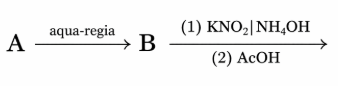
yellow ppt
NTA JEE Mains 24th Jan 2025 Shift 2 - Question 60
The elemental composition of a compound is $$54.2\%C,\ 9.2\%H$$ and $$36.6\%O.$$ If the molar mass of the compound is $$132\ \text{g mol}^{-1},$$ the molecular formula of the compound is: [Given: Relative atomic masses C:H:O = 12:1:16]