For the following questions answer them individually
The distance of the line $$\frac{x-2}{2}=\frac{y-6}{3}=\frac{z-3}{4}$$ from the point (1, 4, 0) along the line $$\frac{x}{1}=\frac{y-2}{2}=\frac{z+3}{3}$$ is :
Let $$A={(x,y) \in R\times R : |x+y|\geq 3}$$ and $$B={(x,y) \in R\times R : |x|+|y|\leq 3}$$. If $$C={(x,y) \in A ∩ B : x=0$$ or $$y=0},then \sum_{(x,y)\in C}^{}|x+y|$$ is :
Let $$X=R\times R$$ Define a relation R on X as : $$(a_{1},b_{1})R(a_{2},b_{2}) \Leftrightarrow b_{1}=b_{2}$$ Statement I : R is an equivalence relation. Statement II : For some $$(a,b) \in X$$, the set $$S={(x,y) \in X : (x,y)R(a,b)}$$ represents a line parallel to y=x In the light of the above statements, choose the correct answer from the options given below :
Let $$\int_{}^{} x^{3}\sin x dx =g(x)+C$$, where is the constant of integration. If $$8(g(\frac{\pi}{2})+g'(\frac{\pi}{2}))=\alpha \pi^{3} + \beta \pi^{2} + \gamma ,\alpha ,\beta ,\gamma \in Z$$, then $$\alpha +\beta - \gamma$$ equals :
A rod of length eight units moves such that its ends A and B always lie on the lines x - y + 2=0 and y + 2 = 0. respectively. If the locus of the point P, that divides the rod AB internally in the ratio 2:1 is $$9(x^{2}+\alpha y^{2}+\beta xy+\gamma x+ 28y)-76=0$$. then $$\alpha -\beta -\gamma$$ equals to :
If the square of the shortest distance between the lines $$frac{x-2}{1}=\frac{y-1}{2}=\frac{z+3}{-3}$$ and $$\frac{x+1}{2}=\frac{y+3}{4}=\frac{x+5}{-5}\text{ is }\frac{m}{n}$$, where m, n are coprime numbers, then m + n is equals to:
$$\lim_{x \rightarrow \infty}\frac{(2x^{2}-3x+5)(3x-1)^{\frac{x}{2}}}{(3x^{2}+5x+4)\sqrt{(3x+2)^{x}}}$$ is equals to :
Let the point A divide the line segment joining the points P(−1,−1, 2) and Q(5, 5, 10) internally in the ratio $$r : 1 (r > 0)$$. If O is the origin and $$(\overrightarrow{OQ}.\overrightarrow{OA})-\frac{1}{5}|\overrightarrow{OP}.\overrightarrow{OA}|^{2}=10$$. then the value of r is :
The length of the chord of the ellipse $$\frac{x^{2}}{4}+\frac{y^{2}}{2}=1$$, whose mid-point is $$(1,\frac{1}{2})$$, is :
The system of equations $$x+y+z=6\\x+2y+5z=9,\\x+5y+\lambda z=\mu,$$ has no solution if
Let the range of the function $$f(x)=6+16\cos x.\cos (\frac{\pi}{3}-x).\cos (\frac{\pi}{3}+x).\sin 3x.\cos 6x, x \in R\text{ be }[\alpha,\beta]$$.Then the distance of the point $$(\alpha,\beta)$$ from the line 3x + 4y + 12 = 0 is :
Let x = x(y) be the solution of the differential equation $$y = \left(x-y\frac{dx}{dy}\right)\sin \left(\frac{x}{y}\right),y > 0$$ and $$x(1)=\frac{\pi}{2}$$. Then $$\cos (x(2))$$ is equals to :
A spherical chocolate ball has a layer of ice-cream of uniform thickness around it. When the thickness of the ice-cream layer is 1 cm , the ice-cream melts at the rate of $$81 cm^{3}/min$$ and the thickness of the ice-cream layer decreases at the rate of $$\frac{1}{4\pi} cm/min$$. The surface area $$(in cm^{2})$$ of the chocolate ball (without the ice-cream layer) is :
The number of complex numbers z, satisfying $$|z|=1\text{ and }|\frac{z}{\overline{z}}+\frac{\overline{z}}{z}| = 1$$, is :
Let $$A = [a_{ij}]$$ be $$3\times 3$$ matrix such that $$A\begin{bmatrix}0 \\1\\0 \end{bmatrix} =\begin{bmatrix}0 \\0\\1 \end{bmatrix},A\begin{bmatrix}4 \\1\\3 \end{bmatrix}=\begin{bmatrix}0 \\1\\0 \end{bmatrix}$$ and $$A\begin{bmatrix}2 \\1\\2 \end{bmatrix}=\begin{bmatrix}1 \\0\\0 \end{bmatrix}$$, then $$a_{23}$$ equals :
If $$I=\int_{0}^{\frac{\pi}{2}}\frac{\sin^{\frac{3}{2}} x}{\sin^{\frac{3}{2}} x+ \cos^{\frac{3}{2} x}}dx$$, then $$\int_{0}^{21}\frac{x\sin x \cos x}{\sin^{4} x+\cos^{4} x}dx$$ equals :
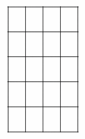
A board has 16 squares as shown in the figure:

Out of these 16 squares, two squares are chosen at random. The probability that they have no side in common is:
Let the shortest distance from (a, 0), a > 0, to the parabola $$y^{2}= 4x$$ be 4. Then the equation of the circle passing through the point (a,0) and the focus of the parabola, and having its centre on the axis of the parabola is:
If in the expansion of $$(1+x)^{p}(1-x)^{q}$$, the coefficients of x and $$x^{2}$$ are 1 and -2 , respectively, then $$p^{2}+q^{2}$$ is equal to :
If the area of the region $$\{(x,y):-1 \leq x \leq 1, 0 \leq y \leq a + e^{|x|}-e^{-x}, a > 0\}$$ is $$\frac{e^{2}+8e+1}{e}$$, then the value of a is :
The variance of the numbers 8, 21, 34, 47,…, 320 is
The roots of the quadratic equation $$3x^{2} - px + q = 0$$ are $$10^{th}$$ and $$11^{th}$$ terms of an arithmetic progression with common difference $$\frac{3}{2}$$. If the sum of the first 11 terms of this arithmetic progression is 88 , then q - 2p is equal to
The number of ways, 5 boys and 4 girls can sit in a row so that either all the boys sit together or no two boys sit together, is
The focus of the parabola $$y^{2}=4x+16$$ is the centre of the circle C of radius 5 . If the values of $$\ambda$$, for which C passes through the point of intersection of the lines 3x − y = 0 and $$x + \lambda y = 4$$, are $$\lambda_{1}$$ and $$\lambda_{2},\lambda_{1} < \lambda_{2}$$, then $$12\lambda_{1}+29\lambda_{2}$$ is equal to
Let $$\alpha,\beta$$ be the roots of the equation $$x^{2}-ax-b=0$$ with $$Im(\alpha) < Im(\beta)$$. Let $$P_{n}=\alpha^{n}-\beta^{n}$$. If $$P_{3}=-5\sqrt{7}i,P_{4}-3\sqrt{7}i,P_{5}=11\sqrt{7}i\text{ and }P_{}=45\sqrt{7}i$$.then $$|\alpha^{4}+\beta^{4}|$$ is equal to