NTA JEE Mains 04th April 2024 Shift 2
For the following questions answer them individually
NTA JEE Mains 04th April 2024 Shift 2 - Question 1
Applying the principle of homogeneity of dimensions, determine which one is correct, where $$T$$ is time period, $$G$$ is gravitational constant, $$M$$ is mass, $$r$$ is radius of orbit.
NTA JEE Mains 04th April 2024 Shift 2 - Question 2
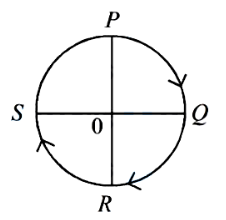
A cyclist starts from the point $$P$$ of a circular ground of radius $$2$$ km and travels along its circumference to the point $$S$$. The displacement of a cyclist is:
NTA JEE Mains 04th April 2024 Shift 2 - Question 3
A $$2$$ kg brick begins to slide over a surface which is inclined at an angle of $$45°$$ with respect to horizontal axis. The co-efficient of static friction between their surfaces is:

NTA JEE Mains 04th April 2024 Shift 2 - Question 4
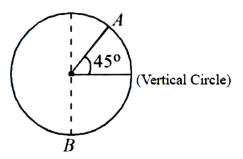
A body of $$m$$ kg slides from rest along the curve of vertical circle from point $$A$$ to $$B$$ in friction less path. The velocity of the body at $$B$$ is: (given, $$R = 14$$ m, $$g = 10$$ m/s$$^2$$ and $$\sqrt{2} = 1.4$$)
NTA JEE Mains 04th April 2024 Shift 2 - Question 5
A $$90$$ kg body placed at $$2R$$ distance from surface of earth experiences gravitational pull of: ($$R$$ = Radius of earth, $$g = 10$$ m s$$^{-2}$$)
NTA JEE Mains 04th April 2024 Shift 2 - Question 6
Correct formula for height of a satellite from earth's surface is:
NTA JEE Mains 04th April 2024 Shift 2 - Question 7
Given below are two statements: Statement I: The contact angle between a solid and a liquid is a property of the material of the solid and liquid as well. Statement II: The rise of a liquid in a capillary tube does not depend on the inner radius of the tube. In the light of the above statements, choose the correct answer from the options given below:
NTA JEE Mains 04th April 2024 Shift 2 - Question 8
A sample of gas at temperature $$T$$ is adiabatically expanded to double its volume. Adiabatic constant for the gas is $$\gamma = 3/2$$. The work done by the gas in the process is: ($$\mu = 1$$ mole)
NTA JEE Mains 04th April 2024 Shift 2 - Question 9
The translational degrees of freedom $$(f_t)$$ and rotational degrees of freedom $$(f_r)$$ of $$CH_4$$ molecule are:
NTA JEE Mains 04th April 2024 Shift 2 - Question 10
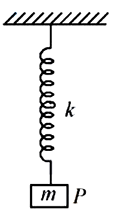
In simple harmonic motion, the total mechanical energy of given system is $$E$$. If mass of oscillating particle $$P$$ is doubled then the new energy of the system for same amplitude is