For the following questions answer them individually
The area (in sq. units) of the region $$S = \{z \in \mathbb{C} : |z - 1| \leq 2; (z + \bar{z}) + i(z - \bar{z}) \leq 2, \text{Im}(z) \geq 0\}$$ is
The value of $$\frac{1 \times 2^2 + 2 \times 3^2 + \ldots + 100 \times (101)^2}{1^2 \times 2 + 2^2 \times 3 + \ldots + 100^2 \times 101}$$ is
Let three real numbers $$a, b, c$$ be in arithmetic progression and $$a + 1, b, c + 3$$ be in geometric progression. If $$a > 10$$ and the arithmetic mean of $$a, b$$ and $$c$$ is $$8$$, then the cube of the geometric mean of $$a, b$$ and $$c$$ is
If the coefficients of $$x^4$$, $$x^5$$ and $$x^6$$ in the expansion of $$(1 + x)^n$$ are in the arithmetic progression, then the maximum value of $$n$$ is:
Let $$C$$ be a circle with radius $$\sqrt{10}$$ units and centre at the origin. Let the line $$x + y = 2$$ intersects the circle $$C$$ at the points $$P$$ and $$Q$$. Let $$MN$$ be a chord of $$C$$ of length $$2$$ unit and slope $$-1$$. Then, a distance (in units) between the chord $$PQ$$ and the chord $$MN$$ is
Let $$PQ$$ be a chord of the parabola $$y^2 = 12x$$ and the midpoint of $$PQ$$ be at $$(4, 1)$$. Then, which of the following point lies on the line passing through the points $$P$$ and $$Q$$?
Consider a hyperbola $$H$$ having centre at the origin and foci on the $$x$$-axis. Let $$C_1$$ be the circle touching the hyperbola $$H$$ and having the centre at the origin. Let $$C_2$$ be the circle touching the hyperbola $$H$$ at its vertex and having the centre at one of its foci. If areas (in sq units) of $$C_1$$ and $$C_2$$ are $$36\pi$$ and $$4\pi$$, respectively, then the length (in units) of latus rectum of $$H$$ is
Let $$f(x) = \int_0^x (t + \sin(1 - e^t))dt$$, $$x \in \mathbb{R}$$. Then, $$\lim_{x \to 0} \frac{f(x)}{x^3}$$ is equal to
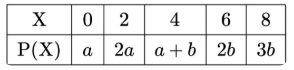
If the mean of the following probability distribution of a random variable $$X$$:

is $$\frac{46}{9}$$, then the variance of the distribution is
Let a relation $$R$$ on $$\mathbb{N} \times \mathbb{N}$$ be defined as: $$(x_1, y_1) R (x_2, y_2)$$ if and only if $$x_1 \leq x_2$$ or $$y_1 \leq y_2$$. Consider the two statements: (I) $$R$$ is reflexive but not symmetric. (II) $$R$$ is transitive. Then which one of the following is true?
Let $$A = \begin{bmatrix} 1 & 2 \\ 0 & 1 \end{bmatrix}$$ and $$B = I + \text{adj}(A) + (\text{adj } A)^2 + \ldots + (\text{adj } A)^{10}$$. Then, the sum of all the elements of the matrix $$B$$ is:
Given that the inverse trigonometric function assumes principal values only. Let $$x, y$$ be any two real numbers in $$[-1, 1]$$ such that $$\cos^{-1} x - \sin^{-1} y = \alpha$$, $$\frac{-\pi}{2} \leq \alpha \leq \pi$$. Then, the minimum value of $$x^2 + y^2 + 2xy \sin \alpha$$ is
If the function $$f(x) = \begin{cases} \frac{72^x - 9^x - 8^x + 1}{\sqrt{2} - \sqrt{1 + \cos x}}, & x \neq 0 \\ a \log_e 2 \log_e 3, & x = 0 \end{cases}$$ is continuous at $$x = 0$$, then the value of $$a^2$$ is equal to
Let $$f(x) = 3\sqrt{x - 2} + \sqrt{4 - x}$$ be a real valued function. If $$\alpha$$ and $$\beta$$ are respectively the minimum and the maximum values of $$f$$, then $$\alpha^2 + 2\beta^2$$ is equal to
If the value of the integral $$\int_{-1}^{1} \frac{\cos \alpha x}{1 + 3^x} dx$$ is $$\frac{2}{\pi}$$. Then, a value of $$\alpha$$ is
The area (in sq. units) of the region described by $$\{(x, y) : y^2 \leq 2x, y \geq 4x - 1\}$$ is
Let $$y = y(x)$$ be the solution of the differential equation $$(x^2 + 4)^2 dy + (2x^3 y + 8xy - 2)dx = 0$$. If $$y(0) = 0$$, then $$y(2)$$ is equal to
Let $$\vec{a} = \hat{i} + \hat{j} + \hat{k}$$, $$\vec{b} = 2\hat{i} + 4\hat{j} - 5\hat{k}$$ and $$\vec{c} = x\hat{i} + 2\hat{j} + 3\hat{k}$$, $$x \in \mathbb{R}$$. If $$\vec{d}$$ is the unit vector in the direction of $$\vec{b} + \vec{c}$$ such that $$\vec{a} \cdot \vec{d} = 1$$, then $$(\vec{a} \times \vec{b}) \cdot \vec{c}$$ is equal to
For $$\lambda > 0$$, let $$\theta$$ be the angle between the vectors $$\vec{a} = \hat{i} + \lambda\hat{j} - 3\hat{k}$$ and $$\vec{b} = 3\hat{i} - \hat{j} + 2\hat{k}$$. If the vectors $$\vec{a} + \vec{b}$$ and $$\vec{a} - \vec{b}$$ are mutually perpendicular, then the value of $$(14 \cos \theta)^2$$ is equal to
Let $$P$$ be the point of intersection of the lines $$\frac{x-2}{1} = \frac{y-4}{5} = \frac{z-2}{1}$$ and $$\frac{x-3}{2} = \frac{y-2}{3} = \frac{z-3}{2}$$. Then, the shortest distance of $$P$$ from the line $$4x = 2y = z$$ is
There are 4 men and 5 women in Group A, and 5 men and 4 women in Group B. If 4 persons are selected from each group, then the number of ways of selecting 4 men and 4 women is _____
Let $$S = \{\sin^2 2\theta : (\sin^4 \theta + \cos^4 \theta)x^2 + (\sin 2\theta)x + (\sin^6 \theta + \cos^6 \theta) = 0$$ has real roots$$\}$$. If $$\alpha$$ and $$\beta$$ be the smallest and largest elements of the set $$S$$, respectively, then $$3((\alpha - 2)^2 + (\beta - 1)^2)$$ equals _____
Consider a triangle $$ABC$$ having the vertices $$A(1, 2)$$, $$B(\alpha, \beta)$$ and $$C(\gamma, \delta)$$ and angles $$\angle ABC = \frac{\pi}{6}$$ and $$\angle BAC = \frac{2\pi}{3}$$. If the points $$B$$ and $$C$$ lie on the line $$y = x + 4$$, then $$\alpha^2 + \gamma^2$$ is equal to _____
Let $$A$$ be a $$2 \times 2$$ symmetric matrix such that $$A\begin{bmatrix} 1 \\ 1 \end{bmatrix} = \begin{bmatrix} 3 \\ 7 \end{bmatrix}$$ and the determinant of $$A$$ be $$1$$. If $$A^{-1} = \alpha A + \beta I$$, where $$I$$ is an identity matrix of order $$2 \times 2$$, then $$\alpha + \beta$$ equals _____
Consider the function $$f : \mathbb{R} \to \mathbb{R}$$ defined by $$f(x) = \frac{2x}{\sqrt{1 + 9x^2}}$$. If the composition of $$f$$, $$\underbrace{(f \circ f \circ f \circ \cdots \circ f)}_{10 \text{ times}}(x) = \frac{2^{10}x}{\sqrt{1 + 9\alpha x^2}}$$, then the value of $$\sqrt{3\alpha + 1}$$ is equal to _____
Let $$f : \mathbb{R} \to \mathbb{R}$$ be a thrice differentiable function such that $$f(0) = 0, f(1) = 1, f(2) = -1, f(3) = 2$$ and $$f(4) = -2$$. Then, the minimum number of zeros of $$(3f'f'' + ff''')(x)$$ is _____
If $$\int \csc^5 x \, dx = \alpha \cot x \csc x \left(\csc^2 x + \frac{3}{2}\right) + \beta \log_e \left|\tan \frac{x}{2}\right| + C$$ where $$\alpha, \beta \in \mathbb{R}$$ and $$C$$ is the constant of integration, then the value of $$8(\alpha + \beta)$$ equals _____
Let $$y = y(x)$$ be the solution of the differential equation $$(x + y + 2)^2 dx = dy$$, $$y(0) = -2$$. Let the maximum and minimum values of the function $$y = y(x)$$ in $$\left[0, \frac{\pi}{3}\right]$$ be $$\alpha$$ and $$\beta$$, respectively. If $$(3\alpha + \pi)^2 + \beta^2 = \gamma + \delta\sqrt{3}$$, $$\gamma, \delta \in \mathbb{Z}$$, then $$\gamma + \delta$$ equals _____
Consider a line $$L$$ passing through the points $$P(1, 2, 1)$$ and $$Q(2, 1, -1)$$. If the mirror image of the point $$A(2, 2, 2)$$ in the line $$L$$ is $$(\alpha, \beta, \gamma)$$, then $$\alpha + \beta + 6\gamma$$ is equal to _____
In a tournament, a team plays 10 matches with probabilities of winning and losing each match as $$\frac{1}{3}$$ and $$\frac{2}{3}$$ respectively. Let $$x$$ be the number of matches that the team wins, and $$y$$ be the number of matches that team loses. If the probability $$P(|x - y| \leq 2)$$ is $$p$$, then $$3^9 p$$ equals _____