NTA JEE Main 8 April 2018 Offline
For the following questions answer them individually
NTA JEE Main 8 April 2018 Offline - Question 21
An electron, a proton and an alpha particle having the same kinetic energy are moving in circular orbits of radii $$r_e$$, $$r_p$$, $$r_\alpha$$ respectively in a uniform magnetic field B. The relation between $$r_e$$, $$r_p$$, $$r_\alpha$$ is:
NTA JEE Main 8 April 2018 Offline - Question 22
For an RLC circuit driven with voltage of amplitude $$v_m$$ and frequency $$\omega_0 = \frac{1}{\sqrt{LC}}$$, the current exhibits resonance. The quality factor, Q is given by:
NTA JEE Main 8 April 2018 Offline - Question 23
In an A.C. circuit, the instantaneous e.m.f. and current are given by, $$E = 100 \sin 30t$$, $$I = 20 \sin\left(30t - \frac{\pi}{4}\right)$$. In one cycle of A.C., the average power consumed by the circuit (in watt) and the watt-less current (in ampere) are, respectively:

NTA JEE Main 8 April 2018 Offline - Question 24
An EM wave from air enters a medium. The electric fields are $$\vec{E_1} = E_{01}\hat{x}\cos\left[2\pi\nu\left(\frac{z}{c} - t\right)\right]$$ in air and $$\vec{E_2} = E_{02}\hat{x}\cos[k(2z - ct)]$$ in medium, where the wave number k and frequency $$\nu$$ refer to their values in the air. The medium is non-magnetic. If $$\epsilon_{r_1}$$ and $$\epsilon_{r_2}$$ refer to relative permittivities of air and medium respectively, which of the following options is correct?
NTA JEE Main 8 April 2018 Offline - Question 25
Unpolarized light of intensity I passes through an ideal polariser A. Another identical polariser B is placed behind A. The intensity of light beyond B is found to be $$\frac{I}{2}$$. Now another identical polariser C is placed between A and B. The intensity beyond B is now found to be $$\frac{I}{8}$$. The angle between polariser A and C is:
NTA JEE Main 8 April 2018 Offline - Question 26
The angular width of the central maximum in a single slit diffraction pattern is 60$$^\circ$$. The width of the slit is 1 $$\mu$$m. The slit is illuminated by monochromatic plane waves. If another slit of the same width is made near it, Young's fringes can be observed on a screen placed at a distance 50 cm from the slits. If the observed fringe width is 1 cm, what is slit separation distance? (i.e., the distance between the centres of each slit.)
NTA JEE Main 8 April 2018 Offline - Question 27
An electron from various excited states of hydrogen atom emit radiation to come to the ground state. Let $$\lambda_n$$, $$\lambda_g$$ be the de Broglie wavelength of the electron in the $$n^{th}$$ state and the ground state respectively. Let $$\Lambda_n$$ be the wavelength of the emitted photon in the transition from the $$n^{th}$$ state to the ground state. For large n, (A, B are constants)
NTA JEE Main 8 April 2018 Offline - Question 28
If the series limit frequency of the Lyman series is $$V_L$$, then the series limit frequency of the Pfund series is:
NTA JEE Main 8 April 2018 Offline - Question 29
The reading of the ammeter for a silicon diode in the given circuit is: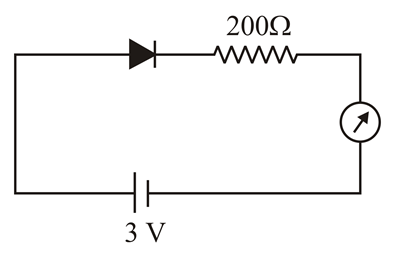
NTA JEE Main 8 April 2018 Offline - Question 30
A telephonic communication service is working at a carrier frequency of 10 GHz. Only 10% of it is utilized for transmission. How many telephonic channels can be transmitted simultaneously if each channel requires a bandwidth of 5 kHz?