NTA JEE Main 5th September 2020 Shift 2
For the following questions answer them individually
NTA JEE Main 5th September 2020 Shift 2 - Question 11
In the circuit shown, charge on the $$5\,\mu\text{F}$$ capacitor is: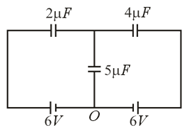
NTA JEE Main 5th September 2020 Shift 2 - Question 12
A parallel plate capacitor has plate of length $$l$$, width $$w$$ and separation of plates is $$d$$. It is connected to a battery of emf $$V$$. A dielectric slab of the same thickness $$d$$ and of dielectric constant $$K = 4$$ is being inserted between the plates of the capacitor. At what length of the slab inside plates, will the energy stored in the capacitor be two times the initial energy stored?
NTA JEE Main 5th September 2020 Shift 2 - Question 13
A galvanometer is used in laboratory for detecting the null point in electrical experiments. If, on passing a current of $$6\,mA$$ it produces a deflection of $$2^\circ$$, its figure of merit is close to:

NTA JEE Main 5th September 2020 Shift 2 - Question 14
In the circuit, given in the figure currents in different branches and value of one resistor are shown. Then potential at point $$B$$ with respect to the point $$A$$ is: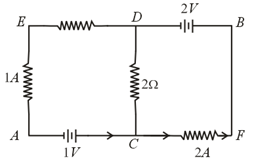
NTA JEE Main 5th September 2020 Shift 2 - Question 15
An iron rod of volume $$10^{-3}\,\text{m}^3$$ and relative permeability 1000 is placed as core in a solenoid with 10 turns $$\text{cm}^{-1}$$. If a current of $$0.5\,\text{A}$$ is passed through the solenoid, then the magnetic moment of the rod will be:
NTA JEE Main 5th September 2020 Shift 2 - Question 16
An infinitely long straight wire carrying current I, one side opened rectangular loop and a conductor C with a sliding connector are located in the same plane, as shown in the figure. The connector has length $$l$$ and resistance $$R$$. It slides to the right with a velocity $$v$$. The resistance of the conductor and the self inductance of the loop are negligible. The induced current in the loop, as a function of separation $$r$$, between the connector and the straight wire is: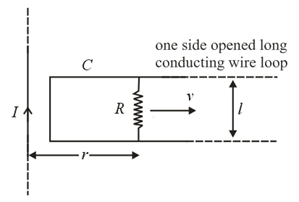
NTA JEE Main 5th September 2020 Shift 2 - Question 17
The correct match between the entries in column I and column II are:
I (Radiation) II (Wavelength)
a. Microwave i. 100 m
b. Gamma rays ii. $$10^{-15}$$ m
c. A.M. radio iii. $$10^{-10}$$ m
d. X-rays iv. $$10^{-3}$$ m
NTA JEE Main 5th September 2020 Shift 2 - Question 18
Two coherent sources of sound, $$S_1$$ and $$S_2$$, produce sound waves of the same wavelength $$\lambda = 1\,\text{m}$$ are in phase. $$S_1$$ and $$S_2$$ are placed $$1.5\,\text{m}$$ apart (see fig). A listener, located at L, directly in front of $$S_2$$, finds that the intensity is at a minimum when he is $$2\,\text{m}$$ away from $$S_2$$. The listener moves away from $$S_1$$, keeping the distance from $$S_2$$ fixed. The adjacent maximum of intensity is observed when the listener is at a distance $$d$$ from $$S_1$$. Then $$d$$ is: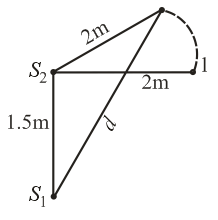
NTA JEE Main 5th September 2020 Shift 2 - Question 19
A radioactive nucleus decays by two different processes. The half-life for the first process is $$10\,\text{s}$$ and that for the second is $$100\,\text{s}$$. The effective half-life of the nucleus is close to:
NTA JEE Main 5th September 2020 Shift 2 - Question 20
Two Zener diodes ($$A$$ and $$B$$) having breakdown voltages of $$6\,\text{V}$$ and $$4\,\text{V}$$ respectively, are connected as shown in the circuit below. The output voltage $$V_0$$ variation with input voltage linearly increasing with time, is given by ($$V_{input} = 0V$$ at $$t = 0$$):