For the following questions answer them individually
A quantity $$x$$ is given by $$(1Fv^2/WL^4)$$ in terms of moment of inertia $$I$$, force $$F$$, velocity $$v$$, work $$W$$ and length $$L$$. The dimensional formula for $$x$$ is same as that of:
A particle of charge $$q$$ and mass $$m$$ is subjected to an electric field $$E = E_0(1 - ax^2)$$ in the $$x$$-direction, where $$a$$ and $$E_0$$ are constants. Initially the particle was at rest at $$x = 0$$. Other than the initial position the kinetic energy of the particle becomes zero when the distance of the particle from the origin is:
A small ball of mass $$m$$ is thrown upward with velocity $$u$$ from the ground. The ball experiences a resistive force $$mkv^2$$ where $$v$$ is its speed. The maximum height attained by the ball is:
A person pushes a box on a rough horizontal platform surface. He applies a force of 200 N over a distance of 15 m. Thereafter, he gets progressively tired and his applied force reduces linearly with distance to 100 N. The total distance through which the box has been moved is 30 m. What is the work done by the person during the total movement of the box?
Consider two uniform discs of the same thickness and different radii $$R_1 = R$$ and $$R_2 = \alpha R$$ made of the same material. If the ratio of their moments of inertia $$I_1$$ and $$I_2$$, respectively, about their axes is $$I_1 : I_2 = 1 : 16$$ then the value of $$\alpha$$ is:
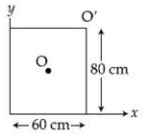
For a uniform rectangular sheet shown in the figure, the ratio of moments of inertia about the axes perpendicular to the sheet and passing through O (the centre of mass) and O' (corner point) is:
A body is moving in a low circular orbit about a planet of mass M and radius R. The radius of the orbit can be taken to be R itself. Then the ratio of the speed of this body in the orbit to the escape velocity from the planet is:
A cube of metal is subjected to a hydrostatic pressure 4 GPa. The percentage change in the length of the side of the cube is close to: (Given bulk modulus of metal, $$B = 8 \times 10^{10}$$ Pa)
Two identical cylindrical vessels are kept on the ground and each contain the same liquid of density $$d$$. The area of the base of both vessels is $$S$$ but the height of liquid in one vessel is $$x_1$$ and in the other $$x_2$$. When both cylinders are connected through a pipe of negligible volume very close to the bottom, the liquid flows from one vessel to the other until it comes to equilibrium at a new height. The change in energy of the system in the process is:
Match the thermodynamics processes taking place in a system with the correct conditions. In the table: $$\Delta Q$$ is the heat supplied, $$\Delta W$$ is the work done and $$\Delta U$$ is change in internal energy of the system.
Process   Condition
(I) Adiabatic   (A) $$\Delta W = 0$$
(II) Isothermal   (B) $$\Delta Q = 0$$
(III) Isochoric   (C) $$\Delta U \neq 0, \Delta W \neq 0, \Delta Q \neq 0$$
(IV) Isobaric   (D) $$\Delta U = 0$$
The driver of bus approaching a big wall notices that the frequency of his bus's horn changes from 420 Hz to 490 Hz when he hears it after it gets reflected from the wall. Find the speed of the bus if speed of the sound is 330 ms$$^{-1}$$:
A capacitor C is fully charged with voltage $$V_0$$. After disconnecting the voltage source, it is connected in parallel with another uncharged capacitor of capacitance $$\frac{C}{2}$$. The energy loss in the process after the charge is distributed between the two capacitors is:
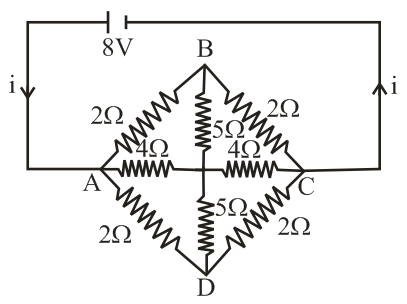
The value of current $$i_1$$ flowing from A to C in the circuit diagram is:
A paramagnetic sample shows a net magnetisation of 6 A/m when it is placed in an external magnetic field of 0.4 T at a temperature of 4 K. When the sample is placed in an external magnetic field of 0.3 T at a temperature of 24 K, then the magnetisation will be:
A circular coil has moment of inertia 0.8 kg m$$^2$$ around any diameter and is carrying current to produce a magnetic moment of 20 Am$$^2$$. The coil is kept initially in a vertical position and it can rotate freely around a horizontal diameter. When a uniform magnetic field of 4 T is applied along the vertical, it starts rotating around its horizontal diameter. The angular speed the coil acquires after rotating by 60° will be:
A series $$L - R$$ circuit is connected to a battery of emf $$V$$. If the circuit is switched on at $$t = 0$$, then the time at which the energy stored in the inductor reaches $$\left(\frac{1}{n}\right)$$ times of its maximum value, is:
The electric field of a plane electromagnetic wave is given by $$\vec{E} = E_0(\hat{x} + \hat{y})\sin(kz - \omega t)$$. Its magnetic field will be given by
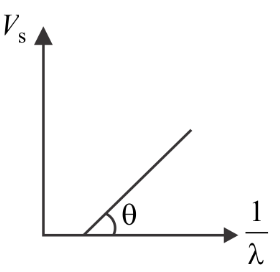
In a photoelectric effect experiment, the graph of stopping potential $$V$$ versus reciprocal of wavelength obtained is shown in the figure. As the intensity of incident radiation is increased:
Find the Binding energy per nucleon for $$^{120}_{50}Sn$$. Mass of proton $$m_p = 1.00783$$ U, mass of neutron $$m_n = 1.00867$$ U and mass of tin nucleus $$m_{sn} = 119.902199$$ U. (take 1U = 931 MeV)
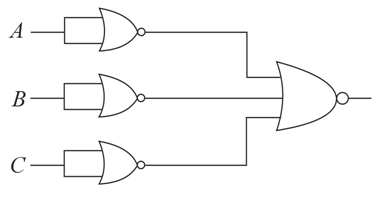
Identify the operation performed by the circuit given below:
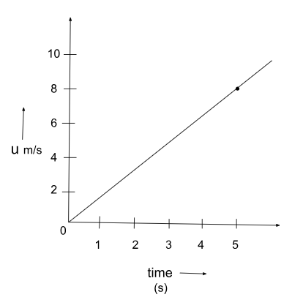
The speed versus time graph for a particle is shown in the figure. The distance travelled (in m) by the particle during the time interval t = 0 to t = 5 s will be __________
The change in the magnitude of the volume of an ideal gas when a small additional pressure $$\Delta P$$ is applied at a constant temperature, is the same as the change when the temperature is reduced by a small quantity $$\Delta T$$ at constant pressure. The initial temperature and pressure of the gas were 300 K and 2 atm respectively. If $$|\Delta T| = C|\Delta P|$$ then value of C in (K/atm) is __________
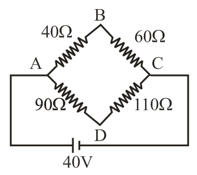
Four resistances 40 $$\Omega$$, 60 $$\Omega$$, 90 $$\Omega$$, 110 $$\Omega$$ and make the arms of a quadrilateral ABCD. Across AC is a battery of emf 40 V and internal resistance negligible. The potential difference across BD in V is __________
The distance between an object and a screen is 100 cm. A lens can produce real image of the object on the screen for two different positions between the screen and the object. The distance between these two positions is 40 cm. If the power of the lens is close to $$\left(\frac{N}{100}\right)$$D where N is an integer, the value of N is __________
Orange light of wavelength $$6000 \times 10^{-10}$$ m illuminates a single slit of width $$0.6 \times 10^{-4}$$ m. The maximum possible number of diffraction minima produced on both sides of the central maximum is __________