NTA JEE Main 31st August 2021 Shift 1
For the following questions answer them individually
NTA JEE Main 31st August 2021 Shift 1 - Question 1
Which of the following equations is dimensionally incorrect?
Where $$t$$ = time, $$h$$ = height, $$s$$ = surface tension, $$\theta$$ = angle, $$\rho$$ = density, $$a, r$$ = radius, $$g$$ = the acceleration due to gravity, $$V$$ = volume, $$p$$ = pressure, $$W$$ = work done, $$\tau$$ = torque, $$\epsilon$$ = permittivity, $$E$$ = electric field, $$J$$ = current density, $$L$$ = length.
NTA JEE Main 31st August 2021 Shift 1 - Question 2
Match List - I with List - II.
List - I List - II
(a) Torque (i) MLT$$^{-1}$$
(b) Impulse (ii) MT$$^{-2}$$
(c) Tension (iii) ML$$^2$$ T$$^{-2}$$
(d) Surface Tension (iv) MLT$$^{-2}$$
Choose the most appropriate answer from the option given below:
NTA JEE Main 31st August 2021 Shift 1 - Question 3
A helicopter is flying horizontally with a speed $$v$$ at an altitude $$h$$ has to drop a food packet for a man on the ground. What is the distance of helicopter from the man when the food packet is dropped?

NTA JEE Main 31st August 2021 Shift 1 - Question 4
A body of mass $$M$$ moving at speed $$V_0$$ collides elastically with a mass $$m$$ at rest. After the collision, the two masses move at angles $$\theta_1$$ and $$\theta_2$$ with respect to the initial direction of motion of the body of mass $$M$$. The largest possible value of the ratio $$\frac{M}{m}$$, for which the angles $$\theta_1$$ and $$\theta_2$$ will be equal, is:
NTA JEE Main 31st August 2021 Shift 1 - Question 5
Angular momentum of a single particle moving with constant speed along circular path:
NTA JEE Main 31st August 2021 Shift 1 - Question 6
The masses and radii of the earth and moon are $$(M_1, R_1)$$ and $$(M_2, R_2)$$ respectively. Their centres are at a distance $$r$$ apart. Find the minimum escape velocity for a particle of mass $$m$$ to be projected from the middle of these two masses:
NTA JEE Main 31st August 2021 Shift 1 - Question 7
A uniform heavy rod of weight 10 kg m s$$^{-2}$$, cross-sectional area 100 cm$$^2$$ and length 20 cm is hanging from a fixed support. Young modulus of the material of the rod is $$2 \times 10^{11}$$ N m$$^{-2}$$. Neglecting the lateral contraction, find the elongation of rod due to its own weight:
NTA JEE Main 31st August 2021 Shift 1 - Question 8
A reversible engine has an efficiency of $$\frac{1}{4}$$. If the temperature of the sink is reduced by 58°C, its efficiency becomes double. Calculate the temperature of the sink:
NTA JEE Main 31st August 2021 Shift 1 - Question 9
For an ideal gas the instantaneous change in pressure $$P$$ with volume $$V$$ is given by the equation $$\frac{dP}{dV} = -aP$$. If $$P = P_0$$ at $$V = 0$$ is the given boundary condition, then the maximum temperature one mole of gas can attain is: (Here $$\mathcal{R}$$ is the gas constant)
NTA JEE Main 31st August 2021 Shift 1 - Question 10
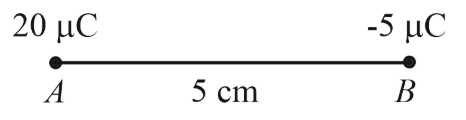
Two particles $$A$$ and $$B$$ having charges 20 $$\mu$$C and $$-5$$ $$\mu$$C respectively are held fixed with a separation of 5 cm. At what position a third charged particle should be placed so that it does not experience a net electric force?

.webp)
