For the following questions answer them individually
Amount of solar energy received on the earth's surface per unit area per unit time is defined a solar constant. Dimension of solar constant is:
A particle is moving unidirectional on a horizontal plane under the action of a constant power supplying energy source. The displacement (s) - time (t) graph that describes the motion of the particle is (graphs are drawn schematically and are not to scale):
Hydrogen ion and singly ionized helium atom are accelerated, from rest, through the same potential difference. The ratio of final speeds of hydrogen and helium ions is close to:
A block of mass 1.9 kg is at rest at the edge of a table, of height 1 m. A bullet of mass 0.1 kg collides with the block and sticks to it. If the velocity of the bullet is 20 m s$$^{-1}$$ in the horizontal direction just before the collision then the kinetic energy just before the combined system strikes the floor, is [Take g = 10 m s$$^{-2}$$. Assume there is no rotational motion and loss of energy after the collision is negligible.]
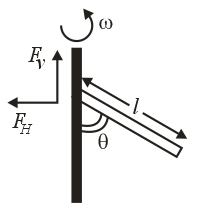
A uniform rod of length '$$\ell$$' is pivoted at one of its ends on a vertical shaft of negligible radius. When the shaft rotates at angular speed $$\omega$$ the rod makes an angle $$\theta$$ with it (see figure). To find $$\theta$$ equate the rate of change of angular momentum (direction going into the paper) $$\frac{m\ell^2}{12}\omega^2 \sin\theta$$ about the centre of mass (CM) to the torque provided by the horizontal and vertical forces $$F_H$$ and $$F_v$$ about the CM. The value of $$\theta$$ is then such that:
The mass density of a planet of radius R varies with the distance r from its centre as $$\rho(r) = \rho_0\left(1 - \frac{r^2}{R^2}\right)$$. Then the gravitational field is maximum at:
A metallic sphere cools from 50°C to 40°C in 300 s. If atmospheric temperature around is 20°C, then the sphere's temperature after the next 5 minutes will be close to:
A calorimeter of water equivalent 20 g contains 180 g of water at 25°C. 'm' grams of steam at 100°C is mixed in it till the temperature of the mixture is 31°C. The value of 'm' is close to (Latent heat of water = 540 cal g$$^{-1}$$, specific heat of water = 1 cal g$$^{-1}$$°C$$^{-1}$$)
To raise the temperature of a certain mass of gas by 50°C at a constant pressure, 160 calories of heat is required. When the same mass of gas is cooled by 100°C at constant volume, 240 calories of heat is released. How many degrees of freedom does each molecule of this gas have (assume gas to be ideal)?
A block of mass m attached to a massless spring is performing oscillatory motion of amplitude 'A' on a frictionless horizontal plane. If half of the mass of the block breaks off when it is passing through its equilibrium point, the amplitude of oscillation for the remaining system become $$fA$$. The value of $$f$$ is:
Concentric metallic hollow spheres of radii R and 4R hold charges $$Q_1$$ and $$Q_2$$ respectively. Given that surface charge densities of the concentric spheres are equal, the potential difference V(R) - V(4R) is:
Two resistors 400 $$\Omega$$ and 800 $$\Omega$$ are connected in series across a 6V battery. The potential difference measured by a voltmeter of 10 k$$\Omega$$ across 400 $$\Omega$$ resistor is close to:
Which of the following will NOT be observed when a multimeter (operating in resistance measuring mode) probes connected across a component, are just reversed?
A perfectly diamagnetic sphere has a small spherical cavity at its centre, which is filled with a paramagnetic substance. The whole system is placed in a uniform magnetic field $$\vec{B}$$. Then the field inside the paramagnetic substance is:
A uniform magnetic field B exists in a direction perpendicular to the plane of a square loop made of a metal wire. The wire has a diameter of 4 mm and a total length of 30 cm. The magnetic field changes with time at a steady rate dB/dt = 0.032 Ts$$^{-1}$$. The induced current in the loop is close to (Resistivity of the metal wire is 1.23 $$\times$$ 10$$^{-8}$$ $$\Omega$$m)
The electric field of a plane electromagnetic wave propagating along the x direction in vacuum is $$\vec{E} = E_0 \hat{j}\cos(\omega t - kx)$$. The magnetic field $$\vec{B}$$, at the moment t = 0 is:
Two sources of light emit X-rays of wavelength 1 nm and visible light of wavelength 500 nm, respectively. Both the sources emit light of the same power 200 W. The ratio of the number density of photons of X-rays to the number density of photons of the visible light of the given wavelengths is:
Two light waves having the same wavelength $$\lambda$$ in vacuum are in phase initially. Then the first wave travels a path $$L_1$$ through a medium of refractive index $$n_1$$ while the second wave travels a path of length $$L_2$$ through a medium of refractive index $$n_2$$. After this the phase difference between the two waves is:
The radius R of a nucleus of mass number A can be estimated by the formula $$R = (1.3 \times 10^{-15})A^{1/3}$$ m. It follows that the mass density of n nucleus is of the order of: $$(M_{prot} \cong M_{neut} \simeq 1.67 \times 10^{-27}$$ kg)
If a semiconductor photo diode can detect a photon with a maximum wavelength of 400 nm, then its band gap energy is: Planck's constant h = 6.63 $$\times$$ 10$$^{-34}$$ J.s, Speed of light c = 3 $$\times$$ 10$$^8$$ m s$$^{-1}$$
A block starts moving up an inclined plane of inclination 30° with an initial velocity of $$v_0$$. It comes back to its initial position with velocity $$\frac{v_0}{2}$$. The value of the coefficient of kinetic friction between the block and the inclined plane is close to $$\frac{I}{1000}$$. The nearest integer to I is:
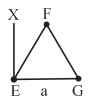
An massless equilateral triangle EFG of side 'a' (As shown in figure) has three particles of mass m situated at its vertices. The moment of inertia of the system about the line EX perpendicular to EG in the plane of EFG is $$\frac{N}{20}ma^2$$ where N is an integer. The value of N is __________.
If minimum possible work is done by a refrigerator in converting 100 grams of water at 0°C to ice, how much heat (in calories) is released to the surroundings at temperature 27°C (Latent heat of ice = 80 Cal/gram) to the nearest integer?
A galvanometer coil has 500 turns and each turn has an average area of $$3 \times 10^{-4}$$ m$$^2$$. If a torque of 1.5 Nm is required to keep this coil parallel to a magnetic field when a current of 0.5A is flowing through it, the strength of the field (in T) is __________.
When an object is kept at a distance of 30 cm from a concave mirror, the image is formed at a distance of 10 cm from the mirror. If the object is moved with a speed of 9 cm s$$^{-1}$$, the speed (in cm s$$^{-1}$$) with which image moves at that instant is