NTA JEE Main 3rd April 2016 Offline
For the following questions answer them individually
NTA JEE Main 3rd April 2016 Offline - Question 11
A pipe open at both ends has a fundamental frequency $$f$$ in air. The pipe is dipped vertically in water so that half of it is in water. The fundamental frequency of the air column is now:
NTA JEE Main 3rd April 2016 Offline - Question 12
A uniform string of length 20 m is suspended from a rigid support. A short wave pulse is introduced at its lowest end. It starts moving up the string. The time taken to reach the support is (Take, $$g = 10$$ m s$$^{-2}$$)
NTA JEE Main 3rd April 2016 Offline - Question 13
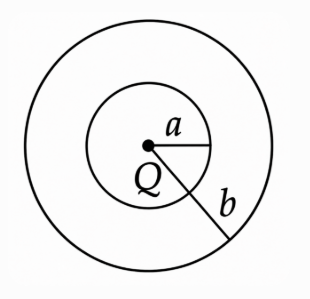
The region between two concentric spheres of radii 'a' and 'b', respectively (see figure), has volume charge density $$\rho = \frac{A}{r}$$, where A is a constant and r is the distance from the centre. At the centre of the spheres is a point charge Q. The value of A such that the electric field in the region between the spheres will be constant, is:

NTA JEE Main 3rd April 2016 Offline - Question 14
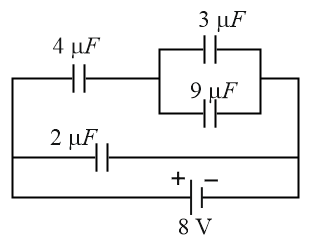
A combination of capacitors is set up as shown in the figure. The magnitude of the electric field, due to a point charge Q (having a charge equal to the sum of the charges on the 4 $$\mu$$F and 9 $$\mu$$F capacitors), at a point distant 30 m from it, would equal:
NTA JEE Main 3rd April 2016 Offline - Question 15
A galvanometer having a coil resistance of 100 $$\Omega$$ gives a full scale deflection, when a current of 1 mA is passed through it. The value of the resistance, which can convert this galvanometer into ammeter giving a full scale deflection for a current of 10 A, is:
NTA JEE Main 3rd April 2016 Offline - Question 16
Hysteresis loops for two magnetic materials A and B are given below:
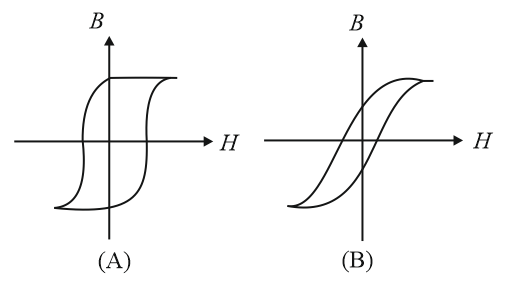
These materials are used to make magnets for electric generators, transformer core and electromagnet core. Then it is proper to use:
NTA JEE Main 3rd April 2016 Offline - Question 17
Two identical wires A and B, each of length $$l$$, carry the same current $$I$$. Wire A is bent into a circle of radius R and wire B is bent to form a square of side $$a$$. If $$B_A$$ and $$B_B$$ are the values of magnetic field at the centres of the circle and square respectively, then the ratio $$\frac{B_A}{B_B}$$ is
NTA JEE Main 3rd April 2016 Offline - Question 18
An arc lamp requires a direct current of 10 A at 80 V to function. If it is connected to a 220 V (rms), 50 Hz AC supply, the series inductor needed for it to work is close to:
NTA JEE Main 3rd April 2016 Offline - Question 19
Arrange the following electromagnetic radiations per quantum in the order of increasing energy:
A: Blue light
B: Yellow light
C: X-ray
D: Radiowave
NTA JEE Main 3rd April 2016 Offline - Question 20
An observer looks at a distant tree of height 10 m with a telescope of magnifying power of 20. To the observer, the tree appears as