NTA JEE Main 3rd April 2016 Offline
For the following questions answer them individually
NTA JEE Main 3rd April 2016 Offline - Question 1
A student measures the time period of 100 oscillations of a simple pendulum four times. The data set is 90 s, 91 s, 95 s and 92 s. If the minimum division in the measuring clock is 1 s, then the reported mean time should be:
NTA JEE Main 3rd April 2016 Offline - Question 2
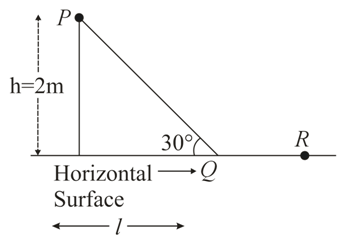
A point particle of mass m, moves along the uniformly rough track PQR as shown in the figure. The coefficient of friction, between the particle and the rough track equals $$\mu$$. The particle is released, from rest, from the point P and it comes to rest at a point R. The energies, lost by the ball, over the parts, PQ and QR, of the track, are equal to each other, and no energy is lost when particle changes direction from PQ to QR. The values of the coefficient of friction $$\mu$$ and the distance x = (QR), are respectively close to:
NTA JEE Main 3rd April 2016 Offline - Question 3
A person trying to lose weight by burning fat lifts a mass of 10 kg upto a height of 1 m 1000 times. Assume that the potential energy lost each time he lowers the mass is dissipated. How much fat will he use up considering the work done only when the weight is lifted up? Fat supplies $$3.8 \times 10^{7}$$ J of energy per kg which is converted to mechanical energy with a 20% efficiency rate. Take $$g = 9.8$$ ms$$^{-2}$$:

NTA JEE Main 3rd April 2016 Offline - Question 4
A particle of mass m is moving along the side of a square of side 'a', with a uniform speed v in the x-y plane as shown in the figure:
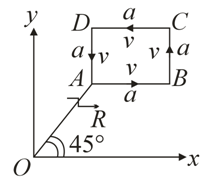
Which of the following statements is false for the angular momentum $$\vec{L}$$ about the origin?
NTA JEE Main 3rd April 2016 Offline - Question 5
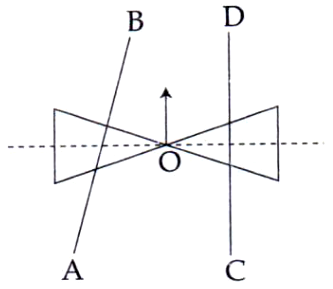
A roller is made by joining together two cones at their vertices O. It is kept on two rails AB and CD which are placed asymmetrically, with its axis perpendicular to CD and its centre O at the centre of line joining AB and CD (see the figure below). It is given a light push so that it starts rolling with its centre O moving parallel to CD in the direction shown. As it moves, the roller will tend to:
NTA JEE Main 3rd April 2016 Offline - Question 6
A satellite is revolving in a circular orbit at a height $$h$$ from the earth's surface (radius of earth $$R$$; $$h << R$$). The minimum increase in its orbital velocity required, so that the satellite could escape from the earth's gravitational field, is close to (Neglect the effect of atmosphere.)
NTA JEE Main 3rd April 2016 Offline - Question 7
A pendulum clock loses 12 s a day if the temperature is 40°C and gains 4 s a day if the temperature is 20°C. The temperature at which the clock will show correct time, and the co-efficient of linear expansion ($$\alpha$$) of the metal of the pendulum shaft are respectively:
NTA JEE Main 3rd April 2016 Offline - Question 8
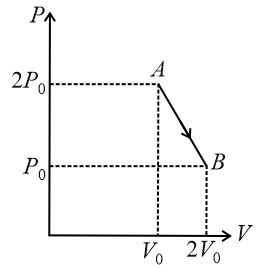
$$n$$ moles of an ideal gas undergoes a process $$A \to B$$ as shown in the figure. The maximum temperature of the gas during the process will be:
NTA JEE Main 3rd April 2016 Offline - Question 9
An ideal gas undergoes a quasi-static, reversible process in which its molar heat capacity C remains constant. If during this process the relation of pressure P and volume V is given by $$PV^n$$ = constant, then n is given by (Here $$C_P$$ and $$C_V$$ are molar specific heat at constant pressure and constant volume, respectively):
NTA JEE Main 3rd April 2016 Offline - Question 10
A particle performs simple harmonic motion with amplitude A. Its speed is tripled at the instant that it is at a distance $$\frac{2A}{3}$$ from equilibrium position. The new amplitude of the motion is: