NTA JEE Main 27th June 2022 Shift 1
For the following questions answer them individually
NTA JEE Main 27th June 2022 Shift 1 - Question 1
A silver wire has a mass $$(0.6 \pm 0.006)$$ g, radius $$(0.5 \pm 0.005)$$ mm and length $$(4 \pm 0.04)$$ cm. The maximum percentage error in the measurement of its density will be
NTA JEE Main 27th June 2022 Shift 1 - Question 2
A projectile is launched at an angle $$\alpha$$ with the horizontal with a velocity $$20$$ m s$$^{-1}$$. After $$10$$ s, its inclination with horizontal is $$\beta$$. The value of $$\tan\beta$$ will be : $$(g = 10$$ m s$$^{-2})$$.
NTA JEE Main 27th June 2022 Shift 1 - Question 3
A girl standing on road holds her umbrella at $$45°$$ with the vertical to keep the rain away. If she starts running without umbrella with a speed of $$15\sqrt{2}$$ km h$$^{-1}$$, the rain drops hit her head vertically. The speed of rain drops with respect to the moving girl is

NTA JEE Main 27th June 2022 Shift 1 - Question 4
A system of two blocks of masses $$m = 2$$ kg and $$M = 8$$ kg is placed on a smooth table as shown in figure. The coefficient of static friction between two blocks is $$0.5$$. The maximum horizontal force $$F$$ that can be applied to the block of mass $$M$$ so that the blocks move together will be $$(g = 9.8$$ m s$$^{-2})$$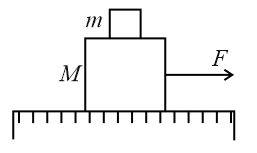
NTA JEE Main 27th June 2022 Shift 1 - Question 5
Two blocks of masses $$10$$ kg and $$30$$ kg are placed on the same straight line with coordinates $$(0, 0)$$ cm and $$(x, 0)$$ cm respectively. The block of $$10$$ kg is moved on the same line through a distance of $$6$$ cm towards the other block. The distance through which the block of $$30$$ kg must be moved to keep the position of centre of mass of the system unchanged is
NTA JEE Main 27th June 2022 Shift 1 - Question 6
What percentage of kinetic energy of a moving particle is transferred to a stationary particle when it strikes the stationary particle of $$5$$ times its mass?
(Assume the collision to be head-on elastic collision)
NTA JEE Main 27th June 2022 Shift 1 - Question 7
Statement II : The weight of any person becomes zero when the person is at the centre of the earth.
In the light of the above statements, choose the correct answer from the options given below.
NTA JEE Main 27th June 2022 Shift 1 - Question 8
The velocity of a small ball of mass $$m$$ and density $$d_1$$, when dropped in a container filled with glycerine, becomes constant after some time. If the density of glycerine is $$d_2$$, then the viscous force acting on the ball will be
NTA JEE Main 27th June 2022 Shift 1 - Question 9
A mixture of hydrogen and oxygen has volume $$2000$$ cm$$^3$$, temperature $$300$$ K, pressure $$100$$ kPa and mass $$0.76$$ g. The ratio of number of moles of hydrogen to number of moles of oxygen in the mixture will be
[Take gas constant $$R = 8.3$$ J K$$^{-1}$$ mol$$^{-1}$$]
NTA JEE Main 27th June 2022 Shift 1 - Question 10
The displacement of simple harmonic oscillator after $$3$$ seconds starting from its mean position is equal to half of its amplitude. The time period of harmonic motion is