If the Thomson model of the atom was correct, then the result of Rutherford's gold foil experiment would have been:

Join Our JEE Preparation Group
Prep with like-minded aspirants; Get access to free daily tests and study material.
Sign in
Please select an account to continue using cracku.in
↓ →
Join Our JEE Preparation Group
Prep with like-minded aspirants; Get access to free daily tests and study material.
If the Thomson model of the atom was correct, then the result of Rutherford's gold foil experiment would have been:
Login to view the detailed solution.
The CORRECT order of first ionisation enthalpy is:
Login to view the detailed solution.
The number of neutrons and electrons, respectively, present in the radioactive isotope of hydrogen is:
Login to view the detailed solution.
.webp)
Match List - I with List II:
List-I List-II
a. Li i. photoelectric cell
b. Na ii. absorbent of CO$$_2$$
c. K iii. coolant in fast breeder nuclear reactor
d. Cs iv. treatment of cancer
v. bearings for motor engines
Choose the correct answer from the options given below:
Login to view the detailed solution.
Which one of the following set of elements can be detected using sodium fusion extract?
Login to view the detailed solution.
Given below are two statements:
Statement I : Hyperconjugation is a permanent effect.
Statement II : Hyperconjugation in ethyl cation $$\left(CH_3 - \overset{+}{CH_2}\right)$$ involves the overlapping of $$C_{sp^2} - H_{1s}$$ bond with empty 2p orbital of other carbon.
Choose the correct option:
Login to view the detailed solution.
.webp)
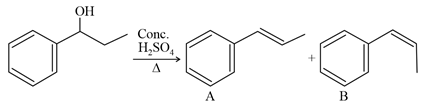
Consider the above reaction, and choose the correct statement:
Login to view the detailed solution.
The correct sequence of correct reagents for the following transformation is:-
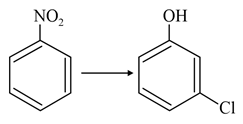
Login to view the detailed solution.
Match List - I with List - II:
List - I (compound) List - II (effect/affected species)
a. Carbon monoxide i. Carcinogenic
b. Sulphur dioxide ii. Metabolized by pyrus plants
c. Polychlorinated biphenyls iii. Haemoglobin
d. Oxides of Nitrogen iv. Stiffness of flower buds
Choose the correct answer from the options given below:
Login to view the detailed solution.
.webp)
Select the correct statements.
(A) Crystalline solids have long range order.
(B) Crystalline solids are isotropic.
(C) Amorphous solid are sometimes called pseudo solids.
(D) Amorphous solids soften over a range of temperatures.
(E) Amorphous solids have a definite heat of fusion.
Choose the most appropriate answer from the options given below.
Login to view the detailed solution.
Given below are two statement: one is labelled as Assertion A and the other is labelled as Reason R.
Assertion A : SO$$_2$$(g) is adsorbed to a large extent than H$$_2$$(g) on activated charcoal.
Reason R : SO$$_2$$(g) has a higher critical temperature than H$$_2$$(g)
In the light of the above statements, choose the most appropriate answer from the options given below.
Login to view the detailed solution.
The addition of silica during the extraction of copper from its sulphide ore:-
Login to view the detailed solution.
.webp)
Number of Cl = O bonds in chlorous acid, chloric acid and perchloric acid respectively are:
Login to view the detailed solution.
Given below are two statements:
Statement I: $$[Mn(CN)_6]^{3-}$$, $$[Fe(CN)_6]^{3-}$$ and $$[Co(C_2O_4)_3]^{3-}$$ are d$$^2$$sp$$^3$$ hybridised.
Statement II: $$[MnCl_6]^{3-}$$ and $$[FeF_6]^{3-}$$ are paramagnetic and have 4 and 5 unpaired electrons, respectively.
In the light of the above statements, choose the correct answer from the options given below:
Login to view the detailed solution.
What is A in the following reaction?
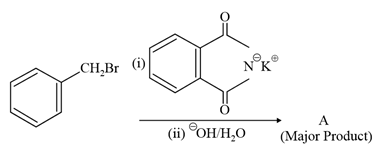
Login to view the detailed solution.

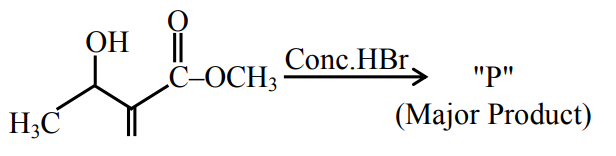
Consider the above reaction, the major product P formed is:
Login to view the detailed solution.
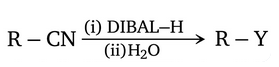
Consider the above reaction and identify "Y"
Login to view the detailed solution.
Given below are two statements:
Statement I : Penicillin is a bacteriostatic type antibiotic.
Statement II : The general structure of Penicillin is:
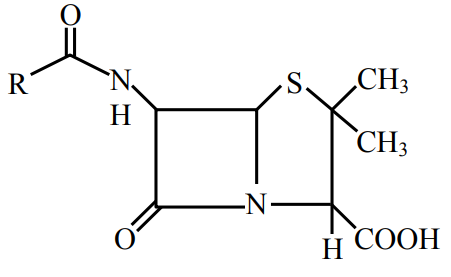
Choose the correct option:
Login to view the detailed solution.
_1.webp)
To an aqueous solution containing ions such as Al$$^{3+}$$, Zn$$^{2+}$$, Ca$$^{2+}$$, Fe$$^{3+}$$, Ni$$^{2+}$$, Ba$$^{2+}$$ and Cu$$^{2+}$$ was added conc. HCl, followed by H$$_2$$S. The total number of cations precipitated during this reaction is/are:
Login to view the detailed solution.
Compound A gives D-Galactose and D-Glucose on hydrolysis. The compound A is:
Login to view the detailed solution.
$$2SO_2(g) + O_2(g) \rightarrow 2SO_3(g)$$
The above reaction is carried out in a vessel starting with partial pressure $$P_{SO_2} = 250$$ m bar, $$P_{O_2} = 750$$ m bar and $$P_{SO_3} = 0$$ bar. When the reaction is complete, the total pressure in the reaction vessel is _________ m bar. (Round off to the nearest integer).
Login to view the detailed solution.
The total number of electrons in all bonding molecular orbitals of $$O_2^{2-}$$ is _________ (Round off to the nearest integer)
Login to view the detailed solution.
When 400 mL of 0.2 M H$$_2$$SO$$_4$$ solution is mixed with 600 mL of 0.1 M NaOH solution, the increase in temperature of the final solution is _________ $$\times 10^{-2}$$ K. (Round off to the nearest integer).
[Use: H$$^+$$(aq) + OH$$^-$$(aq) $$\rightarrow$$ H$$_2$$O: $$\Delta_r H = -57.1$$ kJ mol$$^{-1}$$
Specific heat of H$$_2$$O = 4.18 J K$$^{-1}$$ g$$^{-1}$$, density of H$$_2$$O = 1.0 g cm$$^{-3}$$
Assume no change in volume of solution on mixing.]
Login to view the detailed solution.
The equilibrium constant for the reaction $$A(s) \rightleftharpoons M(s) + \frac{1}{2}O_2(g)$$ is $$K_p = 4$$. At equilibrium, the partial pressure of O$$_2$$ is _________ atm. (Round off to the nearest integer)
Login to view the detailed solution.
10.0 mL of 0.05 M KMnO$$_4$$ solution was consumed in a titration with 10.0 mL of given oxalic acid dihydrate solution. The strength of given oxalic acid solution is _________ $$\times 10^{-2}$$ g/L. (Round off to the nearest integer)
Login to view the detailed solution.
The dihedral angle in staggered form of Newmann's projection of 1, 1, 1-Trichloro ethane is _________ degree. (Round off to the nearest integer)
Login to view the detailed solution.
In a solvent 50% of an acid HA dimerizes and the rest dissociates. The van't Hoff factor of the acid is _________ $$\times 10^{-2}$$ (Round off to the nearest integer)
Login to view the detailed solution.
For the cell Cu(s)|Cu$$^{2+}$$(aq)(0.1M)||Ag$$^+$$(aq)(0.01M)|Ag(s) the cell potential E$$_1$$ = 0.3095 V. For the cell Cu(s)|Cu$$^{2+}$$(aq)(0.01M)||Ag$$^+$$(aq)(0.001M)|Ag(s) the cell potential = $$x \times 10^{-2}$$ V. Find value of x.
(Round off to the Nearest Integer).
[Use: $$\frac{2.303 RT}{F} = 0.059$$ J]
Login to view the detailed solution.
For the first order reaction A $$\rightarrow$$ 2B, 1 mole of reactant A gives 0.2 moles of $$B$$ after 100 minutes. The half life of the reaction is _________ min. (Round off to nearest integer).
[$$Use: ln 2 = 0.69, ln 10 = 2.3$$
Properties of logarithms: $$\ln x^y = y \ln x$$
$$\ln\left(\frac{x}{y}\right)=\ln x-\ln y$$]
(Round off to the nearest integer)
Login to view the detailed solution.
3 moles of metal complex with formula Co(en)$$_2$$Cl$$_3$$ gives 3 moles of silver chloride on treatment with excess of silver nitrate. The secondary valency of Co in the complex is _________ (Round off to the nearest integer)
Login to view the detailed solution.
Educational materials for JEE preparation
 Share
Share