The correct order of ionic radii for the ions, P$$^{3-}$$, S$$^{2-}$$, Ca$$^{2+}$$, K$$^+$$, Cl$$^-$$ is:

Join Our JEE Preparation Group
Prep with like-minded aspirants; Get access to free daily tests and study material.
Sign in
Please select an account to continue using cracku.in
↓ →
Join Our JEE Preparation Group
Prep with like-minded aspirants; Get access to free daily tests and study material.
The correct order of ionic radii for the ions, P$$^{3-}$$, S$$^{2-}$$, Ca$$^{2+}$$, K$$^+$$, Cl$$^-$$ is:
Login to view the detailed solution.
The compound/s which will show significant intermolecular H-bonding is/are:
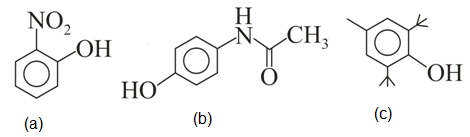
Login to view the detailed solution.
The oxide that gives H$$_2$$O$$_2$$ most readily on treatment with H$$_2$$O is:
Login to view the detailed solution.
.webp)
Choose the correct statement from the following:
Login to view the detailed solution.
The major product (A) formed in the reaction given below is:
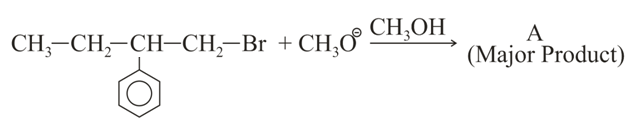
Login to view the detailed solution.
In stratosphere most of the ozone formation is assisted by:
Login to view the detailed solution.
.webp)
Lyophilic sols are more stable than lyophobic sols because:
Login to view the detailed solution.
Match List-I with List-II:
List-I (Name of ore/mineral) List-II (Chemical formula)
(a) Calamine (i) ZnS
(b) Malachite (ii) FeCO$$_3$$
(c) Siderite (iii) ZnCO$$_3$$
(d) Sphalerite (iv) CuCO$$_3$$.Cu(OH)$$_2$$
Choose the most appropriate answer from the options given below:
Login to view the detailed solution.
Which one of the following is formed (mainly) when red phosphorus is heated in a sealed tube at 803 K?
Login to view the detailed solution.
.webp)
Potassium permanganate on heating at 513 K gives a product which is:
Login to view the detailed solution.
Which one of the following is used to remove most of plutonium from spent nuclear fuel?
Login to view the detailed solution.
The addition of dilute NaOH to Cr$$^{3+}$$ salt solution will give:
Login to view the detailed solution.
.webp)
The major product of the following reaction, if it occurs by S$$_N$$2 mechanism is:
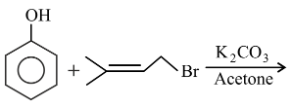
Login to view the detailed solution.
Given below are two statements:
Statement I : Ethyl pent-4-yn-oate on reaction with CH$$_3$$MgBr gives a 3°-alcohol.
Statement II : In this reaction one mole of ethyl pent-4-yn-oate utilizes two moles of CH$$_3$$MgBr.
In the light of the above statements, choose the most appropriate answer from the options given below:
Login to view the detailed solution.
Which one of the following reactions will not yield propanoic acid?
Login to view the detailed solution.

The correct structures of A and B formed in the following reactions are:
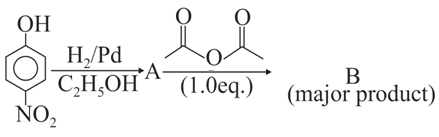
Login to view the detailed solution.
Which one of the following is the major product of the given reaction?
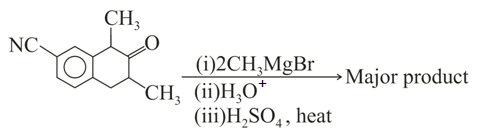
Login to view the detailed solution.
Which one of the following chemicals is responsible for the production of HCl in the stomach leading to irritation and pain?
Login to view the detailed solution.
_1.webp)
Which one of the following tests used for the identification of functional groups in organic compounds does not use copper reagent?
Login to view the detailed solution.
Hydrolysis of sucrose gives:
Login to view the detailed solution.
100 g of propane is completely reacted with 1000 g of oxygen. The mole fraction of carbon dioxide in the resulting mixture is $$x \times 10^{-2}$$. The value of $$x$$ is _________. (Nearest integer)
Login to view the detailed solution.
The number of photons emitted by a monochromatic (single frequency) infrared range finder of power 1 mW and wavelength of 1000 nm, in 0.1 second is $$x \times 10^{13}$$. The value of x is _________. (Nearest integer)
(h = $$6.63 \times 10^{-34}$$ Js, c = $$3.00 \times 10^8$$ ms$$^{-1}$$)
Login to view the detailed solution.
The number of species having non-pyramidal shape among the following is:
(A) SO$$_3$$
(B) NO$$_3^-$$
(C) PCl$$_3$$
(D) CO$$_3^{2-}$$
Login to view the detailed solution.
Two flasks I and II shown below are connected by a valve of negligible volume.
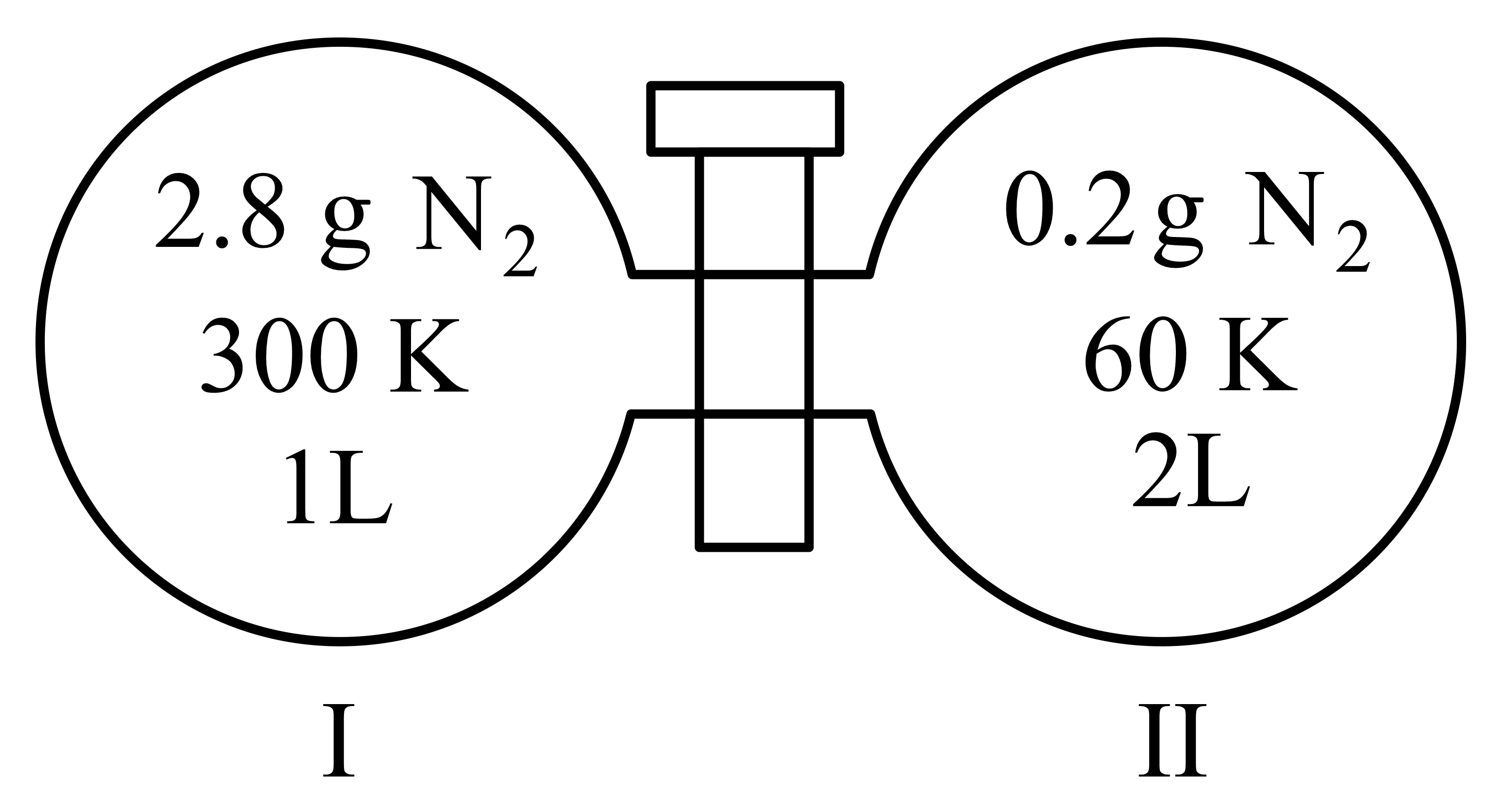
When the valve is opened, the final pressure of the system in bar is $$x \times 10^{-2}$$. The value of x is _________. (Integer answer)
[Assume : Ideal gas; 1 bar = $$10^5$$ Pa; Molar mass of N$$_2$$ = 28.0 mol$$^{-1}$$; R = 8.31 J mol$$^{-1}$$ K$$^{-1}$$]
Login to view the detailed solution.
Data given for the following reaction is as follows:
FeO$$_{(s)}$$ + C$$_{(graphite)}$$ $$\rightarrow$$ Fe$$_{(s)}$$ + CO$$_{(g)}$$
Substance $$\Delta_f H°$$(kJ mol$$^{-1}$$) $$\Delta S°$$(J mol$$^{-1}$$ K$$^{-1}$$)
FeO$$(s)$$ -266.3 57.49
C$$(graphite)$$ 0 5.74
Fe$$(s)$$ 0 27.28
CO$$(g)$$ -110.5 197.6
The minimum temperature in K at which the reaction becomes spontaneous is _________. (Integer answer)
Login to view the detailed solution.
When 5.1 g of solid NH$$_4$$HS is introduced into a two litre evacuated flask at 27°C, 20% of the solid decomposes into gaseous ammonia and hydrogen sulphide. The K$$_p$$ for the reaction at 27°C is $$x \times 10^{-2}$$. The value of x is _________. (Integer answer)
[Given 1R = 0.082 L atm K$$^{-1}$$ mol$$^{-1}$$]
Login to view the detailed solution.
40 g of glucose (Molar mass = 180) is mixed with 200 mL of water. The freezing point of solution is _________ K. (Nearest integer)
[Given : K$$_f$$ = 1.86 K kg mol$$^{-1}$$; Density of water = 1.00 g cm$$^{-3}$$; Freezing point of water = 273.15 K]
Login to view the detailed solution.
The resistance of conductivity cell with cell constant 1.14 cm$$^{-1}$$, containing 0.001M KCl at 298 K is 1500$$\Omega$$. The molar conductivity of 0.001M KCl solution at 298 K in S cm$$^2$$ mol$$^{-1}$$ is _________. (Integer answer)
Login to view the detailed solution.
The first order rate constant for the decomposition of CaCO$$_3$$ at 700 K is $$6.36 \times 10^{-3}$$ s$$^{-1}$$ and activation energy is 209 kJ mol$$^{-1}$$. Its rate constant (in s$$^{-1}$$) at 600 K is $$x \times 10^{-6}$$. The value of x is _________. (Nearest integer)
[Given R = 8.31 J K$$^{-1}$$ mol$$^{-1}$$; log $$6.36 \times 10^{-3}$$ = -2.19, $$10^{-4.79}$$ = $$1.62 \times 10^{-5}$$]
Login to view the detailed solution.
The number of optical isomers possible for [Cr(C$$_2$$O$$_4$$)$$_3$$]$$^{3-}$$ is:
Login to view the detailed solution.
Educational materials for JEE preparation
 Share
Share