NTA JEE Main 26th July 2022 Shift 2
For the following questions answer them individually
NTA JEE Main 26th July 2022 Shift 2 - Question 11
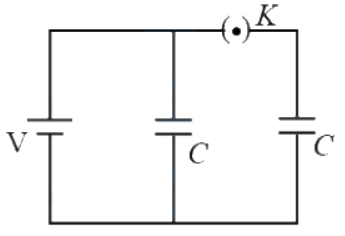
A source of potential difference $$V$$ is connected to the combination of two identical capacitors as shown in the figure. When key $$K$$ is closed, the total energy stored across the combination is $$E_1$$. Now key $$K$$ is opened and dielectric of dielectric constant $$5$$ is introduced between the plates of the capacitors. The total energy stored across the combination is now $$E_2$$. The ratio $$\dfrac{E_1}{E_2}$$ will be
NTA JEE Main 26th July 2022 Shift 2 - Question 12
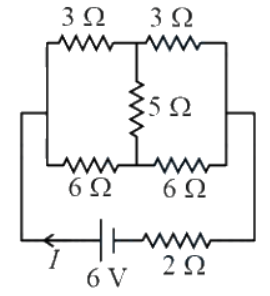
A battery of $$6 \text{ V}$$ is connected to the circuit as shown below. The current $$I$$ drawn from the battery is
NTA JEE Main 26th July 2022 Shift 2 - Question 13
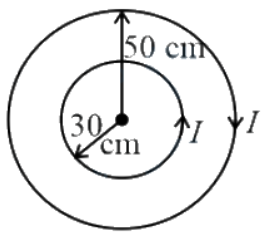
Two concentric circular loops of radii $$r_1 = 30 \text{ cm}$$ and $$r_2 = 50 \text{ cm}$$ are placed in $$X-Y$$ plane as shown in the figure. A current $$I = 7 \text{ A}$$ is flowing through them in the direction as shown in figure. The net magnetic moment of this system of two circular loops is approximately

NTA JEE Main 26th July 2022 Shift 2 - Question 14
A velocity selector consists of electric field $$\vec{E} = E\hat{k}$$ and magnetic field $$\vec{B} = B\hat{j}$$ with $$B = 12 \text{ mT}$$. The value $$E$$ required for an electron of energy $$728 \text{ eV}$$ moving along the positive x-axis to pass undeflected is (Given, mass of electron $$= 9.1 \times 10^{-31} \text{ kg}$$)
NTA JEE Main 26th July 2022 Shift 2 - Question 15
The oscillating magnetic field in a plane electromagnetic wave is given by $$B_y = 5 \times 10^{-6} \sin[1000\pi(5x - 4 \times 10^8 t)] \text{ T}$$. The amplitude of electric field will be
NTA JEE Main 26th July 2022 Shift 2 - Question 16
Light travels in two media $$M_1$$ and $$M_2$$ with speeds $$1.5 \times 10^8 \text{ m s}^{-1}$$ and $$2.0 \times 10^8 \text{ m s}^{-1}$$ respectively. The critical angle between them is
NTA JEE Main 26th July 2022 Shift 2 - Question 17
A nucleus of mass $$M$$ at rest splits into two parts having masses $$\dfrac{M'}{3}$$ and $$\dfrac{2M'}{3}$$ ($$M' < M$$). The ratio of de Broglie wavelength of two parts will be
NTA JEE Main 26th July 2022 Shift 2 - Question 18
Mass numbers of two nuclei are in the ratio of $$4:3$$. Their nuclear densities will be in the ratio of
NTA JEE Main 26th July 2022 Shift 2 - Question 19
The maximum and minimum voltage of an amplitude modulated signal are $$60 \text{ V}$$ and $$20 \text{ V}$$ respectively. The percentage modulation index will be
NTA JEE Main 26th July 2022 Shift 2 - Question 20
In a Vernier Caliper 10 divisions of Vernier scale is equal to the 9 divisions of main scale. When both jaws of Vernier calipers touch each other, the zero of the Vernier scale is shifted to the left of zero of the main scale and 4th Vernier scale division exactly coincides with the main scale reading. One main scale division is equal to $$1 \text{ mm}$$. While measuring diameter of a spherical body, the body is held between two jaws. It is now observed that zero of the Vernier scale lies between 30 and 31 divisions of main scale reading and 6th Vernier scale division exactly coincides with the main scale reading. The diameter of the spherical body will be: