NTA JEE Main 26th July 2022 Shift 2
For the following questions answer them individually
NTA JEE Main 26th July 2022 Shift 2 - Question 1
Two projectiles are thrown with same initial velocity making an angle of $$45°$$ and $$30°$$ with the horizontal respectively. The ratio of their respective ranges will be
NTA JEE Main 26th July 2022 Shift 2 - Question 2
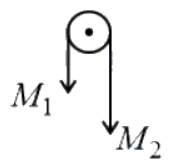
Two masses $$M_1$$ and $$M_2$$ are tied together at the two ends of a light inextensible string that passes over a frictionless pulley. When the mass $$M_2$$ is twice that of $$M_1$$, the acceleration of the system is $$a_1$$. When the mass $$M_2$$ is thrice that of $$M_1$$, the acceleration of the system is $$a_2$$. The ratio $$\dfrac{a_1}{a_2}$$ will be
NTA JEE Main 26th July 2022 Shift 2 - Question 3
A ball of mass $$0.15 \text{ kg}$$ hits the wall with its initial speed of $$12 \text{ m s}^{-1}$$ and bounces back without changing its initial speed. If the force applied by the wall on the ball during the contact is $$100 \text{ N}$$, calculate the time duration of the contact of ball with the wall.

NTA JEE Main 26th July 2022 Shift 2 - Question 4
A body of mass $$8 \text{ kg}$$ and another of mass $$2 \text{ kg}$$ are moving with equal kinetic energy. The ratio of their respective momenta will be
NTA JEE Main 26th July 2022 Shift 2 - Question 5
A body is projected vertically upwards from the surface of earth with a velocity equal to one third of escape velocity. The maximum height attained by the body will be (Take radius of earth $$= 6400 \text{ km}$$ and $$g = 10 \text{ m s}^{-2}$$)
NTA JEE Main 26th July 2022 Shift 2 - Question 6
The area of cross section of the rope used to lift a load by a crane is $$2.5 \times 10^{-4} \text{ m}^2$$. The maximum lifting capacity of the crane is 10 metric tons. To increase the lifting capacity of the crane to 25 metric tons, the required area of cross section of the rope should be (take $$g = 10 \text{ m s}^{-2}$$)
NTA JEE Main 26th July 2022 Shift 2 - Question 7
An ice cube of dimensions $$60 \text{ cm} \times 50 \text{ cm} \times 20 \text{ cm}$$ is placed in an insulation box of wall thickness $$1 \text{ cm}$$. The box keeping the ice cube at $$0°C$$ of temperature is brought to a room of temperature $$40°C$$. The rate of melting of ice is approximately: (Latent heat of fusion of ice is $$3.4 \times 10^5 \text{ J kg}^{-1}$$ and thermal conductivity of insulation wall is $$0.05 \text{ W m}^{-1} °C^{-1}$$)
NTA JEE Main 26th July 2022 Shift 2 - Question 8
A gas has $$n$$ degrees of freedom. The ratio of specific heat of gas at constant volume to the specific heat of gas at constant pressure will be
NTA JEE Main 26th July 2022 Shift 2 - Question 9
A transverse wave is represented by $$y = 2\sin(\omega t - kx) \text{ cm}$$. The value of wavelength (in cm) for which the wave velocity becomes equal to the maximum particle velocity, will be
NTA JEE Main 26th July 2022 Shift 2 - Question 10
Two uniformly charged spherical conductors $$A$$ and $$B$$ of radii $$5 \text{ mm}$$ and $$10 \text{ mm}$$ are separated by a distance of $$2 \text{ cm}$$. If the spheres are connected by a conducting wire, then in equilibrium condition, the ratio of the magnitudes of the electric fields at the surface of the sphere $$A$$ and $$B$$ will be