NTA JEE Main 25th July 2021 Shift 1
For the following questions answer them individually
NTA JEE Main 25th July 2021 Shift 1 - Question 1
Match List I with List II.
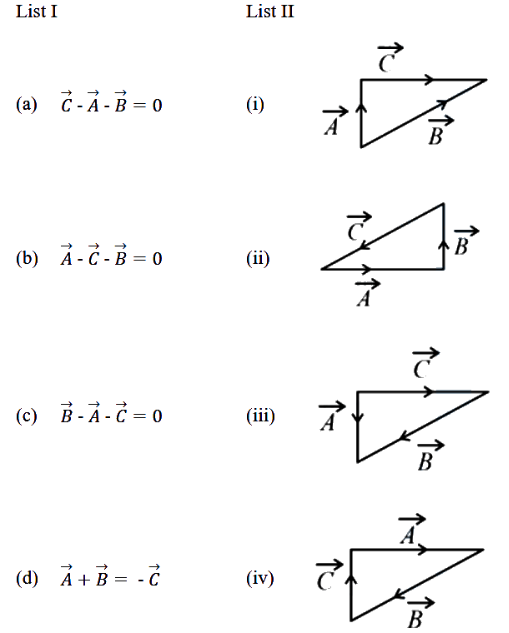
Choose the correct answer from the options given below:
NTA JEE Main 25th July 2021 Shift 1 - Question 2
Water droplets are coming from an open tap at a particular rate. The spacing between a droplet observed at 4$$^{th}$$ second after its fall to the next droplet is 34.3 m. At what rate the droplets are coming from the tap? (Take $$g = 9.8$$ m s$$^{-2}$$)
NTA JEE Main 25th July 2021 Shift 1 - Question 3
Two billiard balls of equal mass 30 g strike a rigid wall with same speed of 108 kmph (as shown) but at different angles. If the balls get reflected with the same speed, then the ratio of the magnitude of impulses imparted to ball a and ball b by the wall along X direction is: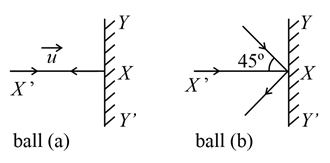

NTA JEE Main 25th July 2021 Shift 1 - Question 4
Given below are two statements: one is labelled as Assertion A and the other is labelled as Reason R.
Assertion A: Moment of inertia of a circular disc of mass M and radius R about X, Y axes (passing through its plane) and Z-axis which is perpendicular to its plane were found to be $$I_x$$, $$I_y$$ and $$I_z$$, respectively. The respective radii of gyration about all the three axes will be the same.
Reason R: A rigid body making rotational motion has fixed mass and shape. In the light of the above statements, choose the most appropriate answer from the options given below:
NTA JEE Main 25th July 2021 Shift 1 - Question 5
The minimum and maximum distances of a planet revolving around the Sun are $$x_1$$ and $$x_2$$. If the minimum speed of the planet on its trajectory is $$v_0$$, then its maximum speed will be:
NTA JEE Main 25th July 2021 Shift 1 - Question 6
Two wires of same length and radius are joined end to end and loaded. The Young's moduli of the materials of the two wires are $$Y_1$$ and $$Y_2$$. The combination behaves as a single wire then its Young's modulus is:
NTA JEE Main 25th July 2021 Shift 1 - Question 7
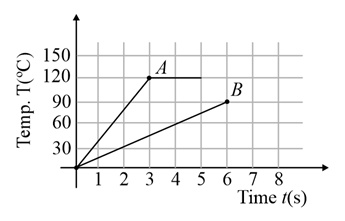
Two different metal bodies A and B of equal mass are heated at a uniform rate under similar conditions. The variation of temperature of the bodies is graphically represented as shown in the figure. The ratio of specific heat capacities is:
NTA JEE Main 25th July 2021 Shift 1 - Question 8
A monoatomic ideal gas, initially at temperature $$T_1$$ is enclosed in a cylinder fitted with a frictionless piston. The gas is allowed to expand adiabatically to a temperature $$T_2$$ by releasing the piston suddenly. If $$l_1$$ and $$l_2$$ are the lengths of the gas column, before and after the expansion respectively, then the value of $$\frac{T_1}{T_2}$$ will be:
NTA JEE Main 25th July 2021 Shift 1 - Question 9
For a gas $$C_P - C_V = R$$ in a state P and $$C_P - C_V = 1.10R$$ in a state Q. $$T_P$$ and $$T_Q$$ are the temperatures in two different states P and Q, respectively. Then
NTA JEE Main 25th July 2021 Shift 1 - Question 10
A parallel plate capacitor with plate area 'A' and distance of separation 'd' is filled with a dielectric. What is the capacity of the capacitor when permittivity of the dielectric varies as:
$$\varepsilon_x = \varepsilon_0 + kx$$, for $$0 < x \le \frac{d}{2}$$
$$\varepsilon_x = \varepsilon_0 + k(d-x)$$, for $$\frac{d}{2} \le x \le d$$