NTA JEE Main 25th February 2021 Shift 2
For the following questions answer them individually
NTA JEE Main 25th February 2021 Shift 2 - Question 11
An electron with kinetic energy $$K_1$$ enters between parallel plates of a capacitor at an angle $$\alpha$$ with the plates. It leaves the plates at angle $$\beta$$ with kinetic energy $$K_2$$. Then the ratio of kinetic energies $$K_1 : K_2$$ will be:
NTA JEE Main 25th February 2021 Shift 2 - Question 12
Match List I with List II.
| List I | List II |
|---|---|
| (a) Rectifier | (i) Used either for stepping up or stepping down the A.C. voltage |
| (b) Stabilizer | (ii) Used to convert A.C. voltage into D.C. voltage |
| (c) Transformer | (iii) Used to remove any ripple in the rectified output voltage |
| (d) Filter | (iv) Used for constant output voltage even when the input voltage or load current change |
Choose the correct answer from the options given below:
NTA JEE Main 25th February 2021 Shift 2 - Question 13
An L.C.R. circuit contains resistance of 110 $$\Omega$$ and a supply of 220 V at 300 rad s$$^{-1}$$ angular frequency. If only capacitance is removed from the circuit, current lags behind the voltage by 45°. If on the other hand, only the inductor is removed the current leads by 45° with the applied voltage. The R.M.S. current flowing in the circuit will be:

NTA JEE Main 25th February 2021 Shift 2 - Question 14
Consider the diffraction pattern obtained from the sunlight incident on a pinhole of diameter 0.1 $$\mu$$m. If the diameter of the pinhole is slightly increased, it will affect the diffraction pattern such that
NTA JEE Main 25th February 2021 Shift 2 - Question 15
An electron of mass $$m_e$$ and a proton of mass $$m_p = 1836 m_e$$ are moving with the same speed. The ratio of their de Broglie wavelength $$\frac{\lambda_{electron}}{\lambda_{proton}}$$ will be:
NTA JEE Main 25th February 2021 Shift 2 - Question 16
The stopping potential for electrons emitted from a photosensitive surface illuminated by light of wavelength 491 nm is 0.710 V. When the incident wavelength is changed to a new value, the stopping potential is 1.43 V. The new wavelength is:
NTA JEE Main 25th February 2021 Shift 2 - Question 17
The wavelength of the photon emitted by a hydrogen atom when an electron makes a transition from $$n = 2$$ to $$n = 1$$ state is:
NTA JEE Main 25th February 2021 Shift 2 - Question 18
The truth table for the following logic circuit is: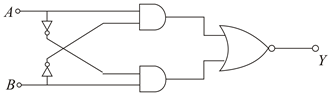
NTA JEE Main 25th February 2021 Shift 2 - Question 19
For extrinsic semiconductors; when doping level is increased;
NTA JEE Main 25th February 2021 Shift 2 - Question 20
If a message signal of frequency $$f_m$$ is amplitude modulated with a carrier signal of frequency $$f_c$$ and radiated through an antenna, the wavelength of the corresponding signal in air is