NTA JEE Main 25th February 2021 Shift 2
For the following questions answer them individually
NTA JEE Main 25th February 2021 Shift 2 - Question 1
If $$e$$ is the electronic charge, $$c$$ is the speed of light in free space and $$h$$ is Planck's constant, the quantity $$\frac{1}{4\pi\varepsilon_0} \frac{|e|^2}{hc}$$ has dimensions of:
NTA JEE Main 25th February 2021 Shift 2 - Question 2
A stone is dropped from the top of a building. When it crosses a point 5 m below the top, another stone starts to fall from a point 25 m below the top. Both stones reach the bottom of building simultaneously. The height of the building is:
NTA JEE Main 25th February 2021 Shift 2 - Question 3
A sphere of radius $$a$$ and mass $$m$$ rolls along a horizontal plane with constant speed $$v_0$$. It encounters an inclined plane at angle $$\theta$$ and climbs upward. Assuming that it rolls without slipping, how far up the sphere will travel?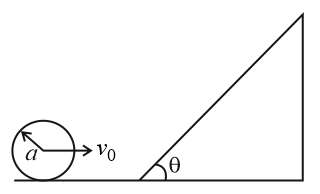

NTA JEE Main 25th February 2021 Shift 2 - Question 4
Thermodynamic process is shown below on a $$P-V$$ diagram for one mole of an ideal gas. If $$V_2 = 2V_1$$, then the ratio of temperature $$\frac{T_2}{T_1}$$ is: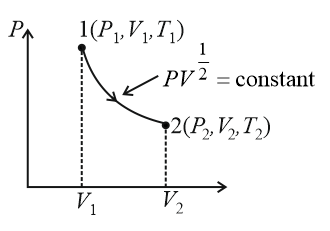
NTA JEE Main 25th February 2021 Shift 2 - Question 5
Given below are two statements:
Statement I: In a diatomic molecule, the rotational energy at a given temperature obeys Maxwell's distribution.
Statement II: In a diatomic molecule, the rotational energy at a given temperature equals the translational kinetic energy for each molecule.
In the light of the above statements, choose the correct answer from the options given below:
NTA JEE Main 25th February 2021 Shift 2 - Question 6
Two identical springs of spring constant $$2k$$ are attached to a block of mass $$m$$ and to fixed support (see figure). When the mass is displaced from equilibrium position on either side, it executes simple harmonic motion. The time period of oscillations of this system is: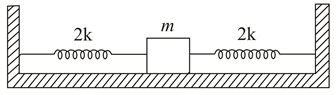
NTA JEE Main 25th February 2021 Shift 2 - Question 7
The point $$A$$ moves with a uniform speed along the circumference of a circle of radius 0.36 m and covers 30° in 0.1 s. The perpendicular projection $$P$$ from $$A$$ on the diameter $$MN$$ represents the simple harmonic motion of $$P$$. The restoration force per unit mass when $$P$$ touches $$M$$ will be: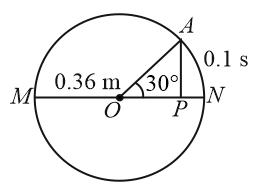
NTA JEE Main 25th February 2021 Shift 2 - Question 8
$$Y = A\sin(\omega t + \phi_0)$$ is the time-displacement equation of a SHM. At $$t = 0$$ the displacement of the particle is $$Y = \frac{A}{2}$$ and it is moving along negative $$x$$-direction. Then the initial phase angle $$\phi_0$$ will be:
NTA JEE Main 25th February 2021 Shift 2 - Question 9
A charge $$q$$ is placed at one corner of a cube as shown in figure. The flux of electrostatic field $$\vec{E}$$ through the shaded area is: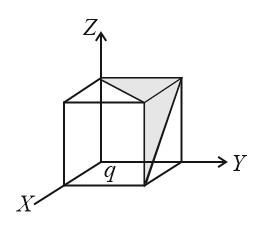
NTA JEE Main 25th February 2021 Shift 2 - Question 10
In a ferromagnetic material, below the curie temperature, a domain is defined as: