For the following questions answer them individually
The period of oscillation of a simple pendulum is $$T = 2\pi\sqrt{\frac{L}{g}}$$. Measured value of $$L$$ is 1.0 m from meter scale having a minimum division of 1 mm and time of one complete oscillation is 1.95 s measured from stopwatch of 0.01 s resolution. The percentage error in the determination of $$g$$ will be:
A particle is projected with velocity $$v_0$$ along $$x$$-axis. A damping force is acting on the particle which is proportional to the square of the distance from the origin i.e. $$ma = -\alpha x^2$$. The distance at which the particle stops:
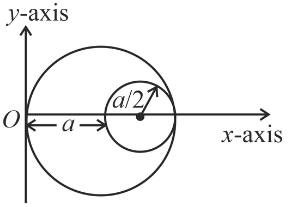
A circular hole of radius $$\frac{a}{2}$$ is cut out of a circular disc of radius $$a$$ as shown in figure. The centroid of the remaining circular portion with respect to point O will be:
A body weighs 49 N on a spring balance at the north pole. What will be its weight recorded on the same weighing machine, if it is shifted to the equator?
[Use $$g = \frac{GM}{R^2} = 9.8$$ m s$$^{-2}$$ and radius of earth, $$R = 6400$$ km.]
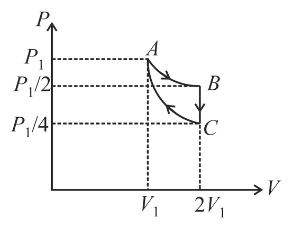
If one mole of an ideal gas at $$(P_1, V_1)$$ is allowed to expand reversibly and isothermally (A to B) its pressure is reduced to one-half of the original pressure (see figure). This is followed by a constant volume cooling till its pressure is reduced to one-fourth of the initial value $$(B \to C)$$. Then it is restored to its initial state by a reversible adiabatic compression (C to A). The net work done by the gas is equal to:
On the basis of kinetic theory of gases, the gas exerts pressure because its molecules:
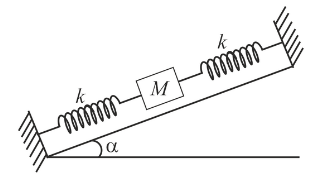
In the given figure, a body of mass $$M$$ is held between two massless springs, on a smooth inclined plane. The free ends of the springs are attached to firm supports. If each spring has spring constant $$k$$, the frequency of oscillation of given body is:
When a particle executes SHM, the nature of graphical representation of velocity as a function of displacement is:
Which of the following equations represents a travelling wave?
Two electrons each are fixed at a distance 2d. A third charge proton placed at the midpoint is displaced slightly by a distance $$x (x \ll d)$$ perpendicular to the line joining the two fixed charges. Proton will execute simple harmonic motion having angular frequency:
($$m$$ = mass of charged particle)
A soft ferromagnetic material is placed in an external magnetic field. The magnetic domains:
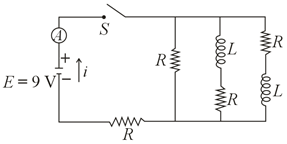
The figure shows a circuit that contains four identical resistors with resistance $$R = 2.0$$ $$\Omega$$, two identical inductors with inductance $$L = 2.0$$ mH and an ideal battery with E.M.F. $$E = 9$$ V. The current $$i$$ just after the switch $$S$$ is closed will be:
An X-ray tube is operated at 1.24 million volt. The shortest wavelength of the produced photon will be:
Match List - I with List - II.
| List-I | List-II |
|---|---|
| (a) Source of microwave frequency | (i) Radioactive decay of nucleus |
| (b) Source of infrared frequency | (ii) Magnetron |
| (c) Source of Gamma Rays | (iii) Inner shell electrons |
| (d) Source of X-rays | (iv) Vibration of atoms and molecules |
| (v) LASER | |
| (vi) RC circuit |
If the source of light used in a Young's double slit experiment is changed from red to violet:
The de Broglie wavelength of a proton and $$\alpha$$-particle are equal. The ratio of their velocities is
According to Bohr atom model, in which of the following transitions will the frequency be maximum?
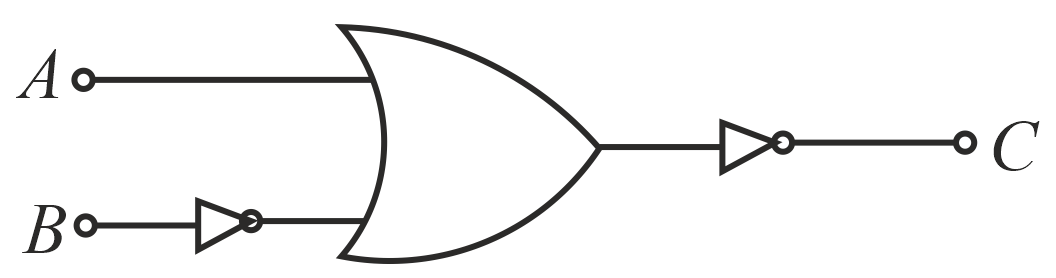
The logic circuit shown above is equivalent to:
Zener breakdown occurs in a $$p - n$$ junction having $$p$$ and $$n$$ both:
Given below are two statements:
Statement I: $$p - n$$ junction diodes can be used to function as a transistor, simply by connecting two diodes, back to back, which acts as the base terminal.
Statement II: In the study of transistors, the amplification factor $$\beta$$ indicates ratio of the collector current to the base current.
In the light of the above statements, choose the correct answer from the options given below.
Two solids $$A$$ and $$B$$ of mass 1 kg and 2 kg respectively are moving with equal linear momentum. The ratio of their kinetic energies $$(K.E.)_A : (K.E.)_B$$ will be $$\frac{A}{1}$$, so the value of $$A$$ will be ______.
A uniform thin bar of mass 6 kg and length 2.4 meter is bent to make an equilateral hexagon. The moment of inertia about an axis passing through the centre of mass and perpendicular to the plane of hexagon is ______ $$\times 10^{-1}$$ kg m$$^2$$.
A uniform metallic wire is elongated by 0.04 m when subjected to a linear force $$F$$. The elongation, if its length and diameter is doubled and subjected to the same force will be ______ cm.
The root-mean-square speed of molecules of a given mass of a gas at 27°C and 1 atmosphere pressure is 200 m s$$^{-1}$$. The root-mean-square speed of molecules of the gas at 127°C and 2 atmosphere pressure is $$\frac{x}{\sqrt{3}}$$ m s$$^{-1}$$. The value of $$x$$ will be ______.
Two cars are approaching each other at an equal speed of 7.2 km hr$$^{-1}$$. When they see each other, both blow horns having a frequency of 676 Hz. The beat frequency heard by each driver will be ______ Hz. [Velocity of sound in air is 340 m s$$^{-1}$$.]
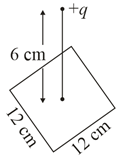
A point charge of $$+12$$ $$\mu C$$ is at a distance 6 cm vertically above the centre of a square of side 12 cm as shown in figure. The magnitude of the electric flux through the square will be ______ $$\times 10^3$$ N m$$^2$$ C$$^{-1}$$.
A cylindrical wire of radius 0.5 mm and conductivity $$5 \times 10^7$$ S m$$^{-1}$$ is subjected to an electric field of 10 mV m$$^{-1}$$. The expected value of current in the wire will be $$x^3\pi$$ mA. The value of $$x$$ is ______.
A series LCR circuit is designed to resonate at an angular frequency $$\omega_0 = 10^5$$ rad s$$^{-1}$$. The circuit draws 16 W power from 120 V source at resonance. The value of resistance $$R$$ in the circuit is ______ $$\Omega$$.
An electromagnetic wave of frequency 3 GHz enters a dielectric medium of relative electric permittivity 2.25 from vacuum. The wavelength of this wave in that medium will be ______ $$\times 10^{-2}$$ cm.
A signal of 0.1 kW is transmitted in a cable. The attenuation of cable is $$-5$$ dB per km and cable length is 20 km. The power received at the receiver is $$10^{-x}$$ W. The value of $$x$$ is ______. [Gain in dB = $$10 \log_{10}\left(\frac{P_O}{P_i}\right)$$]