NTA JEE Main 22nd April 2013 Online
For the following questions answer them individually
NTA JEE Main 22nd April 2013 Online - Question 1
The dimensions of angular momentum, latent heat and capacitance are, respectively.
NTA JEE Main 22nd April 2013 Online - Question 2
A ball projected from ground at an angle of 45° just clears a wall in front. If point of projection is 4 m from the foot of wall and ball strikes the ground at a distance of 6 m on the other side of the wall, the height of the wall is :
NTA JEE Main 22nd April 2013 Online - Question 3
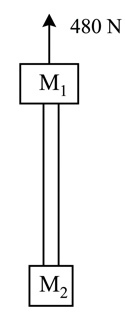
Two blocks of mass $$M_1 = 20$$ kg and $$M_2 = 12$$ kg are connected by a metal rod of mass 8 kg. The system is pulled vertically up by applying a force of 480 N as shown. The tension at the mid-point of the rod is:

NTA JEE Main 22nd April 2013 Online - Question 4
A body starts from rest on a long inclined plane of slope 45°. The coefficient of friction between the body and the plane varies as $$\mu = 0.3x$$, where x is distance travelled down the plane. The body will have maximum speed (for $$g = 10$$ m/s$$^2$$) when $$x$$ =
NTA JEE Main 22nd April 2013 Online - Question 5
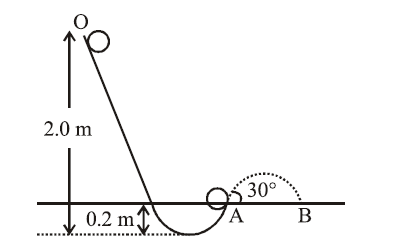
A tennis ball (treated as hollow spherical shell) starting from O rolls down a hill. At point A the ball becomes air borne leaving at an angle of 30° with the horizontal. The ball strikes the ground at B. What is the value of the distance AB? (Moment of inertia of a spherical shell of mass m and radius R about its diameter = $$\frac{2}{3}mR^2$$)
NTA JEE Main 22nd April 2013 Online - Question 6
The change in the value of acceleration of earth towards sun, when the moon comes from the position of solar eclipse to the position on the other side of earth in line with sun is: (mass of the moon = $$7.36 \times 10^{22}$$ kg, radius of the moon's orbit = $$3.8 \times 10^8$$ m).
NTA JEE Main 22nd April 2013 Online - Question 7
A uniform wire (Young's modulus $$2 \times 10^{11}$$ Nm$$^{-2}$$) is subjected to longitudinal tensile stress of $$5 \times 10^7$$ Nm$$^{-2}$$. If the overall volume change in the wire is 0.02%, the fractional decrease in the radius of the wire is close to:
NTA JEE Main 22nd April 2013 Online - Question 8
Air of density 1.2 kg m$$^{-3}$$ is blowing across the horizontal wings of an aeroplane in such a way that its speeds above and below the wings are 150 ms$$^{-1}$$ and 100 ms$$^{-1}$$, respectively. The pressure difference between the upper and lower sides of the wings, is :
NTA JEE Main 22nd April 2013 Online - Question 9
Given that 1 g of water in liquid phase has volume 1 cm$$^3$$ and in vapour phase 1671 cm$$^3$$ at atmospheric pressure and the latent heat of vaporization of water is 2256 J/g; the change in the internal energy in joules for 1 g of water at 373 K when it changes from liquid phase to vapour phase at the same temperature is :
NTA JEE Main 22nd April 2013 Online - Question 10
An ideal gas at atmospheric pressure is adiabatically compressed so that its density becomes 32 times of its initial value. If the final pressure of gas is 128 atmospheres, the value of '$$\gamma$$' of the gas is :