NTA JEE Main 2025 April 8th Shift 2
For the following questions answer them individually
NTA JEE Main 2025 April 8th Shift 2 - Question 31
A concave-convex lens of refractive index $$1.5$$ and the radii of curvature of its surfaces are $$30 cm$$ and $$20 cm$$, respectively. The concave surface is upwards and is filled with a liquid of refractive index $$1.3$$. The focal length of the liquid-glass combination will be
NTA JEE Main 2025 April 8th Shift 2 - Question 32
An infinitely long wire has uniform linear charge density $$\lambda = 2$$ nC/m. The net flux through a Gaussian cube of side length $$\sqrt{3}$$ cm, if the wire passes through two corners of the cube that are maximally displaced from each other, would be $$x$$ Nm$$^2$$C$$^{-1}$$, where x is :
[Neglect any edge effects and use $$\frac{1}{4\pi\epsilon_0}= 9\times10^{9}$$ SI units]
NTA JEE Main 2025 April 8th Shift 2 - Question 33
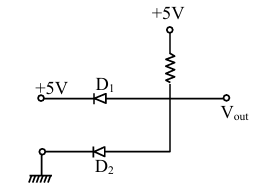
The output voltage in the following circuit is (Consider ideal diode case) :

NTA JEE Main 2025 April 8th Shift 2 - Question 34
Two metal spheres of radius R and 3R have same surface charge density $$\sigma$$. If they are brought in contact and then separated, the surface charge density on smaller and bigger sphere becomes $$\sigma_1$$ and $$\sigma_2$$, respectively. The ratio $$\frac{\sigma_1}{\sigma_2}$$ is :
NTA JEE Main 2025 April 8th Shift 2 - Question 35
A quantity Q is formulated as $$X^{-2}Y^{+\frac{3}{2}}Z^{-\frac{2}{5}}$$. X, Y and Z are independent parameters which have fractional errors of 0.1, 0.2 and 0.5, respectively in measurement. The maximum fractional error of Q is
NTA JEE Main 2025 April 8th Shift 2 - Question 36
A monoatomic gas having $$\gamma = \frac{5}{3}$$ is stored in a thermally insulated container and the gas is suddenly compressed to $$\left(\frac{1}{8}\right)^{\text{th}}$$ of its initial volume. The ratio of final pressure and initial pressure is :
($$\gamma$$ is the ratio of specific heats of the gas at constant pressure and at constant volume)
NTA JEE Main 2025 April 8th Shift 2 - Question 37
A convex lens of focal length 30 cm is placed in contact with a concave lens of focal length 20 cm. An object is placed at 20 cm to the left of this lens system. The distance of the image from the lens in cm is _____.
NTA JEE Main 2025 April 8th Shift 2 - Question 38
Two strings with circular cross section and made of same material, are stretched to have same amount of tension. A transverse wave is then made to pass through both the strings. The velocity of the wave in the first string having the radius of cross section R is $$v_1$$, and that in the other string having the radius of cross section R/2 is $$v_2$$. Then $$\frac{v_2}{v_1}$$ =
NTA JEE Main 2025 April 8th Shift 2 - Question 39
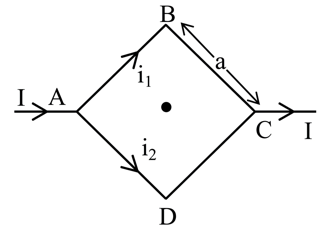
Figure shows a current carrying square loop ABCD of edge length 'a' lying in a plane. If the resistance of the ABC part is r and that of ADC part is 2r, then the magnitude of the resultant magnetic field at centre of the square loop is
NTA JEE Main 2025 April 8th Shift 2 - Question 40
A body of mass 2 kg moving with velocity of $$\vec{v}_{in} = 3\hat{i} + 4\hat{j}$$ ms$$^{-1}$$ enters into a constant force field of 6N directed along positive z-axis. If the body remains in the field for a period of $$\frac{5}{3}$$ seconds, then velocity of the body when it emerges from force field is