NTA JEE Main 2025 April 4th Shift 2
For the following questions answer them individually
NTA JEE Main 2025 April 4th Shift 2 - Question 51
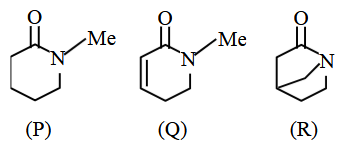
The correct order of basicity for the following molecules is :
NTA JEE Main 2025 April 4th Shift 2 - Question 52
The incorrect relationship in the following pairs in relation to ionisation enthalpies is :
NTA JEE Main 2025 April 4th Shift 2 - Question 53
Which among the following compounds give yellow solid when reacted with NaOI/NaOH?
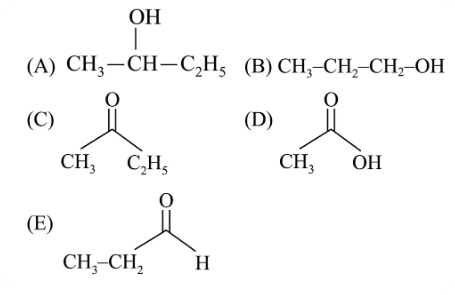
Choose the correct answer from the options given below :

NTA JEE Main 2025 April 4th Shift 2 - Question 54
A dipeptide, "x" on complete hydrolysis gives "y" and "z". "y" on treatment with aq. HNO$$_2$$ produces lactic acid. On the other hand "z" on heating gives a cyclic molecule.
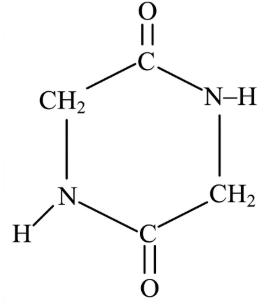
Based on the information given, the dipeptide X is:
NTA JEE Main 2025 April 4th Shift 2 - Question 55
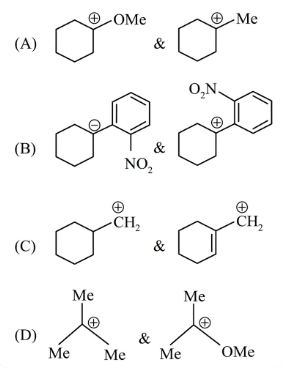
In which pairs, the first ion is more stable than the second?
NTA JEE Main 2025 April 4th Shift 2 - Question 56
Given below are two statements :
Statement (I) : Alcohols are formed when alkyl chlorides are treated with aqueous potassium hydroxide by elimination reaction.
Statement (II) : In alcoholic potassium hydroxide, alkyl chlorides form alkenes by abstracting the hydrogen from the $$\beta$$-carbon.
In the light of the above statements, choose the most appropriate answer from the option given below :
NTA JEE Main 2025 April 4th Shift 2 - Question 57
Given below are two statements :
Statement (I) : Molal depression constant $$K_f$$ is given by $$\frac{M_1 R T_f}{\Delta S_{fus}}$$, where symbols have their usual meaning.
Statement (II) : $$K_f$$ for benzene is less than the $$K_f$$ for water.
In the light of the above statements, choose the most appropriate answer from the options given below :
NTA JEE Main 2025 April 4th Shift 2 - Question 58
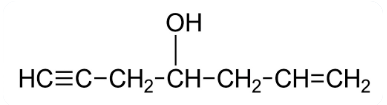
The IUPAC name of the following compound is :
NTA JEE Main 2025 April 4th Shift 2 - Question 59
Match List-I (Separation of) with List-II (Separation Technique) :
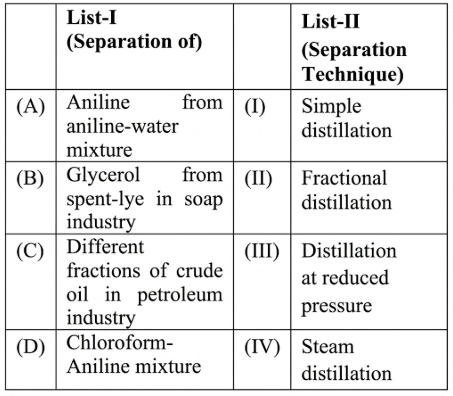
Choose the correct answer from the options given below :
NTA JEE Main 2025 April 4th Shift 2 - Question 60
A toxic compound "A" when reacted with NaCN in aqueous acidic medium yields an edible cooking component and food preservative 'B'. "B" is converted to "C" by diborane and can be used as an additive to petrol to reduce emission. "C" upon reaction with oleum at $$140^{\circ}$$ C yields an inhalable anesthetic "D". Identify "A", "B", "C" and "D", respectively.