NTA JEE Main 20th July 2021 Shift 1
For the following questions answer them individually
NTA JEE Main 20th July 2021 Shift 1 - Question 31
An inorganic Compound 'X' on treatment with concentrated H$$_2$$SO$$_4$$ produces brown fumes and gives dark brown ring with FeSO$$_4$$ in presence of concentrated H$$_2$$SO$$_4$$. Also Compound 'X' gives precipitate 'Y', when its solution in dilute HCl is treated with H$$_2$$S gas. The precipitate 'Y' on treatment with concentrated HNO$$_3$$ followed by excess of NH$$_4$$OH further gives deep blue coloured solution, Compound 'X' is:
NTA JEE Main 20th July 2021 Shift 1 - Question 32
The set in which compounds have different nature is:
NTA JEE Main 20th July 2021 Shift 1 - Question 33
The species given below that does NOT show disproportionation reaction is:

NTA JEE Main 20th July 2021 Shift 1 - Question 34
Given below are two statements : One is labelled as Assertion A and other is labelled as Reason R.
Assertion A : The dihedral angles in H$$_2$$O$$_2$$ in gaseous phase is 90.2$$^\circ$$ and in solid phase is 111.5$$^\circ$$.
Reason R : The change in dihedral angle in solid and gaseous phase is due to the difference in the intermolecular forces.
Choose the most appropriate answer from the options given below for A and R.
NTA JEE Main 20th July 2021 Shift 1 - Question 35
A s-block element (M) reacts with oxygen to form an oxide of the formula MO$$_2$$. The oxide is pale yellow in colour and paramagnetic. The element (M) is:
NTA JEE Main 20th July 2021 Shift 1 - Question 36
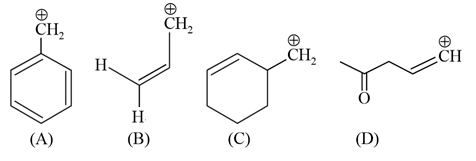
Among the given species the Resonance stabilised carbocations are:
NTA JEE Main 20th July 2021 Shift 1 - Question 37
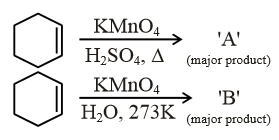
For above chemical reactions, identify the correct statement from the following:
NTA JEE Main 20th July 2021 Shift 1 - Question 38
Green chemistry in day-to-day life is in the use of:
NTA JEE Main 20th July 2021 Shift 1 - Question 39
Given below are two statements. One is labelled as Assertion A and the other is labelled as Reason R.
Assertion A : Sharp glass edge becomes smooth on heating it up to its melting point.
Reason R : The viscosity of glass decreases on melting.
Choose the most appropriate answer from the options given below.
NTA JEE Main 20th July 2021 Shift 1 - Question 40
The conditions given below are in the context of observing Tyndall effect in colloidal solutions:
(A) The diameter of the colloidal particles is comparable to the wavelength of light used.
(B) The diameter of the colloidal particles is much smaller than the wavelength of light used.
(C) The diameter of the colloidal particles is much larger than the wavelength of light used.
(D) The refractive indices of the dispersed phase and the dispersion medium are comparable.
(E) The dispersed phase has a very different refractive index from the dispersion medium. Choose the most appropriate conditions from the options given below: