NTA JEE Main 20th July 2021 Shift 1
For the following questions answer them individually
NTA JEE Main 20th July 2021 Shift 1 - Question 1
If $$\vec{A}$$ and $$\vec{B}$$ are two vectors satisfying the relation $$\vec{A} \cdot \vec{B} = |\vec{A} \times \vec{B}|$$. Then the value of $$|\vec{A} - \vec{B}|$$ will be:
NTA JEE Main 20th July 2021 Shift 1 - Question 2
A butterfly is flying with a velocity $$4\sqrt{2}$$ m s$$^{-1}$$ in north-east direction. Wind is slowly blowing at 1 m s$$^{-1}$$ from north to south. The resultant displacement of the butterfly in 3 seconds is:
NTA JEE Main 20th July 2021 Shift 1 - Question 3
The normal reaction $$N$$ for a vehicle of 800 kg mass, negotiating a turn on a 30$$^\circ$$ banked road at maximum possible speed without skidding is ___ $$\times 10^3$$ kg m s$$^{-2}$$.

NTA JEE Main 20th July 2021 Shift 1 - Question 4
A steel block of 10 kg rests on a horizontal floor as shown. When three iron cylinders are placed on it as shown, the block and cylinders go down with an acceleration 0.2 m s$$^{-2}$$. The normal reaction $$R'$$ by the floor if mass of the iron cylinders are equal and of 20 kg each is (in N),
[Take $$g = 10$$ m s$$^{-2}$$ and $$\mu_s = 0.2$$]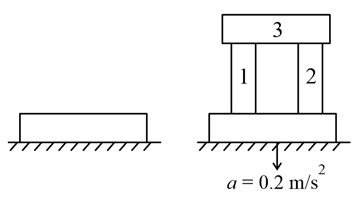
NTA JEE Main 20th July 2021 Shift 1 - Question 5
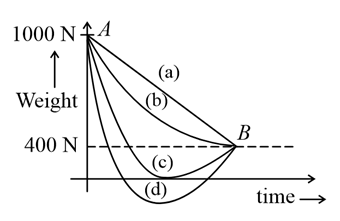
A person whose mass is 100 kg travels from Earth to Mars in a spaceship. Neglect all other objects in sky and take acceleration due to gravity on the surface of the Earth and Mars as 10 m s$$^{-2}$$ and 4 m s$$^{-2}$$, respectively. Identify from the below figures, the curve that fits best for the weight of the passenger as a function of time.
NTA JEE Main 20th July 2021 Shift 1 - Question 6
The value of tension in a long thin metal wire has been changed from $$T_1$$ to $$T_2$$. The lengths of the metal wire at two different values of tension $$T_1$$ and $$T_2$$ are $$\ell_1$$ and $$\ell_2$$, respectively. The actual length of the metal wire is:
NTA JEE Main 20th July 2021 Shift 1 - Question 7
The amount of heat needed to raise the temperature of 4 moles of a rigid diatomic gas from 0 $$^\circ$$C to 50 $$^\circ$$C when no work is done is ($$R$$ is the universal gas constant)
NTA JEE Main 20th July 2021 Shift 1 - Question 8
The entropy of any system is given by,
$$S = \alpha^2 \beta \ln\left[\frac{\mu kR}{J\beta^2} + 3\right]$$
where $$\alpha$$ and $$\beta$$ are the constants. $$\mu$$, $$J$$, $$k$$ and $$R$$ are number of moles, mechanical equivalent of heat, Boltzmann's constant and gas constant, respectively.
[Take $$S = \frac{dQ}{T}$$]
Choose the incorrect option from the following:
NTA JEE Main 20th July 2021 Shift 1 - Question 9
Consider a mixture of gas molecules of types A, B and C having masses $$m_A < m_B < m_C$$. The ratio of their root mean square speeds at normal temperature and pressure is:
NTA JEE Main 20th July 2021 Shift 1 - Question 10
A certain charge $$Q$$ is divided into two parts $$q$$ and $$(Q - q)$$. How should the charges $$Q$$ and $$q$$ be divided so that $$q$$ and $$(Q - q)$$ placed at a certain distance apart experience maximum electrostatic repulsion?