NTA JEE Main 20th July 2021 Shift 1
For the following questions answer them individually
NTA JEE Main 20th July 2021 Shift 1 - Question 11
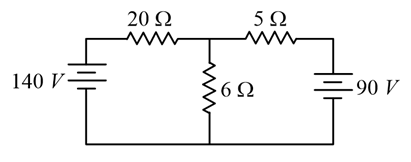
The value of current in the 6 $$\Omega$$ resistance is:
NTA JEE Main 20th July 2021 Shift 1 - Question 12
A current of 5 A is passing through a non-linear magnesium wire of cross-section 0.04 m$$^2$$. At every point the direction of current density is at an angle of 60$$^\circ$$ with the unit vector of area of cross-section. The magnitude of electric field at every point of the conductor is: (resistivity of magnesium $$\rho = 44 \times 10^{-8}$$ $$\Omega$$m)
NTA JEE Main 20th July 2021 Shift 1 - Question 13
A deuteron and an alpha particle having equal kinetic energy enter perpendicular into a magnetic field. Let $$r_d$$ and $$r_\alpha$$ be their respective radii of circular path. The value of $$\frac{r_d}{r_\alpha}$$ is equal to:

NTA JEE Main 20th July 2021 Shift 1 - Question 14
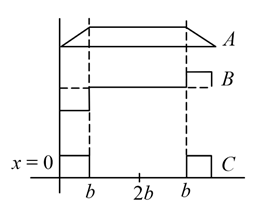
The arm PQ of a rectangular conductor is moving from $$x = 0$$ to $$x = 2b$$ outwards and then inwards from $$x = 2b$$ to $$x = 0$$ as shown in the figure. A uniform magnetic field perpendicular to the plane is acting from $$x = 0$$ to $$x = b$$. Identify the graph showing the variation of different quantities with distance: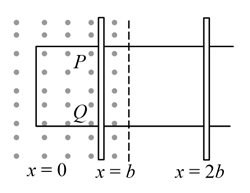
NTA JEE Main 20th July 2021 Shift 1 - Question 15
AC voltage $$V(t) = 20 \sin \omega t$$ of frequency 50 Hz is applied to a parallel plate capacitor. The separation between the plates is 2 mm and the area is 1 m$$^2$$. The amplitude of the oscillating displacement current for the applied AC voltage is [Take $$\varepsilon_0 = 8.85 \times 10^{-12}$$ F m$$^{-1}$$]
NTA JEE Main 20th July 2021 Shift 1 - Question 16
Region I and II are separated by a spherical surface of radius 25 cm. An object is kept in region I at a distance of 40 cm from the surface. The distance of the image from the surface is: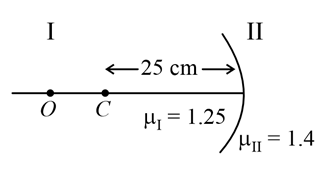
NTA JEE Main 20th July 2021 Shift 1 - Question 17
The radiation corresponding to $$3 \to 2$$ transition of a hydrogen atom falls on a gold surface to generate photoelectrons. These electrons are passed through a magnetic field of $$5 \times 10^{-4}$$ T. Assume that the radius of the largest circular path followed by these electrons is 7 mm, the work function of the metal is:
(Mass of electron $$= 9.1 \times 10^{-31}$$ kg)
NTA JEE Main 20th July 2021 Shift 1 - Question 18
A radioactive material decays by simultaneous emissions of two particles with half lives of 1400 years and 700 years, respectively. What will be the time after the which one third of the material remains? (Take ln 3 = 1.1)
NTA JEE Main 20th July 2021 Shift 1 - Question 19
A nucleus of mass $$M$$ emits $$\gamma$$-ray photon of frequency $$\nu$$. The loss of internal energy by the nucleus is: [Take $$c$$ as the speed of electromagnetic wave]
NTA JEE Main 20th July 2021 Shift 1 - Question 20
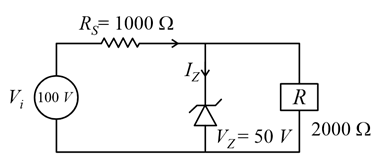
For the circuit shown below, calculate the value of $$I_z$$: