NTA JEE Main 17th March 2021 Shift 1
For the following questions answer them individually
NTA JEE Main 17th March 2021 Shift 1 - Question 1
A car accelerates from rest at a constant rate $$\alpha$$ for some time after which it decelerates at a constant rate $$\beta$$ to come to rest. If the total time elapsed is $$t$$ seconds, the total distance travelled is:
NTA JEE Main 17th March 2021 Shift 1 - Question 2
A modern grand-prix racing car of mass $$m$$ is travelling on a flat track in a circular arc of radius $$R$$ with a speed $$v$$. If the coefficient of static friction between the tyres and the track is $$\mu_s$$, then the magnitude of negative lift $$F_L$$ acting downwards on the car is: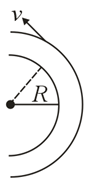
NTA JEE Main 17th March 2021 Shift 1 - Question 3
A boy is rolling a 0.5 kg ball on the frictionless floor with the speed of 20 m s$$^{-1}$$. The ball gets deflected by an obstacle on the way. After deflection it moves with 5% of its initial kinetic energy. What is the speed of the ball now?

NTA JEE Main 17th March 2021 Shift 1 - Question 4
A triangular plate is shown. A force $$\vec{F} = 4\hat{i} - 3\hat{j}$$ is applied at point $$P$$. The torque at point $$P$$ with respect to point $$O$$ and $$Q$$ are: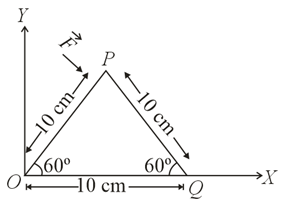
NTA JEE Main 17th March 2021 Shift 1 - Question 5
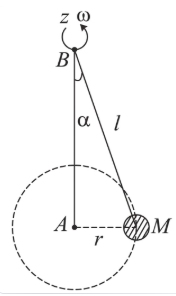
A mass $$M$$ hangs on a massless rod of length $$l$$ which rotates at a constant angular frequency. The mass $$M$$ moves with steady speed in a circular path of constant radius. Assume that the system is in steady circular motion with constant angular velocity $$\omega$$. The angular momentum of $$M$$ about point $$A$$ is $$L_A$$ which lies in the positive $$z$$ direction and the angular momentum of $$M$$ about $$B$$ is $$L_B$$. The correct statement for this system is:
NTA JEE Main 17th March 2021 Shift 1 - Question 6
When two soap bubbles of radii $$a$$ and $$b$$ ($$b > a$$) coalesce, the radius of curvature of common surface is:
NTA JEE Main 17th March 2021 Shift 1 - Question 7
Two identical metal wires of thermal conductivities $$K_1$$ and $$K_2$$ respectively are connected in series. The effective thermal conductivity of the combination is:
NTA JEE Main 17th March 2021 Shift 1 - Question 8
A Carnot's engine working between 400 K and 800 K has a work output of 1200 J per cycle. The amount of heat energy supplied to the engine from the source in each cycle is:
NTA JEE Main 17th March 2021 Shift 1 - Question 9
A polyatomic ideal gas has 24 vibrational modes. What is the value of $$\gamma$$?
NTA JEE Main 17th March 2021 Shift 1 - Question 10
Two ideal polyatomic gases at temperatures $$T_1$$ and $$T_2$$ are mixed so that there is no loss of energy. If $$F_1$$ and $$F_2$$, $$m_1$$ and $$m_2$$, $$n_1$$ and $$n_2$$ be the degrees of freedom, masses, number of molecules of the first and second gas respectively, the temperature of mixture of these two gases is: