For the following questions answer them individually
8 g of NaOH is dissolved in 18g of $$H_2O$$. Mole fraction of NaOH in solution and molality (in mol kg$$^{-1}$$) of the solution respectively are:
If the de Broglie wavelength of the electron in $$n^{th}$$ Bohr orbit in a hydrogenic atom is equal to $$1.5\pi a_0$$ ($$a_0$$ is Bohr radius), then the value of $$\frac{n}{z}$$ is:
The element that does not show catenation is
The correct order of atomic radii is:
The element that shows greater ability to form $$p\pi - p\pi$$ multiple bonds is:
An open vessel at $$27°C$$ is heated until two fifth of the air (assumed as an ideal gas) in it has escaped from the vessel. Assuming that the volume of the vessel remains constant, the temperature to which the vessel has heated is:
Given:
(i) C(graphite) + O$$_2$$(g) $$\to$$ CO$$_2$$(g); $$\Delta_r H^{\ominus} = x$$ kJ mol$$^{-1}$$,
(ii) C(graphite) + $$\frac{1}{2}$$O$$_2$$(g) $$\to$$ CO(g); $$\Delta_r H^{\ominus} = y$$ kJ mol$$^{-1}$$,
(iii) CO(g) + $$\frac{1}{2}$$O$$_2$$(g) $$\to$$ CO$$_2$$(g); $$\Delta_r H^{\ominus} = z$$ kJ mol$$^{-1}$$.
Based on the above thermochemical equations, find out which one of the following algebraic relationships is correct?
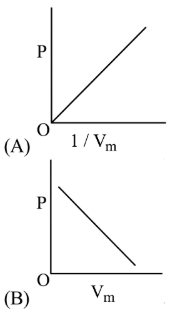
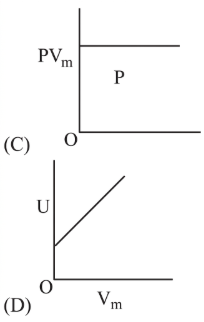
The combination of plots which does not represent isothermal expansion of an ideal gas is

If $$K_{sp}$$ of $$Ag_2CO_3$$ is $$8 \times 10^{-12}$$, the molar solubility of $$Ag_2CO_3$$ in 0.1 M $$AgNO_3$$ is:
The volume strength of 1M $$H_2O_2$$ is: (Molar mass of $$H_2O_2 = 34$$ g mol$$^{-1}$$)
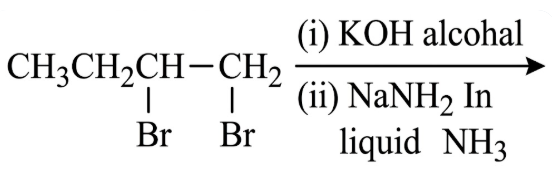
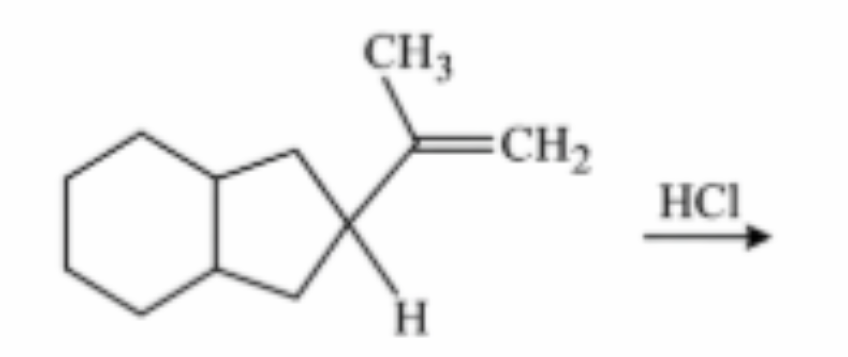
The major product of the following reaction is:Â
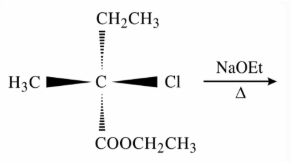
The major product of the following reaction is: (compound with Cl reacting with NaOEt/heat)
The compound that is NOT a common component of photochemical smog is:
The upper stratosphere consisting of the ozone layer, protects us from the sun's radiation that falls in the wavelength region of
Molecules of benzoic acid ($$C_6H_5COOH$$) dimerise in 30 g of benzene. 'w' g of benzoic acid shows a depression in freezing point equal to 2 K. If the percentage association of the acid to form dimer in the solution is 80, then w is: (Given that $$K_f = 5$$ K mol$$^{-1}$$, molar mass of benzoic acid = 122 g mol$$^{-1}$$)
$$\Lambda_m^°$$ for NaCl, HCl and NaA are 126.4, 425.9 and 100.5 S cm$$^2$$ mol$$^{-1}$$ respectively. If the conductivity of 0.001 M HA is $$5 \times 10^{-5}$$ S cm$$^{-1}$$, degree of dissociation of HA is
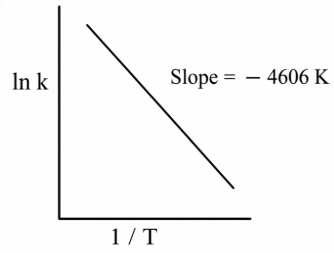
For a reaction, consider the plot of ln k versus 1/T given in the figure. If the rate constant of this reaction at 400 K is $$10^{-5} s^{-1}$$, then the rate constant at 500 K is:
Among the following, the false statement is:
The pair that does not require calcination is
Chlorine on reaction with hot and concentrated sodium hydroxide gives
The magnetic moment of an octahedral homoleptic Mn(II) complex is 5.9 B.M. The suitable ligand for this complex is:
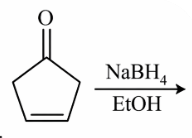
The major product of the following reaction is:Â
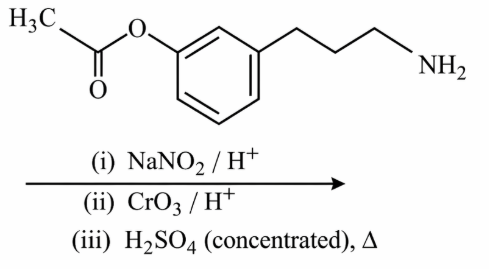
The major product in the following conversion is:
The major product of the following reaction is:Â
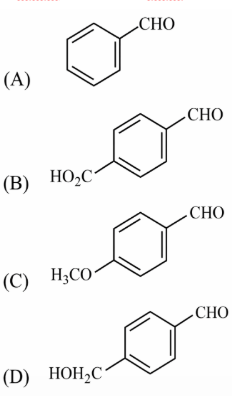
The aldehydes which will not form Grignard product with one equivalent of Grignard reagents are:
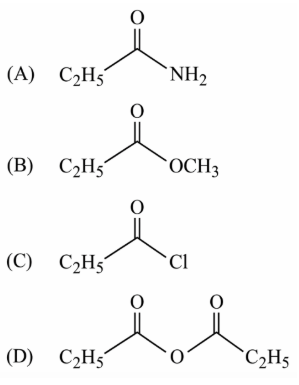
The increasing order of the reactivity of the following with LiAlH$$_4$$ is:
The major product of the following reaction is:Â
The two monomers for the synthesis of nylon 6,6 are
The correct statement(s) among I to III with respect to potassium ions that are abundant within the cell fluids, is/are: I. They activate many enzymes. II. They participate in the oxidation of glucose to produce ATP. III. Along with sodium ions, they are responsible for the transmission of nerve signals.
The correct structure of histidine in a strongly acidic solution (pH = 2) is