NTA JEE Main 10th January 2019 Shift 1
For the following questions answer them individually
NTA JEE Main 10th January 2019 Shift 1 - Question 21
An insulating thin rod of length $$l$$ has a linear charge density $$\rho(x) = \rho_0 \frac{x}{l}$$ on it. The rod is rotated about an axis passing through the origin ($$x = 0$$) and perpendicular to the rod. If the rod makes $$n$$ rotations per second, then the time averaged magnetic moment of the rod is:
NTA JEE Main 10th January 2019 Shift 1 - Question 22
A solid metal cube of edge length 2 cm is moving in the positive y-direction, at a constant speed of 6 m s$$^{-1}$$. There is a uniform magnetic field of 0.1 T in the positive z-direction. The potential difference between the two faces of the cube, perpendicular to the x-axis, is:
NTA JEE Main 10th January 2019 Shift 1 - Question 23
If the magnetic field of a plane electromagnetic wave is given by (The speed of light $$= 3 \times 10^8$$ m/s) $$B = 100 \times 10^{-6} \sin\left[2\pi \times 2 \times 10^{15}\left(t - \frac{x}{c}\right)\right]$$ then the maximum electric field associated with it is:

NTA JEE Main 10th January 2019 Shift 1 - Question 24
A plano-convex lens of refractive index $$\mu_1$$ and focal length $$f_1$$ is kept in contact with another plano-concave lens of refractive index $$\mu_2$$ and focal length $$f_2$$. If the radius of curvature of their spherical faces is $$R$$ each and $$f_1 = 2f_2$$, the $$\mu_1$$ and $$\mu_2$$ are related as:
NTA JEE Main 10th January 2019 Shift 1 - Question 25
In a Young's double slit experiment slit separation 0.1 mm, one observes a bright fringe at angle $$\frac{1}{40}$$ rad by using light of wavelength $$\lambda_1$$. When the light of wavelength $$\lambda_2$$ is used a bright fringe is seen at the same angle in the same set up. Given that $$\lambda_1$$ and $$\lambda_2$$ are in visible range (380 nm to 740 nm), their values are:
NTA JEE Main 10th January 2019 Shift 1 - Question 26
In an electron microscope, the resolution that can be achieved is of the order of the wavelength of electrons used. To resolve a width of $$7.5 \times 10^{-12}$$ m, the minimum electron energy required is close to:
NTA JEE Main 10th January 2019 Shift 1 - Question 27
Using a nuclear counter the count rate of emitted particles from a radioactive source is measured. At $$t = 0$$ it was 1600 counts per second and $$t = 8$$ seconds it was 100 counts per second. The count rate observed, as counts per second, at $$t = 6$$ seconds is close to:
NTA JEE Main 10th January 2019 Shift 1 - Question 28
To get output '1' at R, for the given logic gate circuit the input values must be: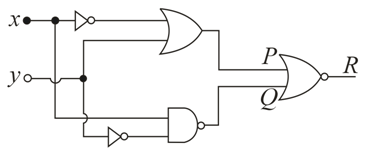
NTA JEE Main 10th January 2019 Shift 1 - Question 29
A TV transmission tower has a height of 140 m and the height of the receiving antenna is 40 m. What is the maximum distance upto which signals can be broadcasted from this tower in LOS (Line of Sight) mode? (Given: radius of earth $$= 6.4 \times 10^6$$ m).
NTA JEE Main 10th January 2019 Shift 1 - Question 30
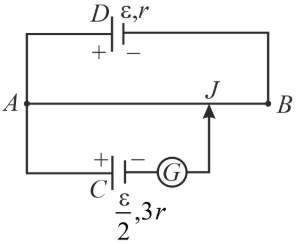
A potentiometer wire AB having length $$L$$ and resistance $$12r$$ is joined to a cell D of emf $$\varepsilon$$ and internal resistance $$r$$. A cell C having EMF $$\varepsilon/2$$ and internal resistance $$3r$$ is connected. The length AJ, at which the galvanometer, as shown in the figure, shows no deflection is: