NTA JEE Main 10th April 2023 Shift 2
For the following questions answer them individually
NTA JEE Main 10th April 2023 Shift 2 - Question 81
The sum of all the four-digit numbers that can be formed using all the digits 2, 1, 2, 3 is equal to _______.
789
456
123
0.-
Clear All
NTA JEE Main 10th April 2023 Shift 2 - Question 82
Suppose $$a_1, a_2, 2, a_3, a_4$$ be in an arithmetico-geometric progression. If the common ratio of the corresponding geometric progression is 2 and the sum of all 5 terms of the arithmetico-geometric progression is $$\frac{49}{2}$$, then $$a_4$$ is equal to _______.
789
456
123
0.-
Clear All
NTA JEE Main 10th April 2023 Shift 2 - Question 83
Let the equations of two adjacent sides of a parallelogram $$ABCD$$ be $$2x - 3y = -23$$ and $$5x + 4y = 23$$. If the equation of its one diagonal $$AC$$ is $$3x + 7y = 23$$ and the distance of $$A$$ from the other diagonal is $$d$$, then $$50d^2$$ is equal to _______.
789
456
123
0.-
Clear All

NTA JEE Main 10th April 2023 Shift 2 - Question 84
Let $$S$$ be the set of values of $$\lambda$$, for which the system of equations $$6\lambda x - 3y + 3z = 4\lambda^2$$, $$2x + 6\lambda y + 4z = 1$$ and $$3x + 2y + 3\lambda z = \lambda$$ has no solution. Then $$12\sum_{\lambda \in S} \lambda$$ is equal to _______.
789
456
123
0.-
Clear All
NTA JEE Main 10th April 2023 Shift 2 - Question 85
If the domain of the function $$f(x) = \sec^{-1}\left(\frac{2x}{5x+3}\right)$$ is $$[\alpha, \beta) \cup (\gamma, \delta]$$, then $$3\alpha + 10\beta + \gamma + 21\delta$$ is equal to _______.
789
456
123
0.-
Clear All
NTA JEE Main 10th April 2023 Shift 2 - Question 86
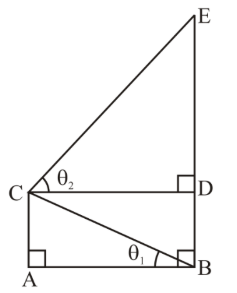
In the figure, $$\theta_1 + \theta_2 = \frac{\pi}{2}$$ and $$\sqrt{3}BE = 4AB$$. If the area of $$\triangle CAB$$ is $$2\sqrt{3} - 3$$ unit$$^2$$, when $$\frac{\theta_2}{\theta_1}$$ is the largest, then the perimeter (in unit) of $$\triangle CED$$ is equal to _______.
789
456
123
0.-
Clear All
NTA JEE Main 10th April 2023 Shift 2 - Question 87
Let the quadratic curve passing through the point (-1, 0) and touching the line $$y = x$$ at (1, 1) be $$y = f(x)$$. Then the $$x$$-intercept of the normal to the curve at the point $$(\alpha, \alpha + 1)$$ in the first quadrant is _______.
789
456
123
0.-
Clear All
NTA JEE Main 10th April 2023 Shift 2 - Question 88
If the area of the region $$\{(x, y): |x^2 - 2| \leq y \leq x\}$$ is A, then $$6A + 16\sqrt{2}$$ is equal to _______.
789
456
123
0.-
Clear All
NTA JEE Main 10th April 2023 Shift 2 - Question 89
Let the tangent at any point P on a curve passing through the points (1, 1) and ($$\frac{1}{10}$$, 100), intersect positive x-axis and y-axis at the points A and B respectively. If PA : PB = 1 : k and $$y = y(x)$$ is the solution of the differential equation $$e^{\frac{dy}{dx}} = kx + \frac{k}{2}$$, $$y(0) = k$$, then $$4y(1) - 5\log_e 3$$ is equal to _______.
789
456
123
0.-
Clear All
NTA JEE Main 10th April 2023 Shift 2 - Question 90
Let the foot of perpendicular from the point A(4, 3, 1) on the plane P: $$x - y + 2z + 3 = 0$$ be N. If $$B(5, \alpha, \beta)$$, $$\alpha, \beta \in \mathbb{Z}$$ is a point on plane P such that the area of the triangle ABN is $$3\sqrt{2}$$, then $$\alpha^2 + \beta^2 + \alpha\beta$$ is equal to _______.
789
456
123
0.-
Clear All