For the following questions answer them individually
Let $$S = \{z = x + iy: \frac{2z - 3i}{4z + 2i} \text{ is a real number}\}$$. Then which of the following is NOT correct?
Eight persons are to be transported from city A to city B in three cars of different makes. If each car can accommodate at most three persons, then the number of ways, in which they can be transported, is
If $$S_n = 4 + 11 + 21 + 34 + 50 + \ldots$$ to $$n$$ terms, then $$\frac{1}{60}S_{29} - S_9$$ is equal to
Let the number $$(22)^{2022} + (2022)^{22}$$ leave the remainder $$\alpha$$ when divided by 3 and $$\beta$$ when divided by 7. Then $$(\alpha^2 + \beta^2)$$ is equal to
If the coefficients of $$x$$ and $$x^2$$ in $$(1 + x)^p(1 - x)^q$$ are 4 and -5 respectively, then $$2p + 3q$$ is equal to
Let $$S = \{x \in [-\frac{\pi}{2}, \frac{\pi}{2}]: 9^{1-\tan^2 x} + 9^{\tan^2 x} = 10\}$$ and $$\beta = \sum_{x \in S} \tan^2 \frac{x}{3}$$, then $$\frac{1}{6}(\beta - 14)^2$$ is equal to
Let $$A$$ be the point (1, 2) and $$B$$ be any point on the curve $$x^2 + y^2 = 16$$. If the centre of the locus of the point $$P$$, which divides the line segment AB in the ratio 3:2 is the point $$C(\alpha, \beta)$$, then the length of the line segment $$AC$$ is
Let a circle of radius 4 be concentric to the ellipse $$15x^2 + 19y^2 = 285$$. Then the common tangents are inclined to the minor axis of the ellipse at the angle
The statement $$\sim p \vee \sim p \wedge q$$ is equivalent to
Let $$\mu$$ be the mean and $$\sigma$$ be the standard deviation of the distribution
| $$X_i$$ | 0 | 1 | 2 | 3 | 4 | 5 |
| $$f_i$$ | $$k+2$$ | $$2k$$ | $$k^2-1$$ | $$k^2-1$$ | $$k^2+1$$ | $$k-3$$ |
Let $$A = \{2, 3, 4\}$$ and $$B = \{8, 9, 12\}$$. Then the number of elements in the relation $$R = \{(a_1, b_1, a_2, b_2) \in A \times B, A \times B: a_1 \text{ divides } b_2 \text{ and } a_2 \text{ divides } b_1\}$$ is
If $$A = \frac{1}{5!6!7!} \begin{vmatrix} 5! & 6! & 7! \\ 6! & 7! & 8! \\ 7! & 8! & 9! \end{vmatrix}$$, then adj $$2A$$ is equal to
Let $$g(x) = f(x) + f(1-x)$$ and $$f''(x) > 0$$, $$x \in (0, 1)$$. If $$g$$ is decreasing in the interval $$(0, \alpha)$$ and increasing in the interval $$(\alpha, 1)$$, then $$\tan^{-1}(2\alpha) + \tan^{-1}\left(\frac{1}{\alpha}\right) + \tan^{-1}\left(\frac{\alpha+1}{\alpha}\right)$$ is equal to
For $$\alpha, \beta, \gamma, \delta \in \mathbb{N}$$, if $$\int \frac{x^{2x}}{e} + \frac{e^{2x}}{x} \log_e x \, dx = \frac{1}{\alpha e} x^{\beta x} - \frac{1}{\gamma x} e^{\delta x} + C$$, where $$e = \sum_{n=0}^\infty \frac{1}{n!}$$ and C is constant of integration, then $$\alpha + 2\beta + 3\gamma - 4\delta$$ is equal to
Let f be a continuous function satisfying $$\int_0^{t^2} f(x) + x^2 dx = \frac{4}{3}t^3$$, $$\forall t > 0$$. Then $$f\left(\frac{\pi^{2}}{4}\right)$$ is equal to
Let $$\vec{a} = 2\hat{i} + 7\hat{j} - \hat{k}$$, $$\vec{b} = 3\hat{i} + 5\hat{k}$$ and $$\vec{c} = \hat{i} - \hat{j} + 2\hat{k}$$. Let $$\vec{d}$$ be a vector which is perpendicular to both $$\vec{a}$$ and $$\vec{b}$$, and $$\vec{c} \cdot \vec{d} = 12$$. Then $$(-\hat{i} + \hat{j} - \hat{k}) \cdot (\vec{c} \times \vec{d})$$ is equal to
If the points $$P$$ and $$Q$$ are respectively the circumcenter and the orthocentre of a $$\triangle ABC$$, then $$\overrightarrow{PA} + \overrightarrow{PB} + \overrightarrow{PC}$$ is equal to
Let the image of the point P(1, 2, 6) in the plane passing through the points A(1, 2, 0) and B(1, 4, 1) C(0, 5, 1) be $$Q(\alpha, \beta, \gamma)$$. Then $$\alpha^2 + \beta^2 + \gamma^2$$ equal to
Let the line $$\frac{x}{1} = \frac{6-y}{2} = \frac{z+8}{5}$$ intersect the lines $$\frac{x-5}{4} = \frac{y-7}{3} = \frac{z+2}{1}$$ and $$\frac{x+3}{6} = \frac{3-y}{3} = \frac{z-6}{1}$$ at the points A and B respectively. Then the distance of the mid-point of the line segment AB from the plane $$2x - 2y + z = 14$$ is
Let a die be rolled n times. Let the probability of getting odd numbers seven times be equal to the probability of getting odd numbers nine times. If the probability of getting even numbers twice is $$\frac{k}{2^{15}}$$, then k is equal to
The sum of all the four-digit numbers that can be formed using all the digits 2, 1, 2, 3 is equal to _______.
Suppose $$a_1, a_2, 2, a_3, a_4$$ be in an arithmetico-geometric progression. If the common ratio of the corresponding geometric progression is 2 and the sum of all 5 terms of the arithmetico-geometric progression is $$\frac{49}{2}$$, then $$a_4$$ is equal to _______.
Let the equations of two adjacent sides of a parallelogram $$ABCD$$ be $$2x - 3y = -23$$ and $$5x + 4y = 23$$. If the equation of its one diagonal $$AC$$ is $$3x + 7y = 23$$ and the distance of $$A$$ from the other diagonal is $$d$$, then $$50d^2$$ is equal to _______.
Let $$S$$ be the set of values of $$\lambda$$, for which the system of equations $$6\lambda x - 3y + 3z = 4\lambda^2$$, $$2x + 6\lambda y + 4z = 1$$ and $$3x + 2y + 3\lambda z = \lambda$$ has no solution. Then $$12\sum_{\lambda \in S} \lambda$$ is equal to _______.
If the domain of the function $$f(x) = \sec^{-1}\left(\frac{2x}{5x+3}\right)$$ is $$[\alpha, \beta) \cup (\gamma, \delta]$$, then $$3\alpha + 10\beta + \gamma + 21\delta$$ is equal to _______.
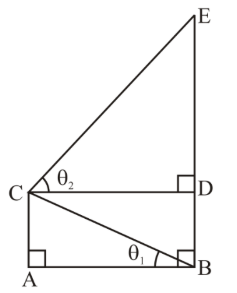
In the figure, $$\theta_1 + \theta_2 = \frac{\pi}{2}$$ and $$\sqrt{3}BE = 4AB$$. If the area of $$\triangle CAB$$ is $$2\sqrt{3} - 3$$ unit$$^2$$, when $$\frac{\theta_2}{\theta_1}$$ is the largest, then the perimeter (in unit) of $$\triangle CED$$ is equal to _______.
Let the quadratic curve passing through the point (-1, 0) and touching the line $$y = x$$ at (1, 1) be $$y = f(x)$$. Then the $$x$$-intercept of the normal to the curve at the point $$(\alpha, \alpha + 1)$$ in the first quadrant is _______.
If the area of the region $$\{(x, y): |x^2 - 2| \leq y \leq x\}$$ is A, then $$6A + 16\sqrt{2}$$ is equal to _______.
Let the tangent at any point P on a curve passing through the points (1, 1) and ($$\frac{1}{10}$$, 100), intersect positive x-axis and y-axis at the points A and B respectively. If PA : PB = 1 : k and $$y = y(x)$$ is the solution of the differential equation $$e^{\frac{dy}{dx}} = kx + \frac{k}{2}$$, $$y(0) = k$$, then $$4y(1) - 5\log_e 3$$ is equal to _______.
Let the foot of perpendicular from the point A(4, 3, 1) on the plane P: $$x - y + 2z + 3 = 0$$ be N. If $$B(5, \alpha, \beta)$$, $$\alpha, \beta \in \mathbb{Z}$$ is a point on plane P such that the area of the triangle ABN is $$3\sqrt{2}$$, then $$\alpha^2 + \beta^2 + \alpha\beta$$ is equal to _______.