NTA JEE Main 10th April 2016 Online
For the following questions answer them individually
NTA JEE Main 10th April 2016 Online - Question 11
Which of the following shows the correct relationship between the pressure $$P$$ and density $$\rho$$ of an ideal gas at constant temperature?
NTA JEE Main 10th April 2016 Online - Question 12
In an engine the piston undergoes vertical simple harmonic motion with amplitude 7 cm. A washer rests on top of the piston and moves with it. The motor speed is slowly increased. The frequency of the piston at which the washer no longer stays in contact with the piston, is close to:
NTA JEE Main 10th April 2016 Online - Question 13
A toy-car, blowing its horn, is moving with a steady speed of 5 m s$$^{-1}$$, away from a wall. An observer, towards whom the toy car is moving, is able to hear 5 beats per second. If the velocity of sound in air is 340 m s$$^{-1}$$, the frequency of the horn of the toy car is close to

NTA JEE Main 10th April 2016 Online - Question 14
Within a spherical charge distribution of charge density $$\rho(r)$$, N equipotential surfaces of potential $$V_0$$, $$V_0 + \Delta V$$, $$V_0 + 2\Delta V$$, ... $$V_0 + N\Delta V$$ $$(\Delta V > 0)$$, are drawn and have increasing radii $$r_0$$, $$r_1$$, $$r_2$$, ... $$r_N$$, respectively. If the difference in the radii of the surfaces is constant for all values of $$V_0$$ and $$\Delta V$$ then:
NTA JEE Main 10th April 2016 Online - Question 15
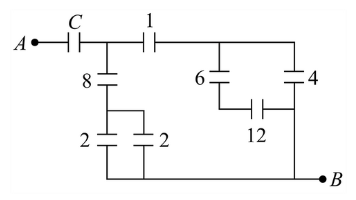
The figure shows a network of capacitors where the number indicates capacitances in micro Farad. The value of capacitance C if the equivalent capacitance between point A and B is to be 1 $$\mu F$$ is:
NTA JEE Main 10th April 2016 Online - Question 16
A galvanometer has a 50 division scale. Battery has no internal resistance. It is found that there is deflection of 40 divisions when R.B. = 2400 $$\Omega$$. Deflection becomes 20 divisions when resistance taken from resistance box is 4900 $$\Omega$$. Then we can conclude:
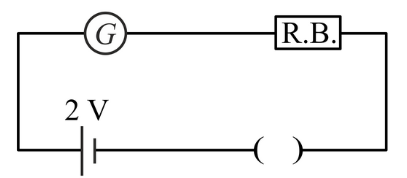
Note: This question is awarded as the bonus. Now the question is corrected.
NTA JEE Main 10th April 2016 Online - Question 17
The resistance of an electrical toaster has a temperature dependence given by $$R(T) = R_0[1 + \alpha(T - T_0)]$$ in its range of operation. At $$T_0 = 300$$ K, $$R = 100$$ $$\Omega$$ and at $$T = 500$$ K, $$R = 120$$ $$\Omega$$. The toaster is connected to a voltage source at 200 V and its temperature is raised at a constant rate from 300 to 500 K in 30 s. The total work done in raising the temperature is:
Note: This question was awarded as the bonus since all options were incorrect in the exam.
NTA JEE Main 10th April 2016 Online - Question 18
A fighter plane of length 20 m, wing span (distance from tip of one wing to the tip of the other wing) of 15 m and height 5 m is flying towards east over Delhi. Its speed is 240 m s$$^{-1}$$. The earth's magnetic field over Delhi is $$5 \times 10^{-5}$$ T with the declination angle ~0° and dip of $$\theta$$ such that $$\sin \theta = \frac{2}{3}$$. If the voltage developed is $$V_B$$ between the lower and upper side of the plane and $$V_W$$ between the tips of the wings then $$V_B$$ and $$V_W$$ are close to:
NTA JEE Main 10th April 2016 Online - Question 19
A conducting metal circular-wire-loop of radius $$r$$ is placed perpendicular to a magnetic field which varies with time as $$B = B_0 e^{-t/\tau}$$, where $$B_0$$ and $$\tau$$ are constants at time $$t = 0$$. If the resistance of the loop is $$R$$, then the heat generated in the loop after a long time $$(t \to \infty)$$ is
NTA JEE Main 10th April 2016 Online - Question 20
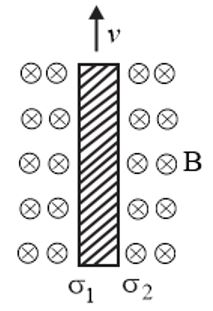
Consider a thin metallic sheet perpendicular to the plane of the paper moving with speed v in a uniform magnetic field B going into the plane of the paper (see the figure below). If the charge densities $$\sigma_1$$ and $$\sigma_2$$ are induced on the left and right surfaces respectively of the sheet, then (ignore fringe effects)