NTA JEE Main 10th April 2015 Online
For the following questions answer them individually
NTA JEE Main 10th April 2015 Online - Question 11
In an ideal gas at temperature T, the average force that a molecule applies on the walls of a closed container depends on $$T$$ as $$T^q$$. A good estimate for $$q$$ is:
NTA JEE Main 10th April 2015 Online - Question 12
$$x$$ and $$y$$ are displacements of a particle are given as $$x(t) = a \sin \omega t$$ and $$y(t) = a \sin 2\omega t$$. Its trajectory will look like:
NTA JEE Main 10th April 2015 Online - Question 13
A simple harmonic oscillator of angular frequency 2 rad s$$^{-1}$$ is acted upon by an external force $$F = \sin t$$ N. If the oscillator is at rest in its equilibrium position at $$t = 0$$, its position at later times is proportional to:

NTA JEE Main 10th April 2015 Online - Question 14
A bat moving at 10 m s$$^{-1}$$ towards a wall sends a sound signal of 8000 Hz towards it. On reflection, it hears a sound of frequency $$f$$. The value of $$f$$ in Hz is close to (speed of sound = 320 m s$$^{-1}$$)
NTA JEE Main 10th April 2015 Online - Question 15
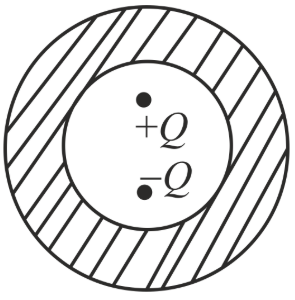
Shown in the figure are two point charges $$+Q$$ and $$-Q$$ inside the cavity of a spherical shell. The charges are kept near the surface of the cavity on opposite sides of the centre of the shell. If $$\sigma_1$$ is the surface charge on the inner surface and $$Q_1$$ net charge on it and $$\sigma_2$$ the surface charge on the outer surface and $$Q_2$$ net charge on it then:
NTA JEE Main 10th April 2015 Online - Question 16
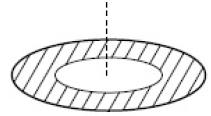
A thin disc of radius $$b = 2a$$ has a concentric hole of radius $$a$$ in it (see figure). It carries uniform surface charge $$\sigma$$ on it. If the electric field on its axis at a height h (h $$<<$$ a) from its centre is given as Ch then the value of C is
NTA JEE Main 10th April 2015 Online - Question 17
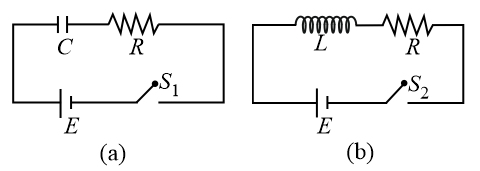
In the given circuits (a) and (b), switches $$S_1$$ and $$S_2$$ are closed at $$t = 0$$ and kept close for a long time. The variation of currents in the two circuits for $$t \geq 0$$ are shown in the options. (Figures are schematic and not drawn to scale.)
NTA JEE Main 10th April 2015 Online - Question 18
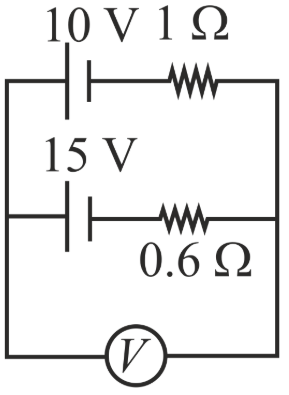
A 10 V battery with internal resistance 1 $$\Omega$$ and a 15 V battery with internal resistance 0.6 $$\Omega$$ are connected in parallel to a voltmeter (see figure). The reading in the voltmeter will be close to:
NTA JEE Main 10th April 2015 Online - Question 19
Suppose the drift velocity $$v_d$$ in a material varied with the applied electric field E as $$v_d \propto \sqrt{E}$$. Then V - I graph for a wire made of such a material is best given by:
NTA JEE Main 10th April 2015 Online - Question 20
A 25 cm long solenoid has the radius 2 cm and 500 turns. It carries a current of 15 A. If it is equivalent to a magnet of the same size and magnetization $$\vec{M}$$ $$\left(\frac{\text{Magnetic Moment}}{\text{volume}}\right)$$, then $$|\vec{M}|$$ is: