91- 6303239042
 IPMAT WhatsApp Group


 Preferred Source

 Google Discover
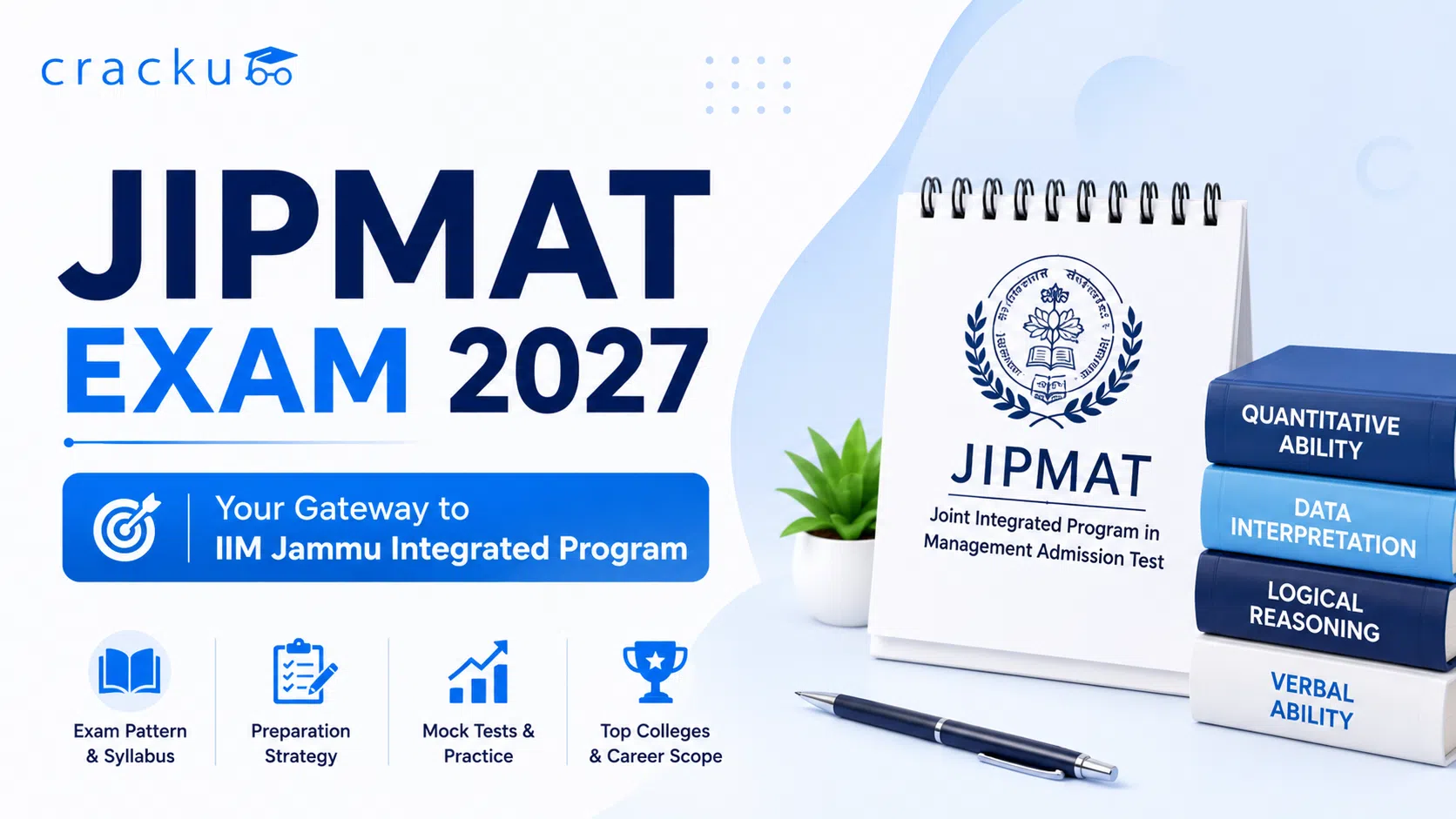
JIPMAT Exam 2027
The JIPMAT Exam 2027 is an aptitude-based objective entrance examination formulated precisely for the young minds in Class 12. As against the traditional way - B. Com/BA/B.Sc Degree, tough CAT (Common Admission Test), competition with lakhs of working professionals, Joint Integrated Programme in Management Admission Test (JIPMAT) assesses you right from your 10+2 level.
Beating JIPMAT at a young age of 17-18 years, you directly enter a premier business school set up - a streamlined, uninterrupted access from base high education into the specialized areas of corporate management.
What is JIPMAT?
JIPMAT, short for the Joint Integrated Programme in Management Admission Test, is a national level entrance examination that determines admission into a 5-Year Integrated Programme in Management (IPM).
The Integrated Program in Management (IPM) is often dubbed as a unique MBA for teenagers in India because it provides the opportunity to pursue both a Bachelor’s Degree and a Master’s Degree in Management at one of the country’s elite IIM campuses through a seamless five-year program. Here’s a breakdown:
- Years 1-3: This initial phase of the program will be at the respective IIM campuses, laying a foundation in social sciences, basic mathematics and economics, literature, and management fundamentals. Upon completion, you’ll be awarded a BBA degree.
- Years 4-5: In this advanced stage, you will undergo integrated training in a core MBA curriculum, running alongside the regular two-year post-graduate program, and finally graduate with an MBA degree.
IIM Jammu and IIM Bodh Gaya are the two IIMs where the admission will be taken based on the JIPMAT 2027 score.
- IIM Jammu (Offering approximately 140 seats)
- IIM Bodh Gaya (Offering approximately 120 seats)
Exit Option: For students who do not wish to continue with the program for the full duration of 5 years, they can opt for a degree exit after completing 3 years of the program. The students will then be awarded a Bachelor of Business Administration (BBA) degree at their disposal. Students with a BBA degree can opt for further studies or jobs, or can go abroad for studies and can make a pivot towards other career paths.
JIPMAT Exam Dates 2027
The National Testing Agency (NTA) follows a standard schedule for conducting the JIPMAT exam, generally to ensure minimal overlap with the Board Examinations and other undergraduate level tests.
The estimated JIPMAT Exam Date 2027, as based on previous NTA exam calendars, is as follows:
Exam Milestone Event | Tentative Timeline (2027) |
Release of Official JIPMAT Notification | Mid-April 2027 |
Commencement of Online Registration | Mid-April 2027 |
Last Date for Form Submission & Fee Payment | Second Week of May 2027 |
Application Correction Window Open | Mid-May 2027 |
Intimation of Advance Exam City Allotment | Last Week of May 2027 |
Release of JIPMAT 2027 Admit Card | 3 to 5 Days Before the Exam |
JIPMAT 2027 Exam Date | First Sunday of June 2027 |
Release of Provisional Answer Key & Response Sheet | Within 3 to 4 Days Post-Exam |
Declaration of Final NTA Scorecards | Late June / Early July 2027 |
JIPMAT Registration 2027
Online mode only through the NTA official website is accepted for JIPMAT 2027. You only have to register once in a single form and will be considered for admission in both IIM Jammu & Bodh Gaya.
A Step-by-Step online JIPMAT 2027 application form procedure can be expected as under:
Step 1: New User Registration
Candidates will need to create a new user ID and password by providing valid details, including an email address and mobile number. An application number will be generated upon completion of the registration process.
Step 2: Fill the JIPMAT Application Form 2027
Candidates will have to fill in personal, academic and other required details such as name, address, father’s/mother’s name, marks obtained in Class 10th and 12th, choice of cities for test center etc., in the registration form.
Step 3: Upload Documents
The required documents must be scanned and uploaded in JPEG or PDF format according to the specifications set by NTA:
- Passport size Photograph
- Signature
- Category Certificate (if applicable)
Step 4: Pay JIPMAT Application Fee 2027
After filling and uploading documents,candidates have to pay the application fee. The mode of payment for the application fee can be Debit Card/Credit Card/Net Banking/UPI.
Step 5: Print the Application Form
The duly filled JIPMAT 2027 application form along with the payment receipt should be printed for future reference.
JIPMAT Notification 2027
The official JIPMAT notification containing full details regarding the examination is released on the NTA website ( exams.nta.ac.in/jipmat ).
Candidates are advised to thoroughly read the examination notice or information bulletin provided on the NTA’s website before submitting their application. Details on registration forms, exam centers, exam fees, reservation policy, eligibility criteria and exam pattern etc., are all encapsulated within the notification. Failure to meticulously adhere to the contents of the official notification can lead to the disqualification of the applicant in the later stage.
JIPMAT Eligibility Criteria 2027
As per the JIPMAT Eligibility Criteria 2027, a student must secure a decent and equal score at both Secondary & Senior Secondary stages.
Class 12 Qualifications: You should have completed Standard XII/ HSC or any equivalent examination in either calendar years 2025 or 2026. If you are preparing for your final Board examinations in 2027, it’s also permissible to apply; these are treated as ‘provisional applications.’
Class 10 Milestones: It is a must that you clear the Class 10/SSC or equivalent examinations in 2024 or after. If your Class 10 examinations were completed in the year 2023 or prior, you are no longer eligible for application.
The aggregate percentage you must achieve at each level:
- General, OBC-NCL & EWS: a minimum of 60% marks at both Class 10 and Class 12, respectively.
- SC, ST, PwD and Transgender: a minimum of 55% marks at both Class 10 and Class 12, respectively.
Streams and boards acceptable: The NTA accepts all streams. Hence, the Commerce stream, Science stream, and Humanities stream have a full place in the exam. Those who study in international curriculums like IGCSE or IB Diploma, and any of the Boards approved by CBSE (Council of Boards of School Education), will need to provide an AIU equivalence transcript for their qualification, for them to gain entry.
JIPMAT Admit Card 2027
The JIPMAT Admit Card 2027 is the official identity card required to enter the examination centre. The same will be released by NTA, a few days prior to the exam dates.
It will remain accessible till the examination day.
Download Admit Card Instructions:
1. Go to the NTA JIPMAT Website
2.Click on “Download Admit Card”
3.Sign In by entering your Application Number with your Password/DOB.
4. Validate and Download Hall ticket for JIPMAT 2027.
5.After downloading, you have to do a check over the personal details mentioned on the admit card such as; Name of candidate, Category of candidate, photo and signature, exam center.
6. Lastly, you must download the admit card print and save it safely in your devices or can take out a clear printed copy.
JIPMAT Syllabus & Exam Pattern 2027
For effective JIPMAT preparation, having a deep understanding of the test framework is crucial. The exam eliminates sectional timings and the subjective elements like case studies and group discussions.
JIPMAT Exam Pattern 2027
- Examination Mode: Computer-Based Test (CBT) held across NTA-designated exam centres.
- Exam Duration: The total time duration for the exam is 150 Minutes (2 hours and 30 minutes) with a continuous format.
- Question Type: 100 MCQs. Exam Language: English Only. Total Score: 400 Marks. Marking scheme: 4 Marks are allotted for each correct answer.
- Negative Marking: 1 Mark deducted for every wrong answer, and 0 Marks are allotted for questions that remain unanswered.
Section Name | Total Questions | Maximum Marks |
Quantitative Aptitude (QA) | 33 | 132 |
Data Interpretation & Logical Reasoning (DILR) | 33 | 132 |
Verbal Ability & Reading Comprehension (VARC) | 34 | 136 |
Total Blueprint | 100 MCQs | 400 Marks |
JIPMAT Syllabus 2027
The comprehensive, topic-wise JIPMAT Syllabus 2027 is detailed below.
1. Quantitative Aptitude (QA):
Core Modules | Sub-Topics Covered |
Arithmetic | Percentages, Profit, Loss & Discount, Simple & Compound Interest, Averages, Ratio & Proportion, Mixtures & Alligations, Time & Work, Pipes & Cisterns, Time, Speed & Distance, Boats & Streams. |
Algebra | Linear Equations, Quadratic Equations, Cubic Equations, Identities, Progressions (AP/GP), Inequalities, Polynomials, Basics of Functions & Graphs. |
Geometry & Mensuration | Lines, Angles, Triangles, Quadrilaterals, Polygons, Circles, Coordinate Geometry, Surface Area & Volume of 2D & 3D shapes, Basics of Trigonometry (Heights & Distances). |
Number System | HCF & LCM, Prime Factors & Multiples, Divisibility Rules, Unit Digit Concept, Remainder Theorems, Surds & Indices, Simplification. |
Modern Mathematics | Set Theory & Venn Diagrams, Data Sufficiency problems, Permutations & Combinations (P&C;), Elementary Probability. |
2. Data Interpretation & Logical Reasoning (DILR):
Core Modules | Sub-Topics Covered |
Data Interpretation (DI) | Data Tables, Bar Graphs, Pie Charts, Line Charts, Caselets, Missing Data Sets, Multi-layered Charts. |
Analytical Reasoning | Linear Arrangements, Circular Seating Arrangements, Complex Puzzles, Matrix Matching, Data Structure Sets. |
Logical Coding & Series | Number Series, Letter Series, Coding-Decoding, Binary Logic, Analogies, Odd One Out. |
Verbal Reasoning | Syllogisms, Statement & Assumptions, Cause & Effect, Statement & Conclusion, Critical Reasoning, Fact-Inference-Judgment (FIJ). |
Miscellaneous Reasoning | Blood Relations (Family Trees), Direction Sense Test, Clocks and Calendars, Cubes & Dice, Input-Output. |
3. Verbal Ability & Reading Comprehension (VARC):
Core Modules | Sub-Topics Covered |
Reading Comprehension (RC) | 2 to 3 Passages (approx. 250–300 words each). Questions target Main Idea, Author’s Tone, Title Selection, Direct Facts, Inferences, and Contextual Vocabulary. |
Grammar & Syntax | Subject-Verb Agreement, Tenses, Articles & Prepositions, Active & Passive Voice, Direct & Indirect Speech, Spotting Errors, Sentence Correction/Improvement. |
Vocabulary | Synonyms & Antonyms, Idioms & Phrases, Word Usage, Spelling Errors, Contextual Fill in the Blanks, One-Word Substitution, Etymology/Roots. |
Verbal Ability | Para Jumbles (Rearranging Scrambled Paragraphs), Paragraph Completion, Cloze Tests (Passages with multiple blanks). |
JIPMAT Study Material 2027
The complete Cracku JIPMAT Study Material breakdown includes:
1. JIPMAT Previous Year Question Papers (With Step-by-Step Solutions):
Cracku's study material centers on utilizing past papers, which you can take as timed online mock tests rather than simple PDFs to mimic exam conditions.
Available Previous Year Papers: JIPMAT 2021 - 2026 are accessible.
JIPMAT Previous Papers | Online Mock Test | |
JIPMAT 2026 Question Paper | ||
2. High-Yield Section-Wise Study Material & PDFs:
Cracku also offers specific question banks based on commonly asked JIPMAT topics, downloadable for offline use:
Quantitative Aptitude (QA): Concentrates on Class 10/11 fundamental math.
- Downloads: Top 30+ JIPMAT Quant Questions PDF with Solutions.
- Formulas PDF: A concise "cheat sheet" of important formulas for Arithmetic (Percentages, Profit & Loss, SI/CI, Ratios, Time-Speed-Distance), basic Algebra, and Geometry/Mensuration.
Data Interpretation & Logical Reasoning (DILR): Practice sets for visual and logical problem-solving:
- Downloads: Most Expected JIPMAT DILR Questions PDF.
- Data Extraction Practice: Covers tables, bar charts, caselets, pie graphs, and arrangements (circular/linear seating, blood relations, coding-decoding).
3. Cracku JIPMAT Full-Length Mock Tests:
Given JIPMAT's lack of sectional time limits, overarching time management is crucial within the 150-minute duration.
- Free Diagnostics Test: A free JIPMAT mock test that replicates the NTA format (100 questions, 400 marks, +4/-1).
- Premium Test Series: Provides access to all-India full-length mock tests that closely resemble the real exam in difficulty, interface, and unpredictable topic weightage.
Who Can Apply for JIPMAT 2027?
A 10+2 or equivalent student is eligible to appear for the JIPMAT 2027 Exam if:
- They are either in the final year of their school or have completed Class 12th within a period of one to two years preceding the test year. For JIPMAT 2027, this typically means completing Class 12th in 2025, 2026 or 2027 from any recognized institution in India or abroad.
- They have passed Class 10th in 2024 or earlier. This is a prerequisite to ensure eligibility for the five-year integrated program.
- Students who have secured a minimum required aggregate percentage in Class 12th exams. (The minimum percentage requirement is generally between 60% and 70% for general category candidates and a bit lower for reserved categories, though the notification will confirm the exact percentage).
- The final result of Class 12th examination should be available on or before the date specified by the NTA.
JIPMAT Exam 2027: Conclusion
The JIPMAT Exam 2027 provides Class 12 students with an opportunity to join the five-year Integrated Programme in Management at IIM Jammu and IIM Bodh Gaya. Candidates should carefully understand the JIPMAT exam dates, registration process, eligibility criteria, syllabus, exam pattern, admit card process, and participating colleges before completing the application form.
A structured preparation strategy can significantly improve performance in the JIPMAT 2027 exam. Students should strengthen their Quantitative Aptitude, DILR, and VARC fundamentals while practising previous-year papers and mock tests. Regular revision, detailed mock analysis, and effective time management will help candidates prepare confidently for JIPMAT 2027.