JEE Main 2021 (18 March Shift 1)
For the following questions answer them individually
JEE Main 2021 (18 March Shift 1) - Question 41
Match List-I with List-II:
List-I (process) List-II (catalyst)
(a) Deacon's process (i) ZSM-5
(b) Contact process (ii) CuCl$$_2$$
(c) Cracking of hydrocarbons (iii) Ni
(d) Hydrogenation of vegetable oils (iv) V$$_2$$O$$_5$$
Choose the most appropriate answer from the options given below:
JEE Main 2021 (18 March Shift 1) - Question 42
Match List-I with List-II:
List-I List-II
(a) Chlorophyll (i) Ruthenium
(b) Vitamin-B$$_{12}$$ (ii) Platinum
(c) Anticancer drug (iii) Cobalt
(d) Grubbs catalyst (iv) Magnesium
Choose the most appropriate answer from the options given below:
JEE Main 2021 (18 March Shift 1) - Question 43
The correct structures of trans-[NiBr$$_2$$(PPh$$_3$$)$$_2$$] and meridional-[Co(NH$$_3$$)$$_3$$(NO$$_2$$)$$_3$$] respectively, are:
JEE Main 2021 (18 March Shift 1) - Question 44
Reaction of Grignard reagent, C$$_2$$H$$_5$$MgBr with C$$_8$$H$$_8$$O followed by hydrolysis gives compound A, which reacts instantly with Lucas reagent to give compound B(C$$_{10}$$H$$_{13}$$Cl). The Compound B is:
JEE Main 2021 (18 March Shift 1) - Question 45
Match List-I with List-II:
List-I (Chemicals) List-II (Use/Preparation/Constituent)
(a) Alcoholic potassium hydroxide (i) Electrodes in batteries
(b) Pd/BaSO$$_4$$ (ii) Obtained by addition reaction
(c) BHC (Benzene hexachloride) (iii) Used for $$\beta$$-elimination reaction
(d) Polyacetylene (iv) Lindlar's catalyst
Choose the most appropriate match:
JEE Main 2021 (18 March Shift 1) - Question 46
Considering the above chemical reaction, identify the product X: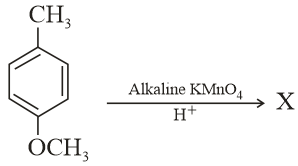
JEE Main 2021 (18 March Shift 1) - Question 47
Considering the above reaction, X and Y respectively are: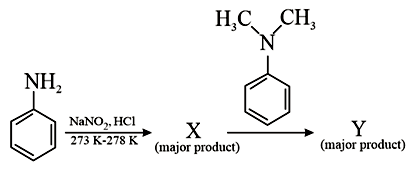
JEE Main 2021 (18 March Shift 1) - Question 48
Consider the above chemical reaction and identify product A: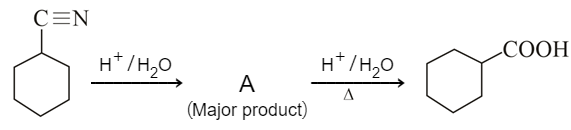
JEE Main 2021 (18 March Shift 1) - Question 49
Match the list-I with list-II:
List-I (Class of Drug) List-II (Example)
(a) Antacid (i) Novestrol
(b) Artificial sweetener (ii) Cimetidine
(c) Antifertility (iii) Valium
(d) Tranquilizers (iv) Alitame
JEE Main 2021 (18 March Shift 1) - Question 50
A non-reducing sugar A hydrolyses to give two reducing mono saccharides. Sugar A is: