91- 6303239042
 IPMAT WhatsApp Group


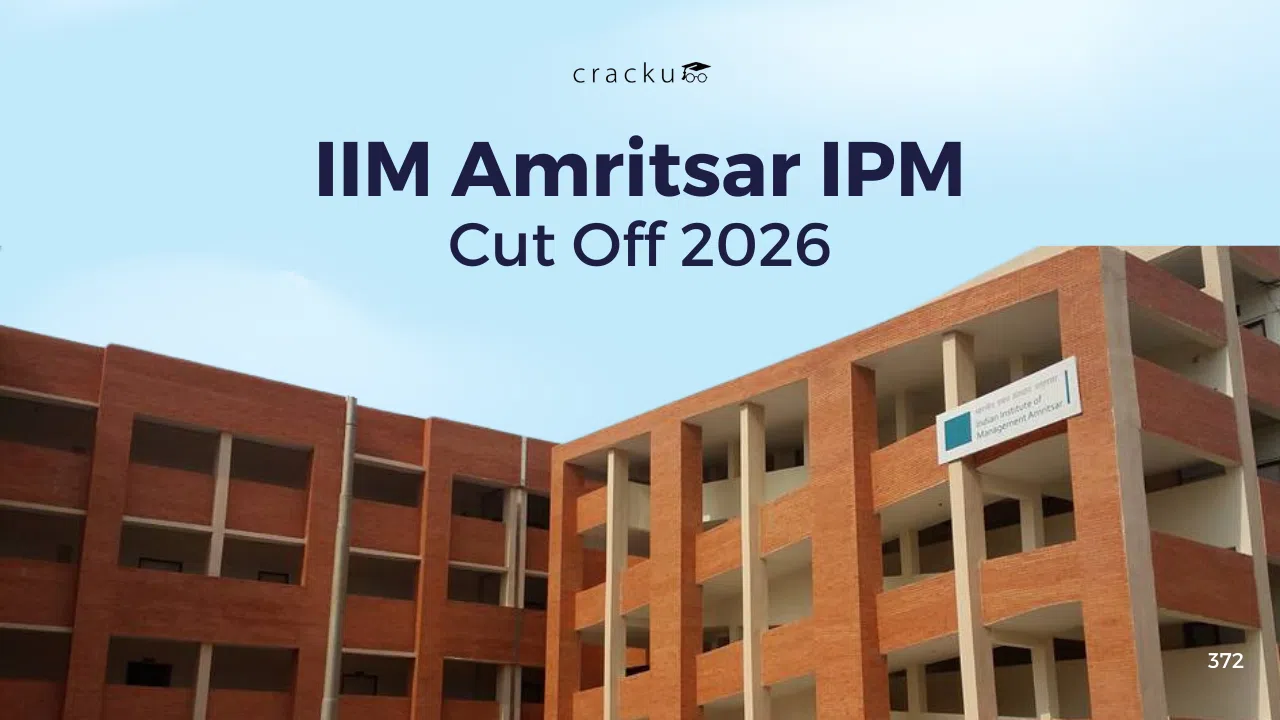
IIM Amritsar IPM Cut Off 2026
IIM Amritsar offers a five-year Integrated Programme in Management for students after Class 12. It is a dual-degree course. Students who exit after three years receive a Bachelor of Science in Quantitative Finance and Economics (BSQFE), while those who complete all five years earn an MBA (dual degree). Admission depends on the IIM Amritsar IPM 2026 score. The cutoff is the first filter. Speed and accuracy decide the final rank. The result? A group of students ready for professional roles.
Competition for the 2026-31 batch is very strong. Only 60 domestic seats are available. Over 30,000 students registered for the entrance exam last year. The institute looks for students who handle advanced topics well. Clearing the cutoffs requires a plan for every section. Which group is toughest? The General group. Every time. These numbers help you set your own targets. Confident attempts always beat rushed ones under pressure.
What is the minimum cutoff for IIM Amritsar?
For General category candidates in 2026, the minimum raw score cutoff for IIM Amritsar is expected to be between 165 and 175 out of 360. The minimum cutoff for IIM Amritsar depends on the difficulty of the paper. Tough paper? Lower cutoff. Easy paper? Higher cutoff. The exam is computer-based with 90 questions across Quantitative Ability (MCQ), Quantitative Ability (Short Answer), and Verbal Ability. Candidates get 120 minutes total with strict 40-minute time limits for each section.
One thing that distinguishes IIM Amritsar is the presence of sectional cutoffs. Shortlisting is based on the Aptitude Test Score (ATS). You must get a positive score in all sections. Fail one? You are out. Scoring positive marks in every section is the first rule to stay in the competition.
- Total Questions: 90
- Marking Scheme: +4 for correct answers and -1 for wrong MCQs
- QA-SA Marking: +4 for correct and 0 for wrong answers
- Sectional Breakdown: 30 (QA-MCQ), 15 (QA-SA), 45 (VA-MCQ)
- Sectional Cutoff: Yes (not mentioned but all sections have good weightage)
Accuracy counts more than raw attempt count. Most students aim for a raw score above 200 to stay safe. Guessing blindly leads to a lower rank because of the penalty system. The exam is timed and the pressure is genuine. Selective, confident attempts will generally outperform rushed, speculative ones. A balanced performance is the only way to remain in the competition.
IIM Amritsar IPM Category-wise Cut off
The IIM Amritsar IPM Category-wise Cut off depends on student performance in each reservation group. Each category has its own threshold. The table below shows the minimum raw marks and composite scores for the year 2025, needed for shortlisting and final admission.
Category | QA-SA | QA-MCQ | VA-MCQ |
General | 24 | 28 | 112 |
EWS | 16 | 18 | 87 |
NC-OBC | 12 | 15 | 78 |
Scheduled Caste (SC) | 12 | 10 | 65 |
Scheduled Tribe (ST) | 8 | 6 | 48 |
General and EWS categories are the most competitive. Candidates here need high normalized scores to reach the interview. This shows that the interview round is very important for final selection. Just clearing the exam is not enough for a seat. You must perform well in the Personal Interview to get the final admission. Admission chances continue even after the first list because of waitlist movement.
Read More: IIM Amritsar IPM RTI Data 2025, Candidates, Class Profile
Previous Year IPM Amritsar Cut Off Trends
IIM Amritsar tracks the Indore test difficulty levels. Cutoffs change based on how the entire group performs. In the General category, the total raw score has stayed very stable. It usually ranges between 160 and 170 marks. Verbal Ability is the most important part of the paper. You need high accuracy in English to survive. Most successful students score above 65% in the Verbal section. The table below shows how sectional requirements have moved over the last three years.
IPMAT 2023 Cutoff
Category | SA (Short Answer) | MCQ (Quant MCQ) | VA (Verbal Ability) |
General | 12 | 39 | 125 |
EWS | 4 | 26 | 98 |
NC-OBC | 4 | 23 | 91 |
SC | 4 | 15 | 69 |
ST | 4 | 5 | 43 |
PwD | 4 | 5 | 43 |
IPMAT 2024 Cutoff
Category | SA (Short Answer) | MCQ (Quant MCQ) | VA (Verbal Ability) |
General | 24 | 35 | 113 |
EWS | 16 | 26 | 89 |
NC-OBC | 12 | 23 | 78 |
SC | 12 | 18 | 60 |
ST | 8 | 13 | 40 |
PwD | 8 | 13 | 40 |
IPMAT 2025 Cutoff
Category | SA (Short Answer) | MCQ (Quant MCQ) | VA (Verbal Ability) |
General | 24 | 28 | 112 |
EWS | 16 | 18 | 87 |
NC-OBC | 12 | 15 | 78 |
SC | 12 | 10 | 65 |
ST | 8 | 6 | 48 |
PwD | 8 | 5 | 47 |
The Quantitative Ability (Short Answer) section is changing. In 2023, it was only 12 marks. By 2025, it reached 24 marks. Students are getting better at solving math without options. It's hard,but very scoring. You should aim for a raw score of 200+ to be safe in 2026. Only 16,357 students got a positive score in all parts in the last cycle. This active group is much smaller than the total registration count. Many students struggle to get even one mark in the math sections.
The selection ratio for an interview call is about 5% for active applicants. For the General category, it is even tighter. Only 2.48% of active General candidates receive a call. These trends show that the real competition is at the top of the list. You are competing against the most motivated students in India. A safe target for NC-OBC is 145+ raw marks. SC and ST candidates should aim for 120+ to stay secure. Consistent academic history can help if your exam score is average. High grades prove your discipline to the institute.
Read More: IPMAT Cut Off 2026, IIM Indore, Rohtak & Bodh Gaya Trends
Factors Affecting IPM Amritsar Cut Off
The final cutoff number depends on several shifting variables. Paper difficulty is the biggest factor. Complex math questions drive the average scores down. This leads the institute to lower the cutoff. For example, a harder math MCQ section in 2025 stabilized the bar. This happened even though applicant numbers were at a record high. Another factor is the applicant count. Over 30,220 students registered for the last cycle. More applicants mean more high-scoring individuals in the pool.
The seat limit is a permanent factor that affects the cut-offs. IIM Amritsar has only 60 domestic seats. Unlike colleges with huge batches, they cannot lower the bar too much. The specialized focus of the degree also prunes the list early. You must have studied Mathematics in Class 12 to be eligible. This rule excludes many streams like Medical or Humanities. It ensures that every student has a strong math foundation for the course.
- Total applicants: Over 30,000 students register for the exam
- Seat availability: 60 domestic seats in total
- Non-Zero rule: Scoring zero in any section causes disqualification
- Normalization math: Topper performance sets the scale for all candidates
- Waitlist movement: Candidates picking older IIMs drives waitlist changes
Normalization is a major part of math. The institute uses the maximum score of the topper as a constant. A high topper score makes it harder for average students to get a high ATS. This means your score is always relative to your batch. You cannot compare your raw marks to a student from a different year. You must understand how your relative rank changes after the normalization formula is applied. This process ensures fairness across different test batches.
Read More: IPM Amritsar Form 2026 OUT, Exam Dates, Documents, Fees
How to Improve Your Chances if you are near the IPM Amritsar Cut Off
If you are near the borderline you must focus on the Personal Interview (PI). This round counts for 25% of the final composite score. A strong interview can bridge a score gap. The panel looks for academic clarity and general awareness. Communication skills are also tested. Preparation for the PI should start right after the written exam. Do not wait for the result to arrive.
The final merit list combines three specific factors. You can gain points in these areas even if your exam score is marginal.
- Aptitude Test Score (ATS) weight: 70% of final score.
- Personal Interview (PI) weight: 25% of final score.
- Gender Diversity weight: 5% of final score.
- Waitlist Movement: If the selected student withdraws from the admission, you get a chance.
Female candidates have a natural advantage. They get a 5% weight added to their final composite score. This weight can push a borderline female student above a male student with a higher test score. National-level achievements in sports or debate helps. Any extra-curricular activities can also give some boost to your profile.
Stay patient if you are on the waitlist. Movement happens in rounds during June and July. Many top performers leave Amritsar for IIM Indore or Rohtak. Some choose premier engineering colleges or the IITs. Their vacant seats are offered to waitlisted candidates. Regular monitoring of the portal is critical during these months. Consistent performance in Class 10 and 12 also proves your foundation. High board marks act as proof of academic dedication. Most students get stuck because they ignore these smaller details. Success comes from a well-rounded profile and a focused interview strategy.
Read More: IPMAT Indore Exam 2026, Eligibility Criteria, Important Dates
IIM Amritsar IPM Cut Off 2026: Conclusion
The IIM Amritsar IPM Cut Off 2026 is very important for students who want to get admission to this five-year management course after Class 12. Since the competition is high and seats are limited, students should not only aim for a good overall score but also try to do well in every section. Knowing the expected cutoff, category-wise cutoff, and previous year trends can help students set a proper target and prepare in a better way.
Students who want admission to IIM Amritsar IPM 2026 should try to score well in all sections and avoid random guessing, as negative marking can reduce their score. Along with the written exam, students should also prepare for the Personal Interview, because it is an important part of the final selection process. With a smart preparation plan, good accuracy, and a confident interview, students can improve their chances of getting shortlisted and getting admission.