Download PDF
 91- 6303239042
Sign in
Please select an account to continue using cracku.in
↓ →
91- 6303239042
 IPMAT WhatsApp Group

Join Our IPMAT Preparation Group
Prep with like-minded aspirants; Get access to free daily tests and study material.
Which of the following functions is a one-to-one and onto function from real numbers to real numbers (R to R).
$$\ln\left(e^{|x|}\right)$$
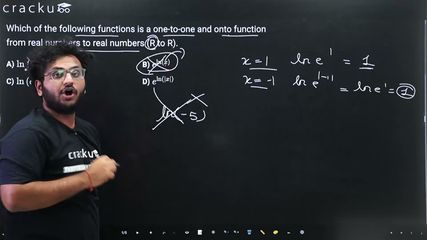
at x = a, the value of $$\ln\left(e^{|x|}\right)$$ is equal to $$\ln\left(e^{a}\right)$$
at x = -a, the value of $$\ln\left(e^{|x|}\right)$$ is equal to $$\ln\left(e^{a}\right)$$
The function is not one-one for (R to R).
$$e^{\ln\left(x\right)}$$ is defined only on the set of positive numbers because negative numbers are not in the domain of logarithmic functions , so not one-one onto for (R to R).
Similarly we can eliminate $$e^{\ln\left(|x|\right)}$$ due to the same logic.
$$\ln\left(e^{x}\right)$$
It is defined on the entire set (R to R).
It will be one-one if $$f\left(x_1\right)=f\left(x_2\right)$$ implies $$x_1=x_2$$
$$\ln\left(e^{x}\right)$$ = $$x$$ for all $$x$$ in (R to R). So it is a one-one function.
It will be an onto function if every element in the codomain is covered.
$$e^x$$ is a monotonically increasing function throughout R and is always positive.
Thus, the function $$\ln\left(e^{x}\right)$$ is one-one and onto in (R to R).
Was this solution helpful?
Click on the Email ☝️ to Watch the Video Solution
Crack IPMAT 2026 with Cracku

Educational materials for IPMAT and IIMB UG preparation

Ask our AI anything

AI can make mistakes. Please verify important information.
AI can make mistakes. Please verify important information.