Download PDF
 91- 6303239042
Sign in
Please select an account to continue using cracku.in
↓ →
91- 6303239042
 IPMAT WhatsApp Group

Join Our IPMAT Preparation Group
Prep with like-minded aspirants; Get access to free daily tests and study material.
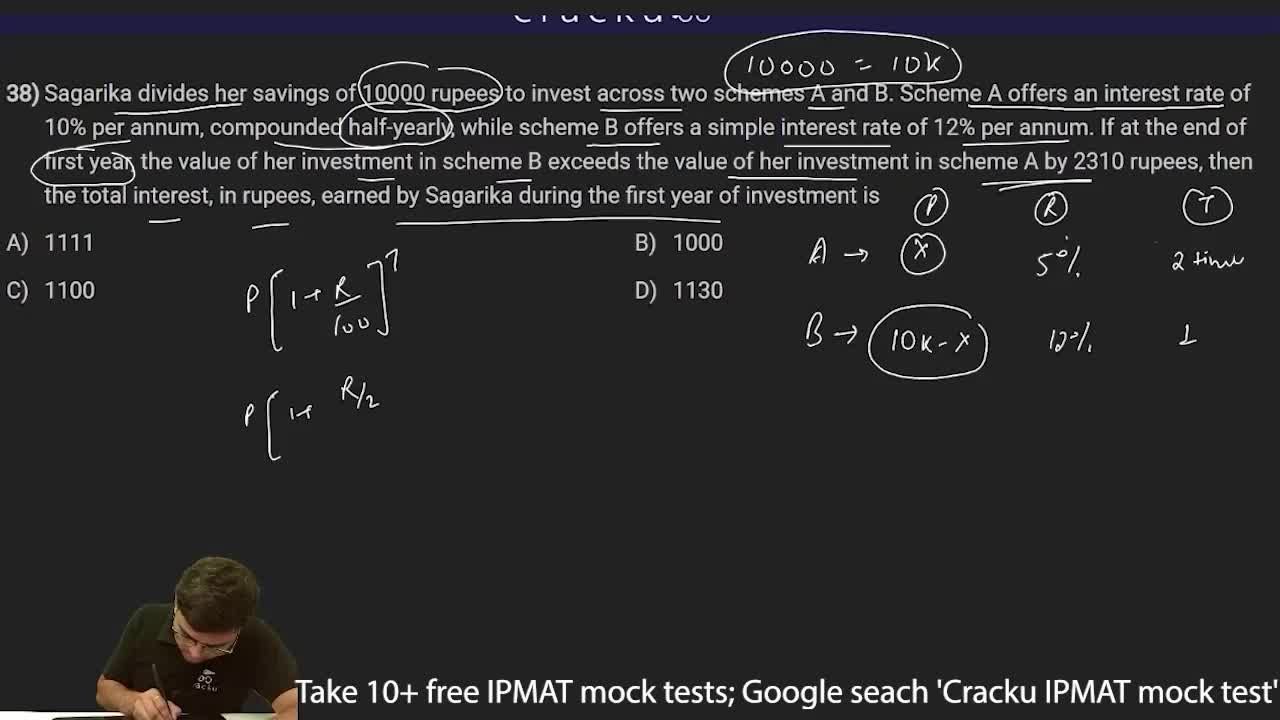
Sagarika divides her savings of 10000 rupees to invest across two schemes A and B. Scheme A offers an interest rate of 10% per annum, compounded half-yearly, while scheme B offers a simple interest rate of 12% per annum. If at the end of first year, the value of her investment in scheme B exceeds the value of her investment in scheme A by 2310 rupees, then the total interest, in rupees, earned by Sagarika during the first year of investment is
Let Sagarika divide the 10,000 rupees into x and y, such that she invests x in scheme A and y in scheme B.
So x+y=10,000 ; or x=10,000-y _______(1)
Scheme A is compound interest at 10% compounded half-yearly.
So, athe mount after 1 year will be $$A=x\left(1+\frac{5}{200}\right)^{2.1}=x\left(1.05\right)^2=1.1025x$$,
And, interest is 1.1025x-x=0.1025x
Scheme B is simple interest at 12% per annum,
So interest is $$SI=\frac{y\times\ 12\times\ 1}{100}=0.12y$$
And the amount is $$SI+P=0.12y+y=1.12y$$
Now, it is given that the value of her investment in scheme B exceeds the value of her investment in scheme A by 2310 rupees,
So, 1.12y-1.1025x=2310
or, 1.12y-1.1025(10,000-y)=2310
or, 1.12y+1.1025y-11025=2310
or,2.222y=13335
or, y=6000. so x=4000
Now, total interest = 0.12y+0.1025x=1130, which is the answer.
Was this solution helpful?
Click on the Email ☝️ to Watch the Video Solution
Create a FREE account and get:


Crack IPMAT 2026 with Cracku

Educational materials for IPMAT and IIMB UG preparation

Ask our AI anything

AI can make mistakes. Please verify important information.
AI can make mistakes. Please verify important information.