Download PDF
 91- 6303239042
Sign in
Please select an account to continue using cracku.in
↓ →
91- 6303239042
 IPMAT WhatsApp Group

Join Our IPMAT Preparation Group
Prep with like-minded aspirants; Get access to free daily tests and study material.
The side AB of a triangle ABC is c. The median BD is of length k. If $$\angle BDA = \theta$$ and $$\theta < 90^\circ$$, then the area of triangle ABC is
Based on the information given in the question, a diagram is constructed where BM is the median of AC. Since the question deals with areas, we construct BM as the altitude for the triangle. $$\angle\ BDA=\theta\ $$ (given) and $$\angle\ BAD=\alpha\ $$ is assumed. The following figure is obtained.
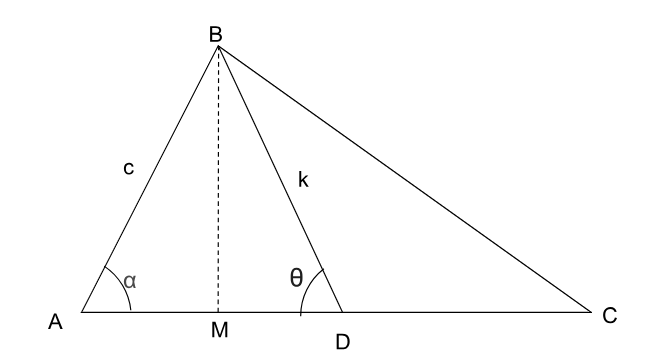
BM is the height, and so $$\angle\ BMA=\angle\ BMD=90^{\circ\ }$$
So, in $$\triangle\ BAM$$,
$$\sin\alpha\ =\frac{BM}{AB}=>\ BM=c\ \sin\alpha\ $$
$$\cos\ \alpha\ =\frac{AM}{AB}=>AM=c\cos\alpha\ $$
Again, in $$\triangle\ BDM$$,
$$\sin\theta\ =\frac{BM}{BD}=>\ BM=k\ \sin\theta\ $$
$$\cos\ \theta\ =\frac{DM}{BD}=>DM=k\cos\theta\ $$
Now, area of $$\triangle\ ABD$$ can be calculated as $$\dfrac{1}{2}\times\ AD\times\ BM=\frac{1}{2}\times\ \left(AM+BM\right)\times\ BM$$
Putting the values obtained we have,
$$ar\triangle\ ABD=\frac{1}{2}\times\ \left(c\ \cos\alpha\ +k\ \cos\theta\ \right)\times\ k\ \sin\theta\ $$ ________(A)
Now, $$c\ \sin a=\ k\ \sin\theta\ =>\sin\ \alpha\ =\dfrac{k\sin\theta\ }{c}\ $$
So, $$\cos\ \alpha\ =\sqrt{\ 1-\left(\frac{k\sin\theta\ }{c}\ \right)^2}=\dfrac{\sqrt{\ c^2-k^2\sin^2\theta\ }}{c}$$
Substituting this in (A) we have
$$ar\triangle\ ABD=\frac{1}{2}\times\ \left(\sqrt{\ c^2-k^2\sin^2\theta\ }\ +k\ \cos\theta\ \right)\times\ k\ \sin\theta\ $$
or, $$ar\triangle\ ABD=\frac{1}{2}\left(\ k\sin\theta\ \sqrt{c^2-k^2\sin^2\theta\ }\ +k^2\ \cos\theta\sin\theta\ \right)$$
or, $$ar\triangle\ ABD=\frac{1}{2}\left(\ k\sin\theta\ \sqrt{c^2-k^2\sin^2\theta\ }\ +\frac{k^2}{2}\times\ \ 2\cos\theta\sin\theta\ \right)$$
or, $$ar\triangle\ ABD=\dfrac{1}{2}\left(\ k\sin\theta\ \sqrt{c^2-k^2\sin^2\theta\ }\ +\dfrac{k^2}{2}\sin2\theta\ \right)$$
Now, since BD is the median, this means the area of $$ar\triangle\ ABC=2\ ar\triangle\ ABD$$
so , $$ar\triangle\ ABC=\ k\sin\theta\ \sqrt{c^2-k^2\sin^2\theta\ }\ +\dfrac{k^2}{2}\sin2\theta\ $$ , which is option B.
Was this solution helpful?
Click on the Email ☝️ to Watch the Video Solution
Create a FREE account and get:


Crack IPMAT 2026 with Cracku

Educational materials for IPMAT and IIMB UG preparation

Ask our AI anything

AI can make mistakes. Please verify important information.
AI can make mistakes. Please verify important information.