Download PDF
 91- 6303239042
Sign in
Please select an account to continue using cracku.in
↓ →
91- 6303239042
 IPMAT WhatsApp Group

Join Our IPMAT Preparation Group
Prep with like-minded aspirants; Get access to free daily tests and study material.
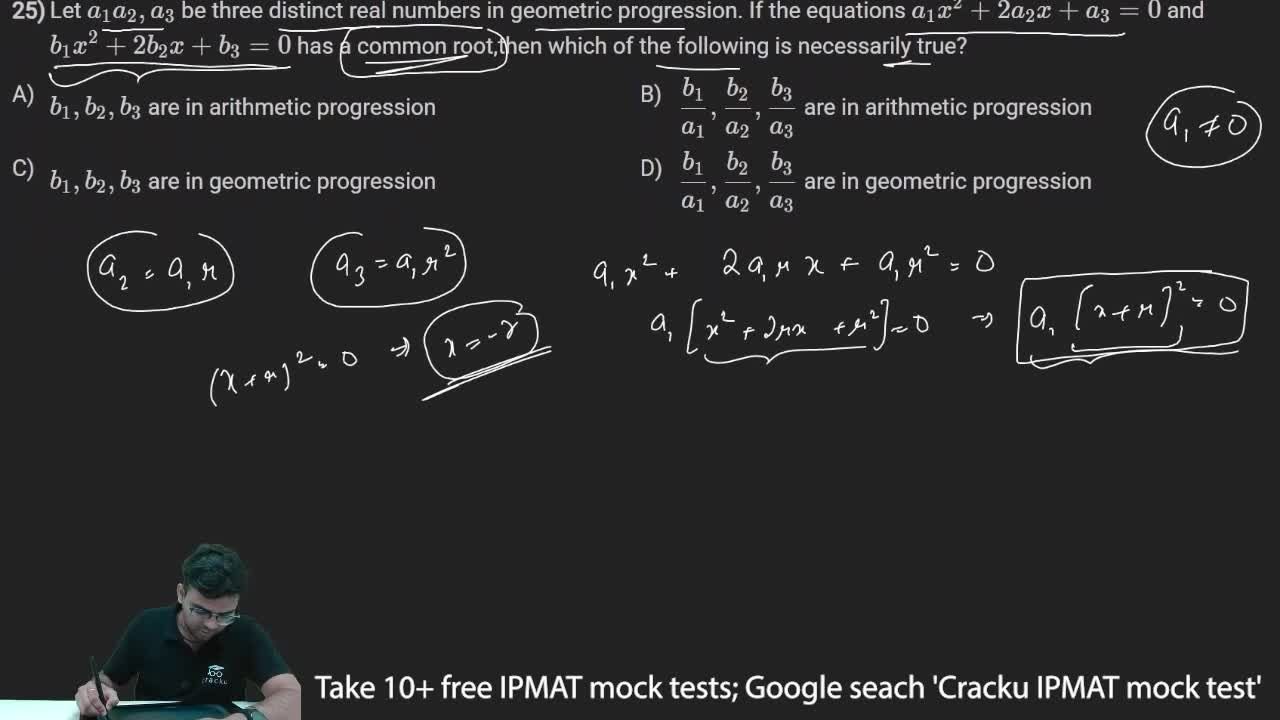
Let $$a_{1} a_{2}, a_{3}$$ be three distinct real numbers in geometric progression. If the equations $$a_{1}x^{2} + 2a_{2} x + a_{3} = 0$$ and $$b_{1}x^{2} + 2b_{2}x + b_{3} = 0$$ has a common root,then which of the following is necessarily true?
Given, $$a_{1} a_{2}, a_{3}$$ are in G.P.
Let the common ratio of the G.P. be $$r$$
So, $$a_2=a_1r,\ a_3=a_1r^2$$
Putting the values in equation, $$a_{1}x^{2} + 2a_{2} x + a_{3} = 0$$
So, $$a_1x^2+2a_1xr+a_1r^2=0$$
or, $$a_1\left(x^2+2xr+r^2\right)=0$$
or, $$a_1\left(x+r\right)^2=0$$
Now, $$a_1\ne\ 0$$
So, $$\left(x+r\right)^2=0$$
or, $$x=-r$$ is the only root
So the common root is also $$x=-r$$
Putting this in the second equation, $$b_{1}x^{2} + 2b_{2}x + b_{3} = 0$$
or, $$b_{1}r^{2} - 2b_{2}r + b_{3} = 0$$
Now we can replace $$r^2=\dfrac{a_3}{a_1},\ r=\dfrac{a_2}{a_1}$$
So, $$b_1\cdot\dfrac{a_3}{a_1}+b_3=2b_2\cdot\dfrac{a_2}{a_1}$$
Dividing all terms by $$a_3$$,
$$\dfrac{b_1}{a_1}+\dfrac{b_3}{a_3}=2\cdot\dfrac{b_2a_2}{a_1a_3}=\dfrac{2b_2a_2}{a_2^2}=\dfrac{2b_2}{a_2}$$
(Since, $$a_1,a_2,a_3$$ are in G.P., $$a_1\cdot a_3=a_2^2$$)
so, $$\dfrac{b_1}{a_1}+\dfrac{b_3}{a_3}=\dfrac{2b_2}{a_2}$$
or, $$\dfrac{b_1}{a_1},\dfrac{b_2}{a_2},\dfrac{b_3}{a_3}$$ are in A.P.
Was this solution helpful?
Click on the Email ☝️ to Watch the Video Solution
Create a FREE account and get:


Crack IPMAT 2026 with Cracku

Educational materials for IPMAT and IIMB UG preparation

Ask our AI anything

AI can make mistakes. Please verify important information.
AI can make mistakes. Please verify important information.