NTA JEE Mains 5th April Shift 2 2026
For the following questions answer them individually
NTA JEE Mains 5th April Shift 2 2026 - Question 51
What volume of hydrogen gas at STP would be liberated by action of 50 mL of $$H_2SO_4$$ of 50% purity (density = 1.3 g mL$$^{-1}$$) on 20 g of zinc?
Given : Molar mass of H, O, S, Zn are 1, 16, 32, 65 g mol$$^{-1}$$ respectively.
NTA JEE Mains 5th April Shift 2 2026 - Question 52
Which of the following statement(s) is/are true?
$$\textbf{A.}$$ If two orbitals have the same value of $$(n + l)$$, the orbital with lower value of $$n$$ will have lower energy.
$$\textbf{B.}$$ Energies of the orbitals in the same subshell increase with increase in atomic number.
$$\textbf{C.}$$ The size of $$2p_x$$ orbital is less than the size of $$3p_x$$ orbital.
$$\textbf{D.}$$ Among $$5f$$, $$6s$$, $$4d$$, $$5p$$ and $$5d$$ orbitals, none of the orbitals have 2 radial nodes.
Choose the correct answer from the options given below:
NTA JEE Mains 5th April Shift 2 2026 - Question 53
The covalent radii of atoms A and B are $$r_A$$ and $$r_B$$ respectively. The covalent bond length and total length of $$AB$$ molecule are respectively :

NTA JEE Mains 5th April Shift 2 2026 - Question 54
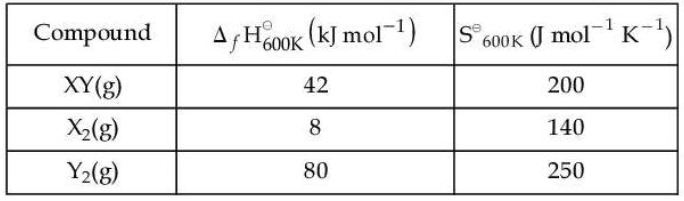
Consider the following data for the reaction
$$\text{X}_2(g) + \text{Y}_2(g) \rightleftharpoons 2\text{XY}(g)$$
at 600 K. The $$\Delta_r G^\circ$$ (in $$kJ/mol^{-1}$$) for the reaction is :
NTA JEE Mains 5th April Shift 2 2026 - Question 55
The correct order of molar heat capacities measured at 298 K and 1 bar is :
NTA JEE Mains 5th April Shift 2 2026 - Question 56
The reaction $$A(g) \rightleftharpoons B(g) + C(g)$$ was initiated with the amount `$$a$$` of $$A(g)$$. At equilibrium it is found that the amount of $$A(g)$$ remaining is $$(a - x)$$ at a total pressure of $$p$$.
The equilibrium constant $$K_p$$ of the reaction can be calculated from the expression:
NTA JEE Mains 5th April Shift 2 2026 - Question 57
One half cell in a voltaic cell is constructed by dipping silver rod in $$\text{AgNO}_3$$ solution of unknown concentration, other half cell is Zn rod dipped in 1 molar solution of $$\text{ZnSO}_4$$. A voltage of $$1.60\,\text{V}$$ is measured at $$298\,\text{K}$$ for this cell. What is the concentration of $$\text{Ag}^+$$ ions used in terms of $$\log x$$ $$(x = [\text{Ag}^+])$$?
$$E^\ominus_{\text{Zn}^{2+}/\text{Zn}} = -0.76\,\text{V}, \quad$$ $$E^\ominus_{\text{Ag}^{+}/\text{Ag}} = +0.80\,\text{V}, \quad$$ $$\frac{2.303RT}{F} = 0.059\,\text{V}$$
NTA JEE Mains 5th April Shift 2 2026 - Question 58
Given below are two statements:
$$\textbf{Statement I :}$$ The number of pairs among $$[\text{Al}_2\text{O}_3, \text{Cr}_2\text{O}_3]$$, $$[\text{Cl}_2\text{O}_7, \text{Mn}_2\text{O}_7]$$, $$[\text{Na}_2\text{O}, \text{V}_2\text{O}_3]$$ and $$[\text{CO}, \text{N}_2\text{O}]$$ that contain oxides of same nature (acidic, basic, neutral or amphoteric) is 4.
$$\textbf{Statement II :}$$ Among $$\text{Na}_2\text{O}$$, $$\text{Al}_2\text{O}_3$$, $$\text{CO}$$ and $$\text{Cl}_2\text{O}_7$$, the most basic and acidic oxides are $$\text{Na}_2\text{O}$$ and $$\text{Cl}_2\text{O}_7$$, respectively.
In the light of the above statements, choose the correct answer from the options given below:
NTA JEE Mains 5th April Shift 2 2026 - Question 59
Given below are two statements:
$$\textbf{Statement I :}$$ Aluminium upon reaction with $$\text{NaOH}$$ forms $$[\text{Al(OH)}_6]^{3-}$$ ion.
$$\textbf{Statement II :}$$ The geometry of $$\text{ICl}_4^{-}$$, $$\text{ClO}_3^{-}$$ and $$\text{IBr}_2^{-}$$ is square planar, pyramidal and linear respectively.
In the light of the above statements, choose the correct answer from the options given below:
NTA JEE Mains 5th April Shift 2 2026 - Question 60
Given below are two statements:
$$\textbf{Statement I :}$$ Presence of large number of unpaired electrons in transition metal atoms results in higher enthalpies of their atomisation.
$$\textbf{Statement II :}$$ $$d_{xy} = d_{xz} = d_{yz} < d_{x^2-y^2} = d_{z^2}$$ and $$d_{x^2-y^2} = d_{z^2} < d_{xy} = d_{xz} = d_{yz}$$ are the d-orbital splittings in $$[\text{Fe}(\text{H}_2\text{O})_6]^{3+}$$ and $$[\text{Ni}(\text{Cl})_4]^{2-}$$ complex ions respectively.
In the light of the above statements, choose the correct answer from the options given below: