Number of moles and number of molecules in 1.4187 L of $$\text{SO}_2$$ at STP respectively are :

Join Our JEE Preparation Group
Prep with like-minded aspirants; Get access to free daily tests and study material.
Sign in
Please select an account to continue using cracku.in
↓ →
Join Our JEE Preparation Group
Prep with like-minded aspirants; Get access to free daily tests and study material.
Number of moles and number of molecules in 1.4187 L of $$\text{SO}_2$$ at STP respectively are :
Login to view the detailed solution.
What is the ratio of wave number of first line (lowest energy line) of Balmer series of H atomic spectrum to first line of its Brackett series?
Login to view the detailed solution.
Which of the following is correct set of 4 quantum numbers of 19th electron in Chromium (Atomic number = 24) in accordance with Aufbau principle?
Login to view the detailed solution.
.webp)
Given below are two statements:
Statement I: For an ideal gas, heat capacity at constant volume is always greater than the heat capacity at constant pressure.
Statement II: In a constant volume process, no work is produced and all the heat withdrawn goes into the chaotic motion and is reflected by a temperature increase of the ideal gas.
In the light of the above statement, choose the correct answer from the options given below.
Login to view the detailed solution.
At $$T$$(K), the equilibrium constant of $$A_2(g) + B_2(g) \rightleftharpoons C(g)$$ is $$2.7 \times 10^{-5}$$. What is the equilibrium constant for $$\frac{1}{3}A_2(g) + \frac{1}{3}B_2(g) \rightleftharpoons \frac{1}{3}C(g)$$ at the same temperature?
Login to view the detailed solution.
In order to oxidise a mixture of 1 mole each of $$\text{FeC}_2\text{O}_4$$, $$\text{Fe}_2(\text{C}_2\text{O}_4)_3$$, $$\text{FeSO}_4$$ and $$\text{Fe}_2(\text{SO}_4)_3$$ in acidic medium, the number of moles of $$\text{KMnO}_4$$ required is :
Login to view the detailed solution.
.webp)
Consider the first order reaction $$R \to P$$. The fraction of molecules decomposed in the given first order reaction can be expressed as :
Login to view the detailed solution.
A monoatomic anion $$(A^-)$$ has 45 neutrons and 36 electrons. Atomic mass, group in the periodic table and physical state at room temperature of the element $$(A)$$ respectively are :
Login to view the detailed solution.
Given below are two statements:
Statement I: The covalency of oxygen is generally two but it can exceed upto four. The oxidation state of oxygen in $$\text{SO}_2$$ is $$-2$$ and in $$\text{OF}_2$$ it is $$+2$$.
Statement II: The anomalous behaviour of oxygen when compared to the other elements of group 16 is due to its small size and high electronegativity.
In the light of the above statements, choose the correct answer from the options given below
Login to view the detailed solution.
.webp)
The correct statements among the following are:
A. Mo(VI) and W(VI) are less stable than Cr(VI).
B. Ce$$^{4+}$$ and Tb$$^{4+}$$ are oxidant while Eu$$^{2+}$$ and Yb$$^{2+}$$ are reductant.
C. Cm and Am have seven unpaired electrons.
D. Actinoid contraction is greater from element to element than lanthanoid contraction.
choose the correct answer from the options given below:
Login to view the detailed solution.
Correct statements from the following are:
A. Potassium dichromate is an oxidising agent and it oxidises $$\text{FeSO}_4$$ to $$\text{Fe}_2(\text{SO}_4)_3$$ in acidic medium.
B. Sodium dichromate can be used as primary standard in volumetric estimation.
C. $$\text{CrO}_4^{2-}$$ and $$\text{Cr}_2\text{O}_7^{2-}$$ are interconvertible in aqueous solution by varying the pH of the solution.
D. Cr-O-Cr bond angle in $$\text{Cr}_2\text{O}_7^{2-}$$ is 126°.
choose the correct answer from the options given below
Login to view the detailed solution.
Match the LIST-I with LIST-II.
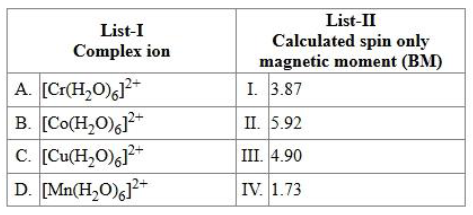
choose the correct answer from the options given below
Login to view the detailed solution.
.webp)
Increasing order of electron withdrawing power of following functional groups is:
a. $$-\text{CN}$$, b. $$-\text{COOH}$$, c. $$-\text{NO}_2$$, d. $$-\text{I}$$
Login to view the detailed solution.
An alkene $$(X)$$ on ozonolysis followed by reduction gives following products:

The alkene $$(X)$$ is :
Login to view the detailed solution.
Match List-I with List-II.
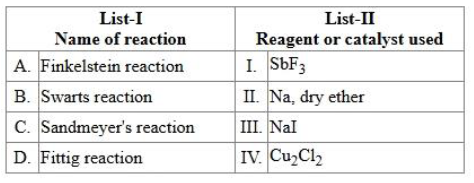
Choose the correct answer from the options given below :
Login to view the detailed solution.

Amongst the following, the total number of compounds soluble in aqueous NaOH at room temperature is:
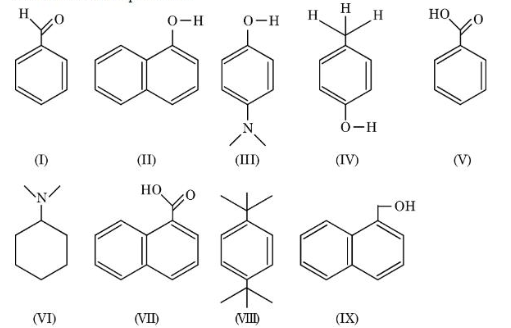
Login to view the detailed solution.
Product C of the following reaction sequence will be:
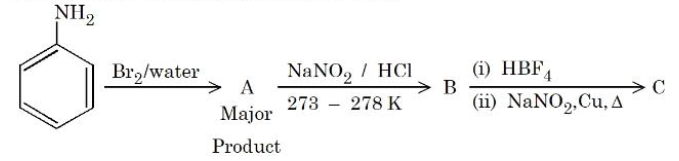
Login to view the detailed solution.
Given below are two statements:
Statement I: The structure of Maltose is given below. Maltose is a non-reducing sugar.
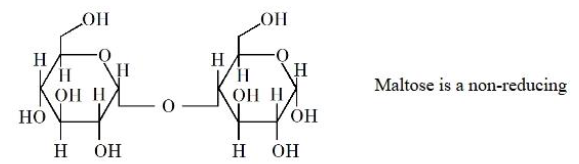
Statement II: The structure of Lactose is given below. Lactose is a reducing sugar.
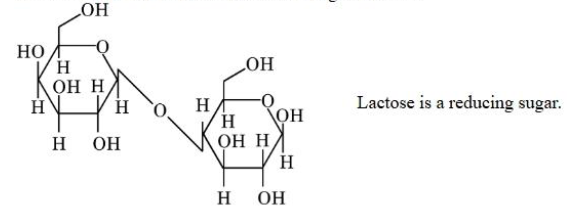
in the light of the above statements, Choose the correct answer from the options given below :
Login to view the detailed solution.
_1.webp)
Match List-I with List-II.
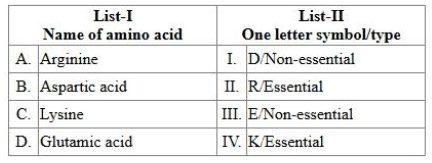
Choose the correct answer from the options given below :
Login to view the detailed solution.
Identify the colour of compound 'X' in the sequence of the reaction:
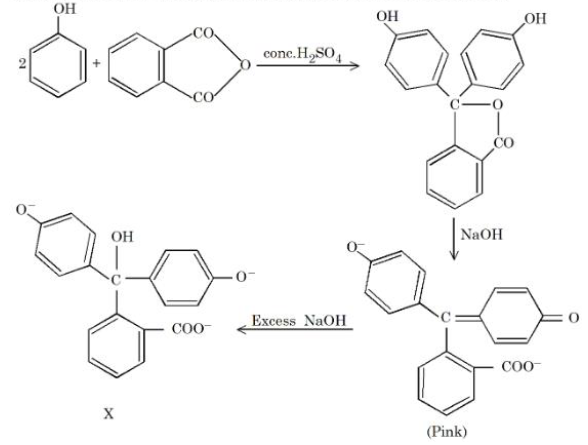
Login to view the detailed solution.
According to Lewis theory, the total number of $$\sigma$$ bond-pairs and lone pair of electrons around the central atom of $$\text{XeO}_6^{4-}$$ ion is _____.
Login to view the detailed solution.
Consider the following sequence of reactions to give the major product $$(X)$$:
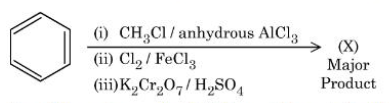
$$P$$ g of the major product $$(X)$$ formed is reacted with $$\text{NaHCO}_3$$ solution to liberate a gas which occupied 11.2 dm³ at STP. $$P$$ = _____ g.
( Given molar mass in g $$mol^{-1} H:1,C:12,O:16,Cl:35.5$$)
Login to view the detailed solution.
2.0 g of a bromo hydrocarbon $$(X)$$ was subjected to Carius analysis, gave 3.36 g of AgBr. The percentage of carbon in the compound $$(X)$$ is 26.7%. Total number of carbon atoms in the empirical formula for compound $$(X)$$ is _____.
( Given molar mass in g $$mol^{-1}H:1,C:12,O:80,Cl:108$$)
Login to view the detailed solution.
The pH of a solution obtained by mixing 5 mL of 0.1 M $$\text{NH}_4\text{OH}$$ solution with 250 mL of 0.1 M $$\text{NH}_4\text{Cl}$$ solution is _____ $$\times 10^{-2}$$. (Nearest integer)
Given: $$\text{pK}_b(\text{NH}_4\text{OH}) = 4.74$$, $$\log 2 = 0.30$$, $$\log 3 = 0.48$$, $$\log 5 = 0.70$$
Login to view the detailed solution.
A non-volatile, non-electrolyte solid solute when dissolved in 40 g of a solvent, the vapour pressure of the solvent decreased from 760 mm Hg to 750 mm Hg. If the same solution boils at 320 K, then the number of moles of the solvent present in the solution is _____. (Nearest integer)
[Given: boiling point of the pure solvent = 319.5 K, $$K_b$$ of the solvent = 0.3 K kg mol$$^{-1}$$]
Login to view the detailed solution.
Educational materials for JEE preparation
 Share
Share

