NTA JEE Mains 30th Jan 2024 Shift 2
For the following questions answer them individually
NTA JEE Mains 30th Jan 2024 Shift 2 - Question 81
The number of real solutions of the equation $$x(x^2 + 3|x| + 5|x-1| + 6|x-2|) = 0$$ is ______.
789
456
123
0.-
Clear All
NTA JEE Mains 30th Jan 2024 Shift 2 - Question 82
In an examination of Mathematics paper, there are 20 questions of equal marks and the question paper is divided into three sections: A, B and C. A student is required to attempt total 15 questions taking at least 4 questions from each section. If section A has 8 questions, section B has 6 questions and section C has 6 questions, then the total number of ways a student can select 15 questions is _________.
789
456
123
0.-
Clear All
NTA JEE Mains 30th Jan 2024 Shift 2 - Question 83
Let $$S_n$$ be the sum to n-terms of an arithmetic progression $$3, 7, 11, \ldots$$, if $$40 < \frac{6}{n(n+1)}\sum_{k=1}^{n} S_k < 42$$, then $$n$$ equals ____________.
789
456
123
0.-
Clear All

NTA JEE Mains 30th Jan 2024 Shift 2 - Question 84
Let $$\alpha = \sum_{k=0}^{n} \frac{{}^nC_k^2}{k+1}$$ and $$\beta = \sum_{k=0}^{n-1} \frac{{}^nC_k \cdot {}^nC_{k+1}}{k+2}$$. If $$5\alpha = 6\beta$$, then $$n$$ equals
789
456
123
0.-
Clear All
NTA JEE Mains 30th Jan 2024 Shift 2 - Question 85
Consider two circles $$C_1: x^2 + y^2 = 25$$ and $$C_2: (x-\alpha)^2 + y^2 = 16$$, where $$\alpha \in (5, 9)$$. Let the angle between the two radii (one to each circle) drawn from one of the intersection points of $$C_1$$ and $$C_2$$ be $$\sin^{-1}\frac{\sqrt{63}}{8}$$. If the length of common chord of $$C_1$$ and $$C_2$$ is $$\beta$$, then the value of $$(\alpha\beta)^2$$ equals _________.
789
456
123
0.-
Clear All
NTA JEE Mains 30th Jan 2024 Shift 2 - Question 86
If the variance $$\sigma^2$$ of the data
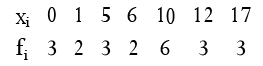
is $$k$$, then the value of $$k$$ is ______ (where $$.$$ denotes the greatest integer function)
789
456
123
0.-
Clear All
NTA JEE Mains 30th Jan 2024 Shift 2 - Question 87
The number of symmetric relations defined on the set $$\{1, 2, 3, 4\}$$ which are not reflexive is _______.
789
456
123
0.-
Clear All
NTA JEE Mains 30th Jan 2024 Shift 2 - Question 88
The area of the region enclosed by the parabola $$(y-2)^2 = x - 1$$, the line $$x - 2y + 4 = 0$$ and the positive coordinate axes is __________.
789
456
123
0.-
Clear All
NTA JEE Mains 30th Jan 2024 Shift 2 - Question 89
Let $$Y = Y(X)$$ be a curve lying in the first quadrant such that the area enclosed by the line $$Y - y = Y'(x)(X - x)$$ and the co-ordinate axes, where $$(x, y)$$ is any point on the curve, is always $$\frac{-y^2}{2Y'(x)} + 1$$, $$Y'(x) \neq 0$$. If $$Y(1) = 1$$, then $$12Y(2)$$ equals ________.
789
456
123
0.-
Clear All
NTA JEE Mains 30th Jan 2024 Shift 2 - Question 90
Let a line passing through the point $$(-1, 2, 3)$$ intersect the lines $$L_1: \frac{x-1}{3} = \frac{y-2}{2} = \frac{z+1}{-2}$$ at $$M(\alpha, \beta, \gamma)$$ and $$L_2: \frac{x+2}{-3} = \frac{y-2}{-2} = \frac{z-1}{4}$$ at $$N(a, b, c)$$. Then the value of $$\frac{(\alpha + \beta + \gamma)^2}{(a + b + c)^2}$$ equals ________________.
789
456
123
0.-
Clear All